

Competition is a normal part of doing business, but for distributed energy providers, it can be fraught because one of their main competitors for customers — electric utilities — enjoys monopoly advantages.
Utilities are guaranteed a rate of return. Distributed energy providers are not. Utilities also control the wires and substations upon which many distributed energy resources (DERs) often depend. Utilities in most states prohibit buildings that install distributed energy, like microgrids, from selling electricity to nearby buildings. Utilities are often much bigger and better financed than many solar, battery and microgrid companies. So they have deeper pockets to draw upon when regulatory or legal battles arise between the two.
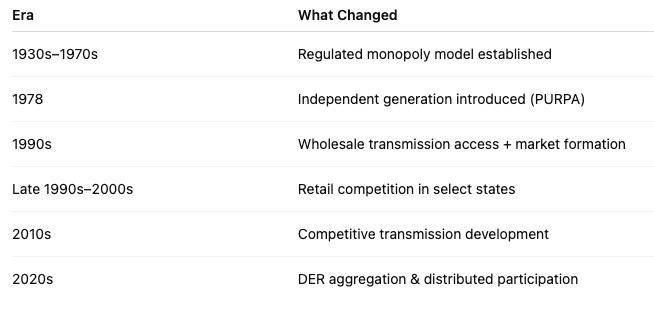
This push-and-pull predates today’s distributed energy market. It began with federal regulatory changes in the 1970s, but intensified in the 2000s, when some states permitted independent companies to compete with utilities for electricity sales. To level the playing field for independent power producers, about one-third of U.S. states prohibited utilities from owning power plants.
The Evolution of Electric Competition in the US
Now, with the rise of virtual power plants, similar ownership questions are emerging. Who gets to own the assets — batteries in particular — that virtual power plants rely upon?
One utility, Xcel Energy, is testing models that sit on either end of this competitive divide. Its virtual power plant program in Colorado allows customers to own the batteries. Meanwhile, in Minnesota the utility owns the virtual power plants assets, a move strongly opposed by competitive companies and their advocates.
Energy Changemakers explores the competitive questions unfolding in Minnesota and Colorado in two stories published today, along with a podcast interview featuring Jigar Shah, entrepreneur and former head of the DOE Loan Programs Office. In the conversation, Shah discusses the controversy and explains why — though he frequently challenges utilities — he supports the utility ownership model proposed by Xcel Minnesota.
We invite you to read and listen, and let us know your thoughts on the issue of utility versus competitive market control of virtual power plants on LinkedIn.
Xcel Energy Colorado Preserves Customer Ownership, Local Energy Benefits of Virtual Power Plants
Jigar Shah’s Surprising Stand on This Utility Program