
I’ve been writing about distributed energy for decades, and I’ve never seen a more paradoxical time. Some in the industry are bullish, some are despondent, some are both at once.
What is going on exactly? And how long will this weird vibe last?
“It is clear we are in a massive transition. The current landscape is a mix of survival and a gold-rush fever,” said Greg Field, a solar home realtor at HomeSmart Realty Pros, who has been in the business for 17 years.
Why this time is different
Distributed energy’s prospects soared in 2022 after the Biden Inflation Reduction Act, which gave renewable energy its single-largest federal boost in US history. Then came hard times for solar and wind with the election of President Trump and a rollback of key incentives.
Of course, this isn’t renewable energy’s first roller coaster ride; it’s been here before with loss of incentives, net metering and high interest rates.
But this time, the ride down was different because companies hardly had a chance to catch their breath before the next ride up appeared in the form of new electric demand not seen in decades.
Things looked up — and down — at the same time.
The Upside
Forecasts vary about exactly how much electricity demand will grow. But Joe Donovan, an energy regulatory and transactional lawyer for almost 28 years and partner at Barnes & Thornburg, says “the hockey puck is going straight up” because it’s driven by more than the often-cited data center boom.
“It’s driven by reshored manufacturing. It’s driven by the electrification of the grid, of appliances, of vehicles. It’s driven by an increased population. It’s driven by an aged infrastructure,” Donovan said.
But Forecasts Don’t Pay the Bills
That’s great news for the distributed energy business. But encouraging forecasts aren’t paying the immediate bills for companies that took a hard hit because of federal policy changes. It takes time to refigure business models and financing, time to renegotiate contracts or make new deals, time to go through the many stages of energy project development.
“There’s definitely real economic pain,” said Tapas Peshin, senior product manager at PCI Energy Solutions. “That is why we are seeing a wave of consolidation, especially in residential solar and among companies that scaled quickly on financing-driven growth.”
Peshin added: “A lot of firms were built for a market that no longer exists.”
And even those developers with the resources are wary because of the risks posed by dramatic changes in regulation and policy. Regulatory uncertainties are “one thing that the C-suites and my clients want to try to avoid,” Donovan said. Along with finance rates, it’s a key input when penciling a project.
Delayed Timelines
Faced with uncertainty, energy developers and their customers move more slowly; they reevaluate how they will approach a particular project — or whether they’ll approach a project at all.
Montgomery County, Maryland, offers a good example. The Washington, DC, suburb has been a mecca for distributed energy development, with several microgrids built and many more planned by the county government. Michael Yambrach, who heads the county’s Office of Energy and Sustainability, explains in an upcoming Energy Changemakers podcast that the new projects will still happen, but not as quickly as they would have had the Biden-era energy policies remained in place.
Rick Bolton, CEO of Compass Energy Platform, takes a darker view. He said that we are “entering a period of great consequence” because the Trump administration is gutting climate change policy, just as AI is increasing energy demand. “It seems we are back where we started, and even closer to the climate change tipping point.”
And Yet…
Despite the pain, it’s impossible to miss the steady hum of an industry poised for more growth, especially microgrids. Data centers are increasingly choosing to build onsite energy, many in the form of large microgrids, to capture speed-to-power.
Xendee’s 2026 Market Survey reflected the industry’s forward momentum. Conducted last year, the poll of more than 150 microgrid and distributed energy companies showed that 67% experienced harm from the loss of federal incentives. Yet, they still anticipate growth over the next three to five years, even in solar. While in the past, 70% used solar and batteries, in the future 75% expect to use solar and 84% expect to use batteries.
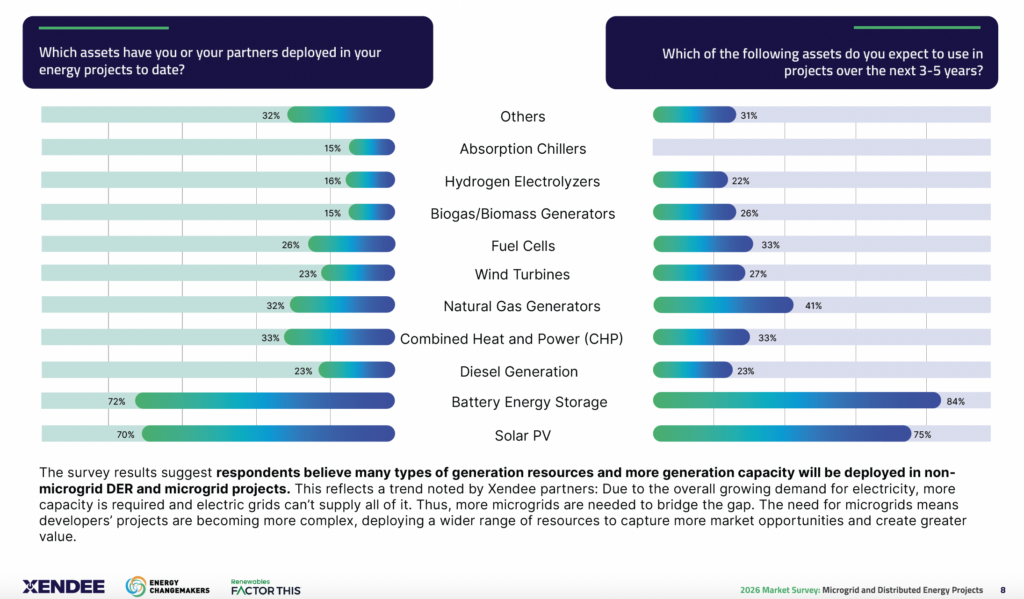
“People are coming back, and they’re actually becoming more positive than they were a year ago. The other thing that we are seeing —a. nd suspected actually — is that the project’s becoming a little bit more complex,” said Michael Stadler, Xendee’s chief technology officer, in a recent Factor This webinar about the findings.
Rather than simple solar and energy systems, they are moving into more complex microgrids.
Different Market for Different DERs
Walt Whitman famously said, “I am large, I contain multitudes,” to explain why he contradicted himself. The same is true for DERs. The vibe in the industry is mixed, in part because DERs are not a single technology but many. Trump’s policies are not affecting them all the same way. While rooftop solar clearly lost with the passage of the One Big Beautiful Bill Act last year, energy storage, fuel cells and linear generators benefited.
As a manufacturer of transformers for the commercial and industrial market, Maddox Industrial Transformer has visibility into market variations based on who is ordering what.
“Over the past year, we’ve seen a lot of renewable developers focus on securing safe-harboring equipment to lock in tax credits. This has increased some of the short-term demand, but overall long-term demand looks down in the solar and wind space,” said Miles Whitling, chief commercial officer. “At the same time, we’re seeing very strong interest in onsite power generation and storage. Companies are building everything from battery energy storage systems and generator sets to even small modular nuclear projects.”
Meanwhile, natural gas generators are finding ready partners in data centers building onsite generation. Nearly 75% of of the 46 data centers (56 MW) analyzed by Cleanview will use natural gas immediately, often with plans to add renewables later.
When Will the New Normal Arrive?
Like most industries, distributed energy craves predictable policy and steady growth. When will that steady state arrive? When will the weird vibe disappear?
Leland Gohl, director of marketing at community solar company PowerMarket, described three dynamics that define the moment and will turn the story around.
- Demand pull is overwhelming policy push. Load growth — not incentives — is becoming the primary driver.
- Execution is the differentiator. Interconnection, financing, and customer acquisition discipline will separate winners from the pack.
- Distributed resources are shifting from “nice to have” to “system critical.” As grid constraints intensify, flexible and local capacity becomes essential infrastructure.
“By year’s end, I expect the narrative to tilt more decisively positive. Not because volatility disappears, but because the demand story is too strong to ignore,” Gohl said.
Added Donovan, “The one thing I would say is, it will work itself out. I am hugely bullish on distributed generation. If someone can keep their head about them, they’re going to do fantastic.”