
Buckle up. The next 1,000 days could determine the fate of distributed energy — and the cities of the future.
That’s the message from Schneider Electric, one of distributed energy’s largest players, which this week laid out its vision to 2,500 people at its annual North American innovation summit in Las Vegas, Nevada.
Why 1,000 days?
“We’re sort of obsessed about time because I think there are moments in the evolution of any industry where change has to happen more quickly,” said Aamir Paul, president of Schneider’s North America operations, during a keynote address Tuesday. “Every actor in the value chain has to own the next 143 weeks or 11 quarters.”
Over that timeframe, the US needs to address impediments that are slowing the economic and social milestones promised by decentralized energy and electrification. This includes resolving the conflict between AI growth and electricity prices. The answer can’t be a trade-off between building data centers and providing affordable energy for every citizen, he said.
“We have to find collectively a better, smarter way to attack this problem. We think distributed energy will be a big part of this. We think demand side, digital efficiency, making the assets we have smarter and more capable, making them more efficient, is going to be critical,” Paul said.
Two possible futures
The company elaborated further on the significance of the 1,000-day deadline in a report issued by its Sustainability Research Institute and the US National Renewable Energy Laboratory.
The report lays out two futures for energy and the economy. Which one prevails depends on resolving the problem of meeting rapid increases in electric demand.
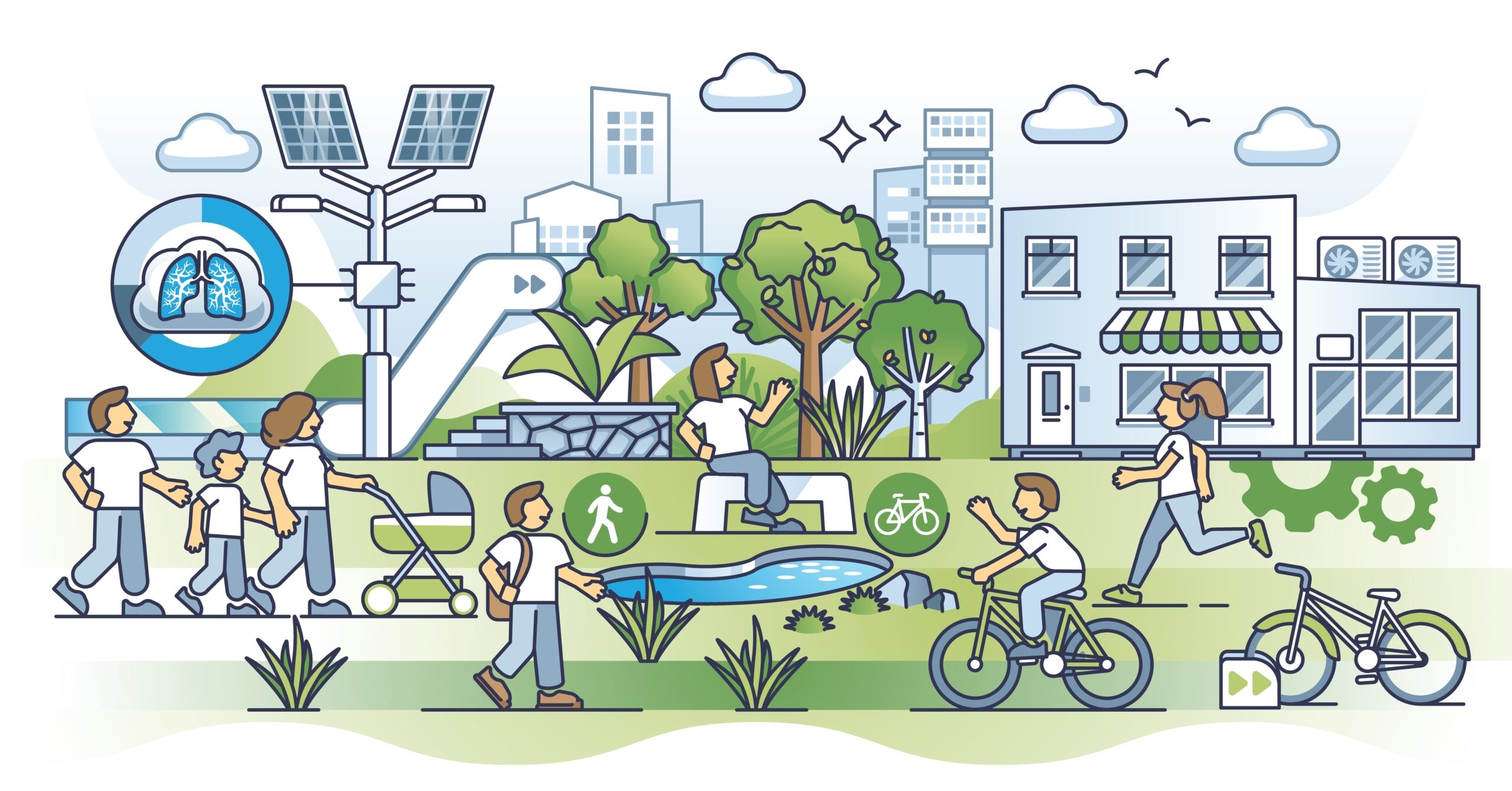
In one scenario, we overcome today’s roadblocks, and by 2050 “micropolitan cities” emerge where people live closer to work, cars become less important, automation characterizes factories, and buildings become their own power plants.
Innovation and investment drive this future, but so does culture.
“America’s ethos of self-determination favors decentralized solutions, local control, and autonomy. This manifests in growing appetite for distributed energy, community-centered living, and technologies that enable self-sufficiency — from rooftop solar to remote work to localized manufacturing,” says the report.
Schneider sees solar as a key technology for achieving this future, potentially accounting for 50% of total generation by 2050, up from 5% today. Rooftop solar alone could provide 900-2,000 TWh by 2050 or 25-45% of the total increase in generation.
If you’d like more of our news and analysis, join the Energy Changemakers community, starting at only $59.99/year.
“Beyond affordability, rooftop solar also presents a unique ability to be deployed more rapidly than centralized systems, with faster and easier rollout processes that are easier to scale,” says the report. “Rooftop solar (and potentially other distributed energy resource solutions) thus represents an essential lever to accelerate the buildout of new generation across the U.S.”
Electricity becomes 57% of the energy mix by 2050, up from 23% today, according to the report’s modeling.
“Most, if not all, innovations are today built on the back of, or with the recourse to, digital technologies. And all these innovations are fueled by one source of energy, electricity,” says the report.
It’s not just data centers driving the new demand for power. In fact, data centers become a less dominant part of the electric mix post-2030 as the electric needs of manufacturing, homes and transportation grow.
And even now, data centers are not the sole factor driving up rates, Paul said.
“There’s a lot of conversation about rate increases being a function of data centers. This is the most obvious, most visible, largest, fastest growing load requirement. But actually weather events, aging infrastructure, the slow but consistent electrification of transport and buildings and industries is all accumulating. So this [data centers] is just the catalyst that is taking a system that was already under stress and pushing it, and we have to now think about that system differently,” Paul said.
Adding more generation capacity is one hurdle to achieving the best 2050 scenario; another is making it easier for homes and businesses to electrify, a process that faces significant delays in parts of the US today because of grid constraints.
“The pace at which these connections happen today remains a critical issue. Infrastructure upgrade needs and congestion are notable problems,” says the report. “One key solution to mitigate the impact on distribution grids of more electric loads is distributed generation.”
The report points to the potential for distributed generation to provide more than double the electricity required to meet new demand. As this occurs and buildings take on the added role of acting, in essence, as power plants, they alleviate the need to upgrade the grid to accommodate their demand. Delays cease to be.
The report concludes that “if the digital and energy infrastructure is to ramp up at pace, it will have to rely in part on a significant decentralization of its generation provisions, behind-the-meter (BTM) resources which would represent a massive but ‘silent’ contributor to the new infrastructure buildout. “
If we mess up?
What happens if decisions are not made over the next 1,000 days to resolve capacity constraints, integrate load, and keep electricity prices in check?
Schneider still envisions change, but not nearly as much. In this scenario, Infrastructure upgrades lag behind rising electricity demand, and institutional barriers slow innovation and the use of digital tech. Americans continue to spread out into the suburbs, and reshoring and industrial modernization advance, but unevenly.
“Modernization occurs, but suboptimally, constrained by the pace of policy, planning, and institutional capacity,” says the report.
The report authors reach these conclusions by rejecting energy forecasting methods commonly used to model a fossil-fuel-based economy, which measure energy flows from one place to another using a stocks-and-flows approach. Instead, they take a more forward-looking tact that assumes societal change and new technology will determine energy patterns.
Douglas Arent, executive director of the NREL foundation, describes this as “a system thinking lens,” in the report’s forward, which suggests “plausible futures and new ideas” and “sheds light on underappreciated, perhaps unnoticed, transitions, and trigger debate and future work for the broader energy community.”