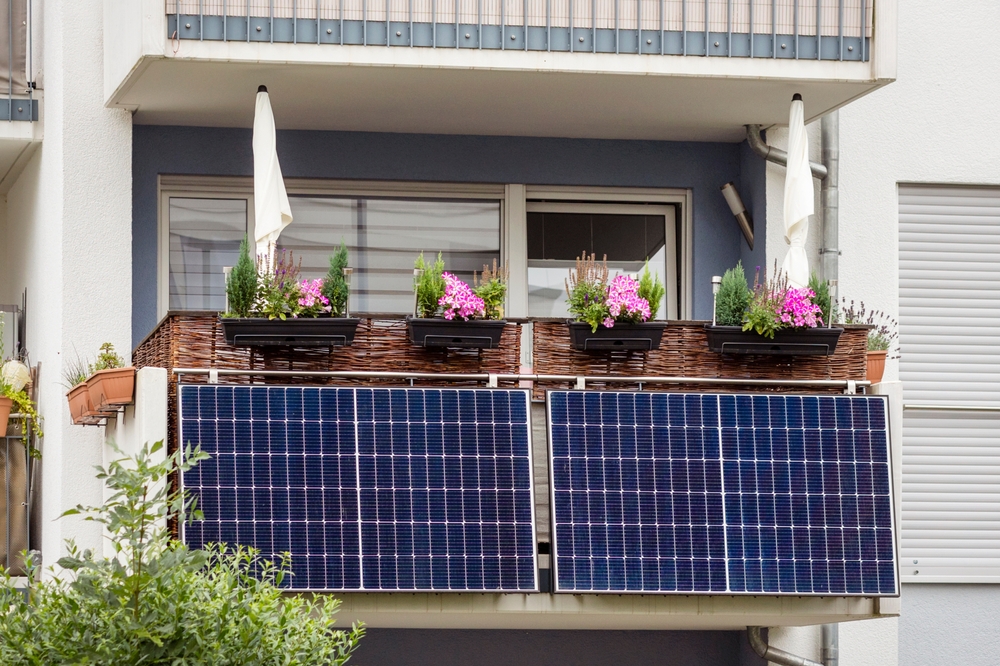
In this era of hyperscalers and mega microgrids, a countertrend is emerging. Consumers are becoming enamored with solar systems so small you can hang them from your porch — and the implications are big for the distributed energy market.
Known as plug-in or balcony solar, these 200 to 1200-watt systems can offer compelling economics under the right circumstances. In Germany, where the technology is popular, a study found that balcony solar typically pays for itself in two to five years and can offset the equivalent of a couple of monthly bills annually, depending on sunlight, shading, demand and grid prices. They cost only $300-$2000 compared to an average of $30,000 for rooftop solar on homes.
But focusing on the savings misses the bigger story.
“Balcony solar is real, and it’s growing fast. The global market hit $1.17 billion in 2024 and is on track to nearly triple by 2033. That’s not a trend. That’s a behavior shift at scale,” said James Showalter, CEO and founder of solar and storage equipment supplier EG4 Electronics.
That phrase — behavior shift — is the key here.
“Here’s what the hype misses: kilowatt-hours are not the story. The story is what happens after someone installs one. When a person goes from passive energy consumer to active energy participant, their decision-making changes,” Showalter said.
The psychological barrier to solar never solved
For years, the industry has treated cost as the primary barrier to solar adoption. Lower the price, improve financing, expand incentives and adoption will follow.
No doubt that works for a segment of the population — rooftop solar has seen tremendous growth. But not everyone is persuaded by financials. As Andrew Hoesly, general manager at solar provider SolarTech, pointed out, for some the obstacle is psychological. “People don’t think solar is for them.” It can feel like a lot to find an installer, wait for permitting, and grasp net metering.
Balcony solar can sidestep all of that because the process is familiar. Like a window air conditioner, you can buy it at a hardware store. Ideally, your utility doesn’t get involved. No one crawls on your roof. You just bring it home and plug it in.
It’s a quick and easy entry point. And once consumers experience the ease, the bill savings, and the sense of being part of an energy revolution, their “energy blindness” starts to fade, according to JD Smith, director of marketing and public relations at Arch Solar, a solar installer.
“There are a lot of people — myself included — who take energy for granted and aren’t thinking about how much they use or when,” Smith said. “Having balcony solar suddenly makes people aware of their usage and how they can take control of it.”
Once the consumer is hooked, the next steps feel less risky and more intriguing. Is it possible to add a battery for resilience? Can a smart electric panel help me optimize energy use? Should I make my home more efficient? Maybe it’s time to install a heat pump or buy an electric vehicle?
At least that’s the theory
All of this makes sense only if it is actually easy to buy and install balcony solar. So far, that’s not true in most of the US.
State and utility rules tend to treat balcony solar the same as rooftop solar, with similarly onerous permitting and interconnection standards. In some ways, the situation is worse because homeowners are more likely to be on their own without a solar installer’s assistance.
But that started to change last year, when Utah Gov. Spencer Cox, a Republican, signed the nation’s first law (HB 340) cutting the red tape for balcony solar installations. For systems up to 1200 watts, state residents no longer need to get a utility interconnection agreement or special permit. They can plug the systems into a standard wall socket – no contractor required.
Maine followed suit last week when Gov. Janet Mills, a Democrat, signed into law a bill (LD 1730) for solar and battery systems up to 1200 watts. Next in line is Virginia, where Gov. Abigail Spanberger, a Democrat, is expected to sign a bill (HB 395 and SB 250) this week that would specifically prohibit utilities from requiring customers to obtain any kind of approval for balcony solar installations.
As of now, at least half of the states are considering easing rules for balcony solar, indicating a wave of potential policy changes is underway.
Mark James, interim director of the Institute for Energy and Environment at Vermont Law and Graduate School, points to Germany as the international world leader in balcony solar deployment, and says it’s now seeing a corresponding uptick in home battery installations as people seek to store their solar energy for later use.
The technology also is spreading across Europe to Italy, Spain and the UK, following a similar trajectory.
Gateway tech: A familiar playbook
Should balcony solar live up to its promise and act as a gateway for consumers to adopt other distributed energy resources, it will follow a pattern familiar to the tech industry. Look no further than how smartphones led to digital banking, ride-sharing, health tracking, streaming and social media.
The key seems to be that the initial tech offers immediate benefits, reduces effort and costs little — all characteristics of balcony solar.
How to make balcony solar matter
As leadership thinker Margaret Wheatley famously said, “Each new innovation creates new questions and opportunities—often far beyond its original purpose.”
Balcony solar looks like this kind of innovation—an entry point worth tracking. It isn’t really about small panels on apartment railings. It’s about the moment a consumer starts to feel agency over their energy.
But creating the funnel from balcony solar to additional distributed energy technologies may require the industry rethink sales funnels, business models and regulation.
“Balcony solar can absolutely be a gateway. But only if the industry stops treating it as a destination and starts designing the pathway that connects it to something larger,” Showalter said. “The question is not whether balcony solar works. The question is whether we build the ecosystem that makes it matter.”
Check out this related story: Solar on Wheels: How a Family-Run Startup is Transforming Driveways into Clean Power Stations