Electricity prices have become political tinder, echoing the 1970s energy crises when US consumers took to the streets and pressured politicians to rein in costs.
But this time it’s different. The solutions on the table — forms of distributed energy — cut costs by giving consumers a stake in the system, rather than asking them to put on a sweater or get behind more fuel diversity.
The future of energy is increasingly distributed. Energy Changemakers follows the companies, technologies, policies, and ideas driving that shift. Become a paid subscriber to support our work and gain early access to deeper analysis.
Support our work with a free or paid subscription
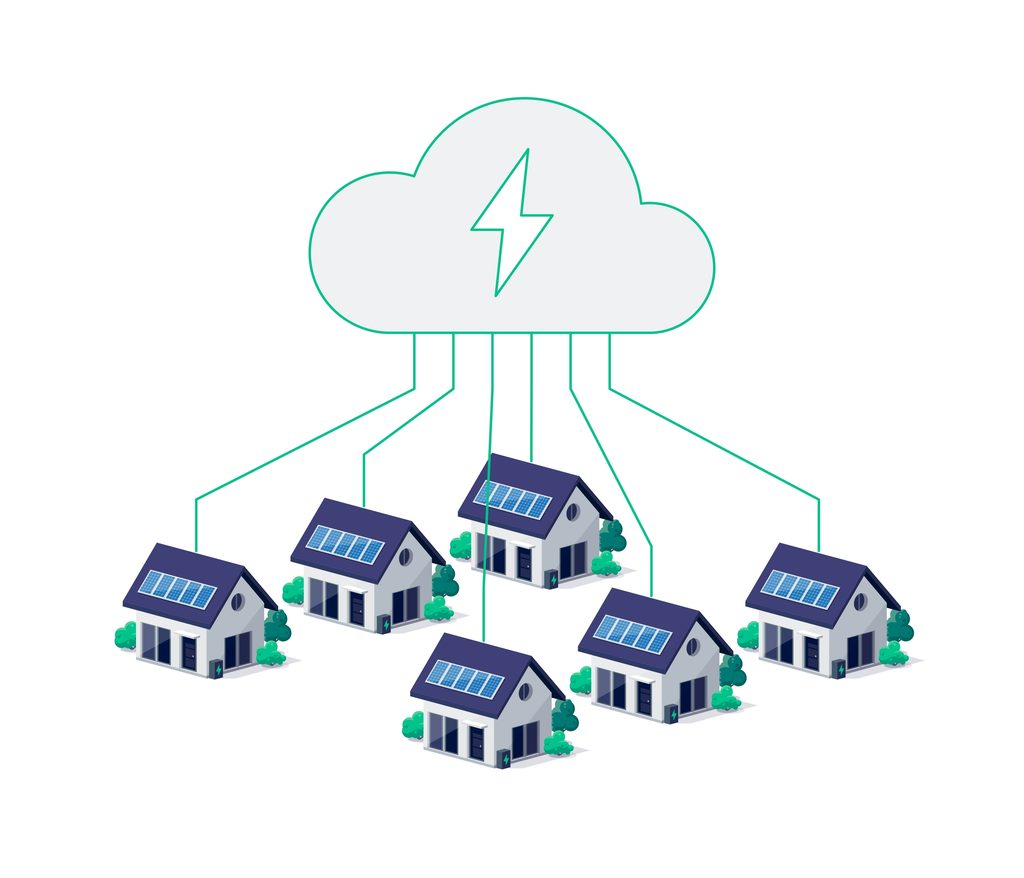
The new models vary, but they share one idea: homes and businesses use equipment they already have — solar panels, batteries, smart thermostats, electric vehicles — to generate, store or shift their energy use, and get paid or save on bills when that flexibility helps the grid.
Among the most closely watched models are virtual power plants, which are attracting interest from technology giants like Google and Microsoft, and from states like Colorado, Hawaii, Illinois, Virginia, and Maryland, which are advancing rules and programs to support their development.
There is good reason for the interest. Virtual power plants could offset more than half of expected electricity bill increases, according to a study the Brattle Group released this week for Everyday Electric (formerly Renew Home).
Where the savings come from
Brattle modeled a utility serving one million residential customers with a 301 MW virtual power plant — about 4% of the utility’s total peak demand — built within five years.
In this scenario, the utility would pay participating households $23 million a year in return for using some of their energy capacity during peak periods — generally done by automatically adjusting thermostats, discharging home batteries or shifting EV charging to off-peak hours.
Participating households aren’t the only ones that benefit. All ratepayers save, according to Brattle, because the utility can avoid spending about $65 million annually on new power plant capacity, energy and grid upgrades. The virtual power plant can do this cheaply because it relies on equipment households already own.
After costs and payments, the utility retains $34 million in annual net system savings, which Brattle assumes will flow through to electricity rates. That offsets about a third of a projected $98 average annual increase in electric bills. Across all households, the average benefit rises to $56, offsetting 57% of the increase. Participating households fare even better, offsetting 93% on average.
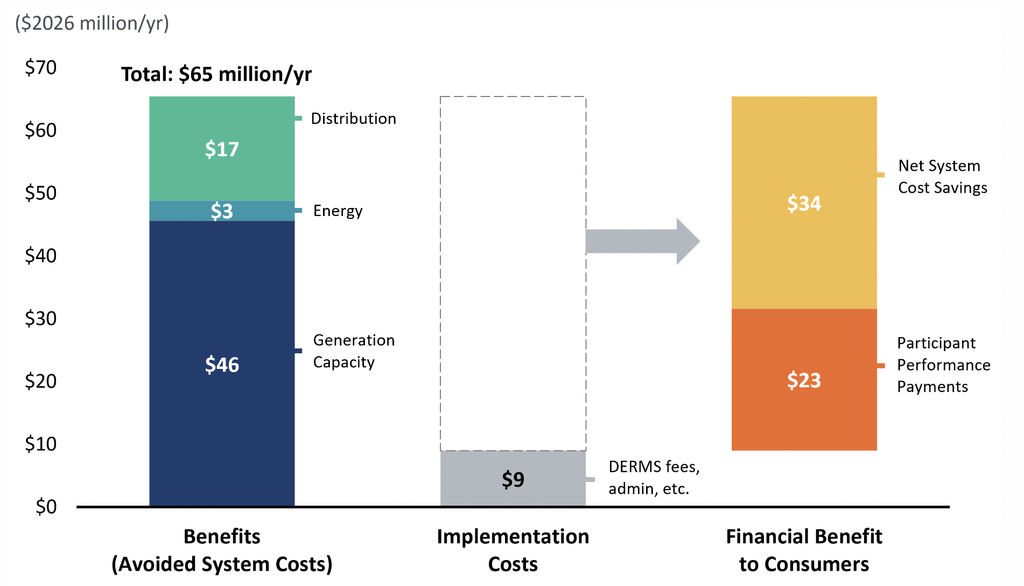
It’s important to note that the $23 million paid to customers isn’t a capital expense for the utility. It’s a performance payment to households for providing grid services.
The bottom line is that virtual power plants are a cheap way to meet growing demand. The value of the modeled virtual power plant is more than seven times the cost of enabling it, according to Brattle.
Voters are angry
These findings come as consumer discontent grows louder nationwide over electric bills that rose faster than inflation from 2020 to 2025. The Energy Information Administration expects residential electricity prices to rise roughly another 5% this year.
In June, protesters staged a mock tug-of-war outside a public utilities commission hearing in Lewiston, Maine, over a proposed rate hike. On one side, protesters in rat masks and top hats played the utility. In Colorado, protesters delivered thousands of petitions to state regulators in mid-October, urging that data centers pay their own way. Multiple governors have taken steps to rein in electricity costs, and lawmakers have introduced measures to curb utility returns.
The fervor hasn’t gone unnoticed by those running for office this year. Candidates are vowing to curb energy costs and pushing for tech companies to pay for electricity infrastructure serving AI.
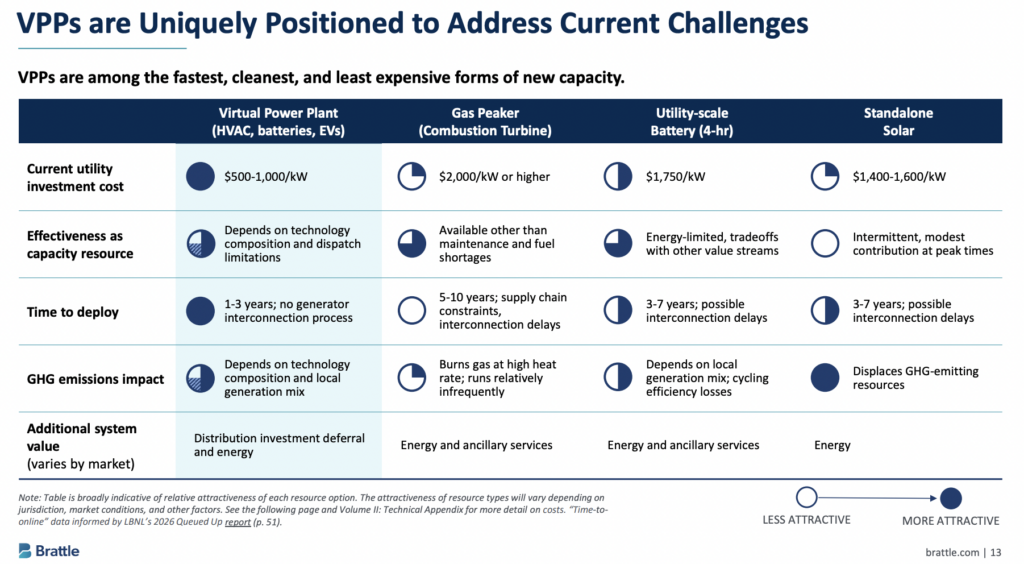
Price pressures are coming from different directions, but Brattle singled out long lead times and rising costs for natural gas turbines — a situation forecast to persist into the 2030s.
“These high prices present a risk of significant costs being passed on to consumers as generation is built to meet load growth. VPPs can provide capacity at a fraction of this cost, representing a significant opportunity to deliver affordability benefits to consumers by avoiding these high costs,” the report said.______
While the results make a strong argument for virtual power plants, there are caveats to consider. These are modeled benefits and projections, not measured savings from an actual virtual power plant. And even if utilities adopt virtual power plants, there is no guarantee they will pass savings on to households. That will depend on utility regulation, market rules and program design across a fragmented utility landscape.
But if they do, the result could be consequential.
The power plants in our homes
Brattle estimates that residential demand response — the mechanism most virtual power plants use — accounts for about 1.1% of utility peak demand nationally. If utilities could raise that figure to 4%, American homes could provide 35 GW of power capacity to the grid when it’s needed most, up from about 10 GW today.
The additional capacity could generate $4 billion to $7 billion annually in financial benefits for households, according to the study.
The backdrop for all of this is that these devices often already exist in homes. Consumers are installing them for their own purposes, and the numbers are growing. US residential battery installations nearly doubled in 2025, while electric vehicle sales have grown more than fivefold since 2020. Smart thermostats can already be found in more than a third of American homes with central air conditioning.
Households are creating the basis for virtual power plants, whether they know it or not. The question for utilities, to flip a familiar line, is this: If they come, will you build it?