

Community solar appears to be on a roll. It’s seeing a lot of market moves (buying, selling, investing) and action by state governments on policy and regulation.
Both of these markers can indicate that a business model or technology is gaining importance in the electric power mix.
While the first, market animation, is an obvious barometer, the second, government action, surprises those in other industries. For them, government action means restrictions. But in the electric power sector, it can create opportunities as new distributed technologies force a rethinking of old rules that were designed for a centralized grid.
So, a recent report by the North Carolina Clean Energy Technology Center offers encouraging news for community solar. It finds 42 proceedings underway involving community solar in 23 states as of the second quarter of 2024.
Government action on community solar
This isn’t an exhaustive list but here are some examples of regulatory and policy activity in recent months.
Alaska’s Senate Bill 152 and Virginia’s SB 255/HB 108) enable community solar programs in the two states. Meanwhile, in Pennsylvania, a “partisan dance” is playing out around a community solar bill being pushed by industry advocates (HB 1842), according to a Standard Solar legislative update.
Maryland is working on moving community solar out of the pilot stage, as mandated under 2023 legislation (H.B. 908) to establish a permanent program by January 1, 2025. Massachusetts is evaluating rule changes that would give low-income customers more access to the state’s thriving community solar programs, which are now largely accessed by wealthier households.
In June, the Michigan Senate Energy and Environment Committee heard testimony on community solar bills (SB 152 and 153) that would let communities build projects of up to 5 MW. Utilities oppose the bill, arguing it’s not needed because they already offer renewable energy programs. Environmental, clean energy, and community groups disagree.
Learn about all things distributed energy. Sign up for the free Energy Changemakers Newsletter.
California’s move on community solar in May generated the most headlines. But rather than opening new pathways for community solar, it may perpetuate the state’s weak activity, according to community solar advocates. The California Public Utilities Commission rejected a net value billing tariff in favor of a utility-backed community solar approach.
In contrast, Colorado, an early leader that later faltered, enacted a new law (Senate Bill 24-207) in May to reinvigorate its community solar program. The law leverages federal incentives and gives low-income electricity users a better shot at participating in programs. It also attempts to preserve open land by prioritizing projects that are developed on rooftops or for dual uses, like agrivoltaics.
These changes come on top top of existing government rules permit independent community solar to do business in about one-fifth of the states and the District of Columbia, according to the Coalition for Community Solar.
Animated market
On the market side, this year has seen the announcement of a plethora of community solar partnerships, projects, and portfolio acquisitions.
- Scale Microgrids was first out of the gate in January with an agreement to partner with developer Gutami on 500 MW of projects across multiple states.
- At about the same time, 38 Degrees North unveiled plans to build 10 community solar projects, totaling 62 MW, as part of a growth equity investment from S2G Venture. The projects are in New York, one of the most active states for community solar.
- Also in New York, Nautilus acquired a 12.7 MW community solar portfolio from SolAmerica Energy. Catalyze took ownership of 12 community solar projects, totaling 76.7 MW, from BW Solar. In New York City, Perch Energy and Nuveen began a campaign to offer thousands of low- and moderate-income residents community solar. The program emerged from a $30 million private equity investment by Nuveen into Perch.
- Nexamp made a deal to provide Starbucks with six new projects in Illinois that show how community solar can double as an ESG play. Also in Illinois, Standard Solar took ownership of 84 MW of projects from New Leaf Energy.
And the list goes on…
So many community solar acquisitions are occurring in the state of Maine, that some are questioning whether local subsidies are benefiting out-of-state corporations, according to Maine Monitor. The publication cites acquisitions of Maine projects by affiliates of Goldman Sachs, BlackRock, Brookfield and other large corporations.
The problem of who’s getting what money aside, the fact that community solar is attracting such large investors offers another indicator of the market’s health.
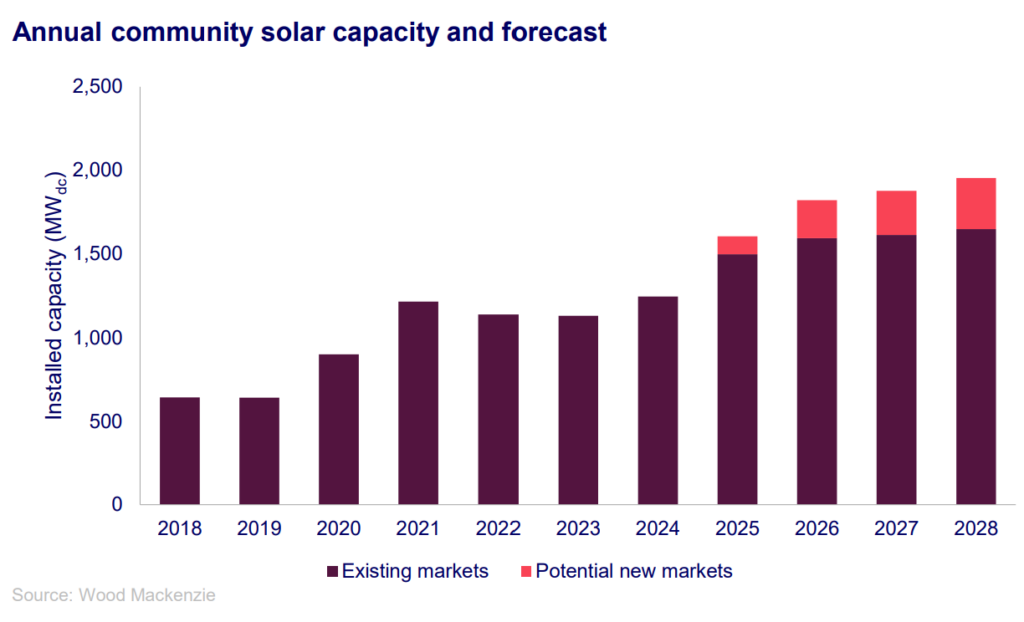
To be clear, community solar deployment remains a fraction of utility-scale solar and also trails residential and commercial solar, according to Wood MacKenzie. However, the research organization expects 2024 to bring growth after a dip in 2023, with new markets forming over the next four years, as illustrated below.
Community solar isn’t just about green megawatts
None of this growth is a surprise, and it is likely to continue if states continue to upgrade regulations. As a business model, community solar ticks the right boxes. First, it serves an unmet need, providing households and businesses with a way to access solar if they can’t install it on their own roofs. Second, it does so in a way that usually saves the customer money while making money for the project developer and operator.
In addition, given that it is neighborhood-centric, community solar can be crafted to meet the social needs of a particular time and place, including:
- Coalescing communities around a positive mission in times of trauma
- Providing low-income neighborhoods with a stake in their energy system
- Becoming a source of economic development, public EV charging, and electric resilience.
It’s possible that community solar’s worth will eventually measured not in megawatts installed, but in the ways it helps the electric system evolve to serve communities in an increasingly customized fashion.
If you’d like to take a deeper dive into how community solar makes and saves money, check out the upcoming Energy Changemakers’ podcast, “The Economics of Community Solar,” with Rob Hong of Sapling Financial Consultants, to be released for EnergyChangemakers premium members on Sept. 4, 2024 and publicly Sept. 11, 2024.