

For nearly half a century, regulated utilities have faced a steady stream of challengers.
First came independent power producers in the late 1970s. Then came merchant generators and competitive electricity suppliers in deregulated states. Next, local energy started chipping away at utility sales — rooftop solar and batteries, community solar and microgrids.
Each represented a new threat to the electric utility’s grip on the power generation business.
Both sides suffered losses and made gains. Competition transformed wholesale generation and broke apart the vertically integrated model in some states. Still, the regulated utility’s basic franchise — owning the wires and serving captive customers — proved remarkably durable.
But the utilities have never seen anything like what they face now with big customers — hyperscalers and AI data center developers — starting to act like competitors, building their own large generators.
The trend is countable in Ohio
At least 10 utility-scale onsite power projects for data centers have entered the Ohio Power Siting Board process since 2025. (An 11th application was withdrawn.) Many are designed to operate off-grid.
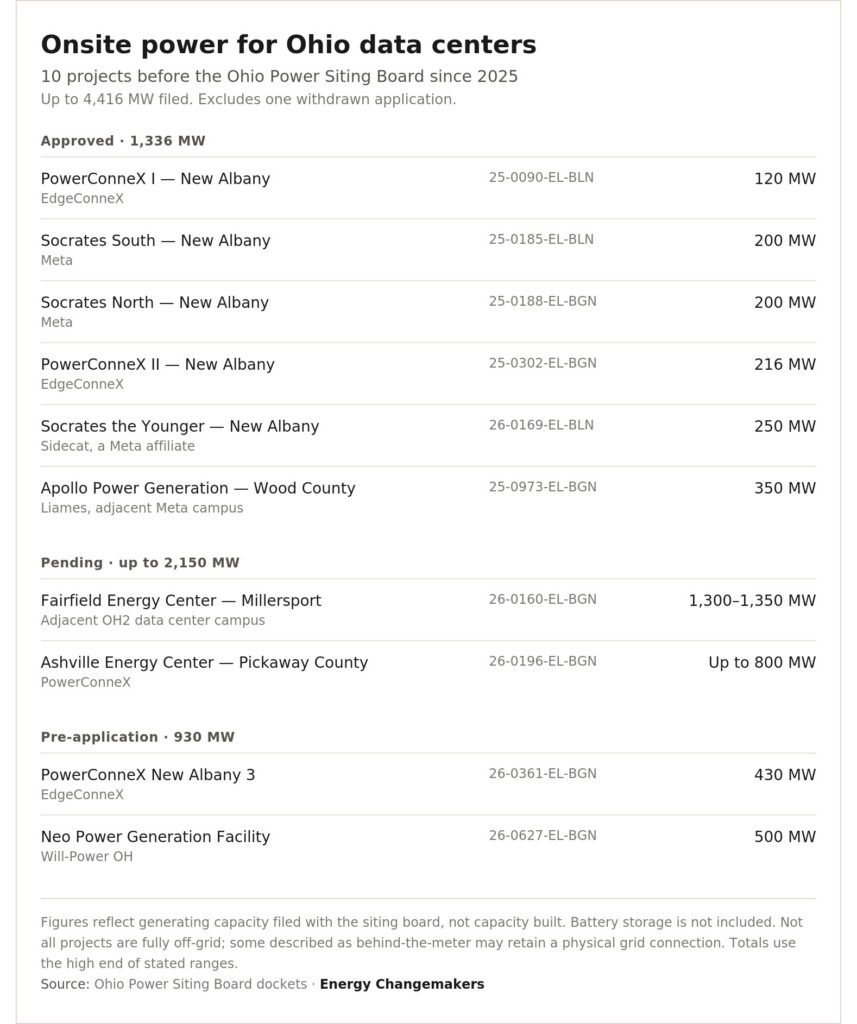
To operate these new behemoths, the data center operators are tapping into the expertise of independent players like global environmental services company Veolia, which recently made public its role in a 350-MW microgrid for an unnamed AI data center campus in New Albany, Ohio. The company will operate and maintain the off-grid plant under a performance-based contract. The project includes a 430 MWh battery energy storage system, linear generators, and gas engines.
On a national level, it’s more difficult to track how many data centers are using onsite power. In most states, onsite data-center power plants do not face an Ohio-style state siting-board review.
But the onsite generation projects are leaving a paper trail in the news. Two often cited examples are New Mexico’s Project Jupiter campus, which plans to install a microgrid with up to 2.45 GW of Bloom Energy fuel cells. In Kentucky, Brookfield and NextEra have proposed a grid-connected AI campus supported by roughly 2 GW of dedicated natural gas generation and 2.6 GW of battery storage.
These are huge projects for the distributed energy industry, which until the data center boom considered a 5 MW microgrid extraordinary.
If nonutility companies provide faster, cheaper access to energy, utilities might not realize the data center-related growth they expect
Onsite power may serve 40% of new data center capacity
Data centers are creating a market for distributed energy companies. But they are also driving new utility sales. Exactly how much new energy is needed and how utilities and competitive companies will divvy up the market remains uncertain.
In its Utilities 2026 Outlook Report, Morningstar warns that if nonutility companies provide faster, cheaper access to energy, utilities might not realize the data center-related growth they expect in the long run. For now, though, Morningstar remains bullish on utilities, saying they are ‘poised for significant growth’ despite the emerging competitive threat.
A report issued by Enverus Intelligence Research in July is more specific — and bullish on distributed energy. The research firm forecasts 62 GW of new data center capacity in the Lower 48 through 2030, supported by roughly $5 trillion in cumulative hyperscaler capital spending from 2026 to 2030.
It expects behind-the-meter projects to account for roughly 40% of installed data-center capacity by 2030, with roughly half concentrated in ERCOT and PJM. That represents generation capacity the incumbent utility generally doesn’t build, rate-base or earn a return on.
But Enverus is candid about the uncertainty. High-confidence project coverage falls from roughly 96% of forecast additions in 2028 to 26% by 2030 — meaning the near-term picture rests on projects already under construction, while the 2030 figure is more speculative.
AI-driven load growth is reshaping the investment landscape, with more hyperscalers and AI firms directly developing and owning generation…S&P Global
Defection is one form of disruption
A data center that builds its own generation is undercutting the traditional utility model. But the disruption the tech world could bring to utilities is about more than megawatts. It’s also about money and clout.
Hints of this capability appeared when Alphabet acquired Intersect Power assets for $4.75 billion. S&P Global said the deal marked the first a hyperscaler bought an independent power producer.
Tech has the means to go further. The market cap of the Magnificent Seven — Alphabet, Amazon, Apple, Meta Platforms, Microsoft, Nvidia and Tesla — is $22 trillion to $23 trillion, roughly 15 to 16 times the entire S&P 500 utilities sector. The 31 U.S. companies in that sector carry a combined market capitalization of about $1.43 trillion.
But buying a regulated utility would mean a multistate regulatory slog that’s unlikely to appeal to the move-fast-and-break-things tech industry. Unregulated generation platforms are the easier acquisition target.
“AI-driven load growth is reshaping the investment landscape, with more hyperscalers and AI firms directly developing and owning generation via platform acquisitions,” writes PwC in its Power and Utilities: US Deals 2026 Midyear Outlook.
The global consulting firm expects hyperscaler activity in IPP platforms, behind-the-meter generation, and early-stage small modular reactor (SMR) infrastructure and advises that power-sector dealmakers “treat hyperscalers as a distinct class of strategic buyers competing for operating assets.”
Hyperscalers have already demonstrated an appetite for shaping energy policy in proceedings before FERC and state utility commissions.
Tech also has the money to influence policy
The reshaping of the competitive playing field by big tech could, however, be less about the number of megawatts or acquisitions and more about policy clout. In the power sector, regulation often determines markets. Distributed energy advocates have long complained that they are outgunned financially in regulatory proceedings by utilities who can afford to hire more lawyers and analysts.
Hyperscalers have already demonstrated an appetite for shaping energy policy in proceedings before FERC and state utility commissions. Google filed testimony opposing AEP Ohio’s data center tariff before the Public Utilities Commission of Ohio and participated in Dominion’s large-load connection queue in Virginia. Amazon challenged Indiana Michigan Power’s proposed thresholds. The Data Center Coalition, an advocacy group, has become a frequent participant in utility and energy-policy proceedings
That work has centered on wholesale-market and interconnection rules at FERC, and on rates, tariffs and cost allocation before state commissions. Distributed energy policy may be next as it grows in importance to hyperscalers.
If they turn their attention to distributed energy policy, the arithmetic of those proceedings changes. The two solar guys in a truck trying to disrupt the utility monopoly may find themselves, oddly, working alongside some of the world’s most valuable companies.