

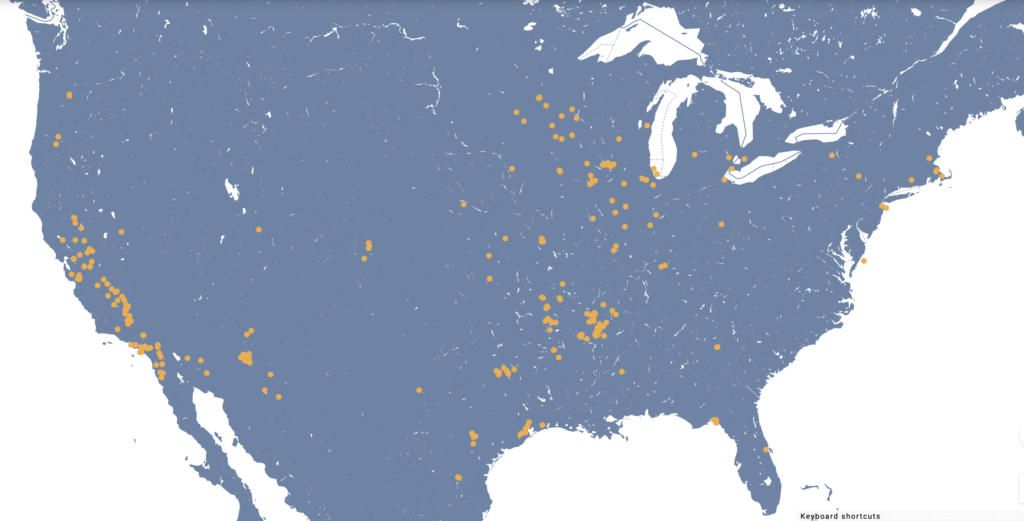
BluePath Finance sits at a unique vantage point in the distributed energy market. Founded in 2012, the company finances, owns and operates about $1 billion of distributed energy projects across about half of the US.
As similar companies retreat from today’s difficult market, BluePath is continuing to expand, following what it describes as a disciplined, owner-focused model. Last week, BluePath announced a new round of financing from TWG Global to help fund its next $2.5 billion in projects.
So I sought out CEO Warren Jones to find out how he sees the distributed energy market now and for the next few years.
Here is our conversation, edited for clarity and brevity.
Q. What is BluePath, and how did it come to be?
WJ. Before founding BluePath, I was an investment banker in San Francisco. We did some of the earliest cleantech deals — and also project finance — working with some of the first solar developers, funding all parts of the capital stack.
Since 2012, we’ve been focused on owning and financing assets, not developing. We have a series of channel partners who develop projects. We purchase the projects and finance them, close to notice to proceed (NTP), sometimes later, sometimes earlier. Essentially, we’re providing all the capital, thinking about that asset over, in some cases, a 40-year useful life.
Q. Why did you choose this business model?
WJ. The market has generally been immature over the last 20 years. People tried to do almost everything in the value chain, which is really not how a more mature market ends up.
A more mature market looks more like the real estate market, where developers develop, constructors construct, and owners own these assets long-term.
Q. Is your model lower risk than developing projects?
WJ. Yes, because it’s infrastructure investment. So we’re looking at projects that are generally close to being constructed.
Q. How would you characterize the distributed energy market today?
WJ. There’s a rationalization of the market going on — in some ways accelerated by the One Big Beautiful Bill, but other things too. A lot of groups raised a fair amount of money when it was very cheap three, four, five years ago. They priced deals as if interest rates couldn’t rise. So there are a lot of upside-down projects in terms of economics. People are unable to raise additional capital. They’re exiting the market to some degree or another.
The Inflation Reduction Act (IRA) gave people the false sense that they could grow into their cost basis, add staff, and become the dominant player. If everyone’s thinking that, pricing gets irrational.
We were disciplined and focused on behind-the-meter projects with relationships we knew well. We could feel confident that we would deliver economic projects for everyone. I think that’s where we are now.
Q. What types of distributed energy are best to pursue now?
WJ. Community solar for sure — we’re doing a fair amount of that. I have a background working in behind-the-meter projects for municipalities. So that continues apace. There are lots of opportunities with municipal utilities. And also community batteries — something like theNew York feeder battery program, which we’ve been heavily invested in.
It’s going to continue to be a fair amount of solar for the next couple of years, and then more and more batteries, too.
Q. So the solar projects you’re describing are safe-harbored in terms of disappearing federal incentives?
WJ. There’s a bit of pig-in-a-python with these safe-harbored solar projects, and that’ll take several quarters to digest. I think we’re talking 18 months to two years. There’s just a lot to finish off in terms of those projects, and that’s not just BluePath — that’s across the industry.
And then what I see happening — I think the Chinese manufacturers are going to continue to have to drop pricing to match the unavailability of the ITC. Equipment will just get cheaper.
So that’ll play out, as this kind of pig-in-the-python of Safe Harbor Projects goes through the system and gets constructed and placed online over the next 18 to 24 months.
Q. What does the market look like on the other side of that 18-to-24-month window?
WJ. The market obviously continues with batteries and microgrids. And then it becomes more regional.
We’ve done a fair amount in Arkansas — believe it or not. You’ll see other states say, “We need this.” You’ll see state-level incentives come back in a stronger way for solar in particular. It’s the only technology that can be installed quickly and at scale.
Gas-fired turbines? You can’t get them. I just talked to a group the other day. You know, it’s 2x the price for a turbine. People are reselling the ones they got because they can make a huge profit. And you can’t get them for two to three years.
Q. Has the DER industry suffered reputational harm from the companies that have struggled or failed?
WJ. Unfortunately, it became a political thing. Electrons are not political — everyone needs them. And maybe it’s our industry’s own fault. We didn’t do enough to say, “Look, these projects are economic.” It’s a no-brainer in certain states to have solar on your roof.
Nobody, zero people in my 20-year career, has done a PPA because of the green aspect to it. They’ve only done it because it’s cheaper than the grid.
I’d also say that if the IRA were simply a 25% investment tax credit for 10 years with no bells and whistles, that would have been the best outcome. It became really complicated to administer — we never got clear guidance on how to do half the things that were in that bill. As an investor, you can’t make investment decisions with that kind of uncertainty.
So we are where we are.
Q. How significant is the data center boom for the distributed energy space?
WJ. Significant. There are a lot of dollars being attracted to that space. The owners of those data centers don’t trust the grid to deliver the electrons they need — that’s number one. It’s a security issue for them. And number two, they don’t control the price. If a massive part of your business is an input that can be variable because it’s coming from the grid — subject to natural gas fluctuations, subject to dealing with utilities — you’re going to try to reduce that risk and have energy generation and storage closer to the load. Getting electrons through the grid to your load can be very complicated and require expensive utility upgrades.
Solar is easy to install, and you can get going right away. People are talking about nuclear, but permitting alone makes that a very long runway. I can’t get lights permitted for my kid’s high school field. How are you going to get a nuclear facility of any size permitted anywhere anytime soon? It’s just not going to happen.
Want to learn more about the distributed energy market? Check this out.