
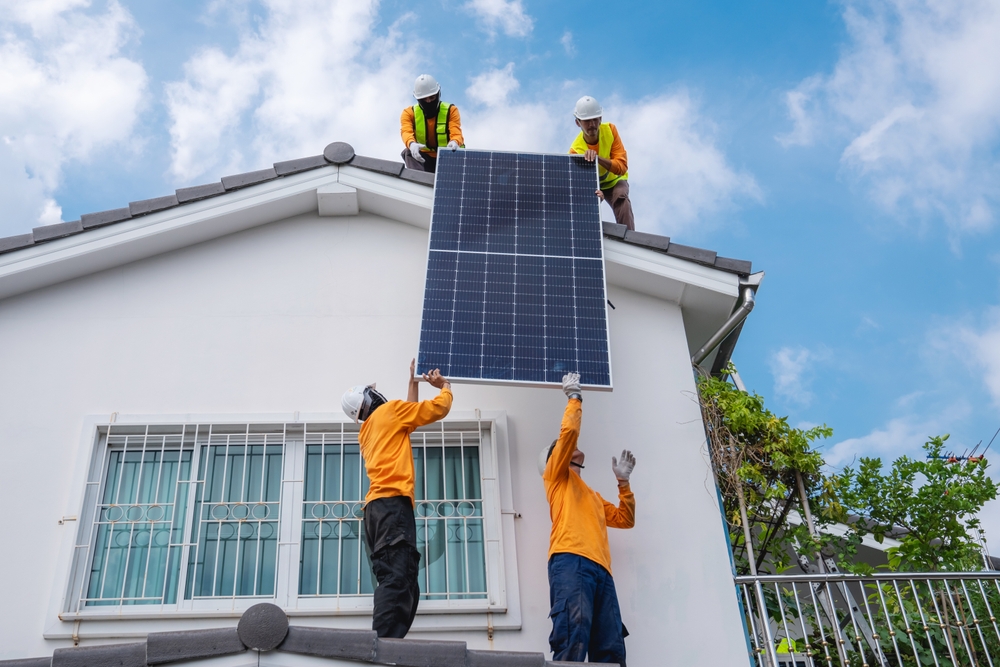
The power industry is starting to look at the home differently—as a kind of mini power plant that can produce meaningful energy products for the grid in aggregate. But so far, the idea has been largely confined to test programs within utility territories.
Startup Resilience Energy has an idea to go bigger: a contracting model it believes it can repeat across large swaths of the United States.
Called the community power purchase agreement, the approach combines elements of two common structures: virtual power plants, which aggregate homes or businesses as grid assets, and conventional power plant financing, where a buyer agrees to purchase power long term at a set price.
Here the “power plant” being financed is an assemblage of solar and storage in homes. They are aggregated as they would be in a virtual power plant for demand response, but what happens next is different. Energy capacity from the solar and batteries—and, where applicable, renewable energy certificates—is sold to utilities, data centers, manufacturers, and other large energy users under 15-20 year power purchase agreements. Those contracts then finance the solar and storage on the homes.
Please support our work. Become a free or paid Energy Changemakers subscriber
Large energy users meet their capacity obligations, while homeowners receive solar and battery installations at no cost, which they can leverage to lower their utility bills and as backup power.
In return, the households agree to allow the batteries to be dispatched when the electric grid is under strain and needs additional capacity, typically 15-20 days per year.
The approach creates “the opportunity to redefine how we think about home, solar storage, and energy affordability,” said Ameet Konkar, CEO, in an interview. “We have an opportunity where we are truly, in some ways, reshaping the grid.”
How the idea emerged
The idea grew out of Konkar’s background in energy and lodging. He previously held leadership positions at Enphase Energy and Zola Electric, before becoming head of sustainability at Airbnb.
Konkar became concerned that the prevailing solutions for keeping household energy costs in check set a low bar.
“Most of the narrative is around, let’s keep the rates the same. Let’s not do any harm,” he said.
He connected two problems. The first is the expense and difficulty of installing solar on homes one by one. The second is the growing energy demand from data centers. He sees the community power purchase agreement as the bridge to solve both while lowering household electricity costs.
The approach can also help address the ongoing challenge data centers face of winning a social license to operate in communities. Hyperscalers have been casting about for ways to ease community tensions, from creating jobs to building eco-friendly campuses.
Resilience Energy becomes a conduit for them to deliver a tangible household device — solar and batteries.
“It can sound a little bit fluffy, but in some ways, we’re finding that it’s even more valuable to some of these companies than even the energy itself because it is permission to operate,” he said.
Still to be tested
To be clear, the one-year-old company has yet to put the concept into practice, but Konkar said it is in late-stage conversations and discussing term sheets with potential offtakers.
To gather participating homes, the company is reaching out to institutional housing owners, low-income housing providers, and state housing agencies and so far has a potential base of more than 100,000 homes, representing about 500 MW. It also recently created a sign-up form on its website for inquiries.
Konkar described one prospective transaction involving 20,000 homes that could provide about 100 MW of capacity. At that scale, the portfolio could involve $500 million to $600 million of equipment.
Resilience would assemble the homes and seek contractors for equipment and installation.
Before the community power purchase agreement
Removing upfront costs for homeowners is not a new idea. Energy-as-a-service contracts and solar power purchase agreements achieve a similar feat. Notably, one of Resilience Energy’s advisors is Jigar Shah, entrepreneur and former head of the U.S. Department of Energy’s Loan Programs Office, who pioneered the solar power purchase agreement that helped accelerate a major wave of solar development 20 years ago by removing the upfront-cost barrier.
What’s different here is that the homes are aggregated to achieve megawatt scale, and done so in a way that flips the typical financial script. Rather than building distributed energy and then monetizing it through net metering or by selling services to the grid, the model leverages grid value in advance to pay for the assets upfront.
As is customary under Solar PPA or energy-as-a-service arrangements, a third party owns the solar and storage installations, in this case Resilience Energy.
Utilities are central
While Resilience is talking to a range of possible capacity offtakers — hyperscalers, data centers, manufacturers — Konkar said he would prefer to work with utilities in a three-party structure. Resilience supplies the portfolio of homes, the utility sits in the middle, and the large energy buyer pays for the capacity.
This deal can be structured as a bilateral contract with the energy user that sleeves in the utility. But Resilience prefers working more directly with the utility. “So we often talk with the energy buyer and then very quickly get the utility involved and basically see if we can do the transaction with the utility for the capacity,” he said.
Putting the utility at the center of the transaction shelters it from risk, he said. It’s not betting on a startup or thousands of homeowners because a creditworthy energy buyer backs the deal.
Utility involvement also opens the door to eventually layering in distribution-grid benefits. Put batteries in the right places, and utilities might be able to postpone a substation upgrade, manage voltage or relieve a local constraint.
Finally, utility involvement makes it easier for Resilience to scale its concept by avoiding potential obstacles in states where retail competition is prohibited.
Targeted locations
The business model works only if enough homes can be aggregated in places where capacity has value. So wholesale market pricing and rules governing distributed aggregation, utility procurement and market participation will help inform where projects go.
The company is focusing first on PJM and MISO, particularly Michigan, Illinois, Ohio and parts of the Mid-Atlantic, including Virginia.
Even once a deal is signed, deployment is not immediate. Konkar said installing equipment across 10,000 or 20,000 homes could take until early 2028.