
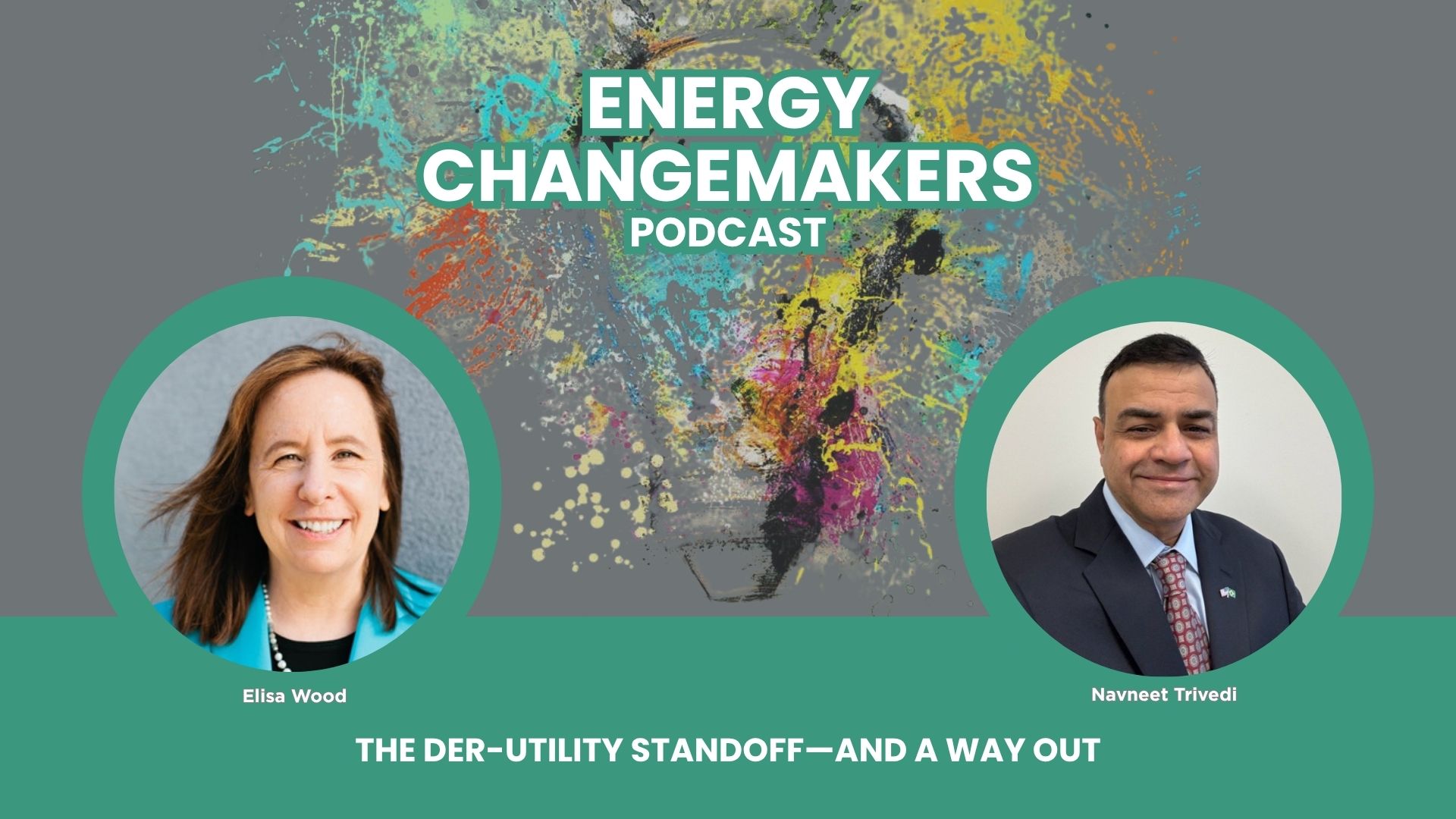
What would utilities and distributed energy companies each have to give up, take on and change to build a more distributed grid?
That’s the question at the center of Elisa Wood’s conversation with Navneet Trivedi, co-founder and COO of Vrinda, who has spent more than three decades working with utilities.
A long-time friend and sounding board of energy entrepreneur Jigar Shah, Navneet’s proposition is simple, but provocative. Batteries, microgrids and other distributed resources are making customers more resilient. So should utilities still carry almost all of the responsibility — and risk — for reliability? Or should some of that risk, and some of the reward, begin to shift to distributed resources?
This podcast explores what that might actually look like, why conversations about an “underutilized” grid can oversimplify what utilities are dealing with, and why DER companies may need to do more than call out what utilities are getting wrong. Navneet’s view is that they also need to understand the risks utilities face — and give them a practical way to move forward.
Key takeaways
- Blame the rules, not the people. Navneet argues that utilities are often wrongly portrayed as deliberately obstructing DERs. Most utility staff want to do the right thing, but they work inside a regulatory construct that punishes risk. Real change means changing that construct and changing how regulators are chosen. He calls for more technical expertise on commissions, which are often filled by political appointees.
- REV’s warning. When New York’s Reforming the Energy Vision launched, Navneet wrote that it was “not for industry, not for utilities.” It gave utilities no clear path to making money in the future and promised data-sharing that he predicted would never arrive in time. More than a decade later, he says, the transformation didn’t happen, but the subsidies did. New York became a “cottage industry for subsidies,” and it has been hard to wean the market off them.
- “Grid utilization” is more complicated than the headlines. Saying the grid is only 55% utilized makes it sound wasteful. But utilization depends on circuit, location, weather, NERC standards, N-1 design criteria, and transmission constraints. Raising it means deciding how much risk society is willing to accept, and that conversation rarely happens.
- Utilities fear reputation more than penalties. Financial penalties are “peanuts” to a utility compared with the political and public fallout from a six-hour blackout. That’s why utilities build large safety buffers. DER companies that want the grid used more intensively need to show what risk they’ll take on, in writing.
- Share reliability, share rewards. Today, reliability metrics like SAIFI and SAIDI rest entirely on utilities, and a customer whose battery rides through an outage gets nothing for it. Navneet proposes a shared model: for example, 95% of reliability from the utility and 4% from distributed resources, with risk and reward split in proportion. His long-term vision is a 50/50 split. Every percentage point of reliability shifted off the utility, he says, means large savings on infrastructure.
- Pay for performance, not installation. Many incentive and demand-response programs pay participants whether or not they show up when the grid needs them. Navneet wants compensation tied to performance and paired with risk. Right now, he says, ratepayers pay twice: once for DER subsidies added as line items on the bill, and again for utility infrastructure that doesn’t count those DERs.
- Be careful with data-center DER deals. Proposals such as a New Jersey concept that would let data centers earn capacity credit for batteries placed anywhere on the grid sound good, but storage in the wrong place doesn’t avoid a transmission line or substation. It can even cause problems for the system. It also leaves open who pays if a data center closes.
- Open the black boxes. Navneet calls for independent oversight of utility planning, including the load-flow studies and assumptions behind them, and a fresh look at interconnection requirements, utility operating practices, and NERC standards that are still built on century-old criteria.
- For utilities: act first, then ask. His advice to progressive utilities is to do the right thing, show that it works, and then ask regulators to write the rule. Regulators want evidence, and utilities won’t create evidence if they never try. For DER developers, including his friend Jigar Shah: impatience won’t move utilities. Give them a way out and some confidence.
About the guest
Navneet Trivedi is co-founder and Chief Operating Officer of Vrinda Inc., a New York-based strategy and implementation firm serving the utility and clean energy sector, which he co-founded in 2014. The company is named after his daughter. An electrical engineer by training, Navneet began his career in India right after graduating in 1992, building one of the country’s first wind power plants, a 2 MW project on a hilltop ridge, largely on his own. He then earned a master’s degree in renewable energy at IIT Bombay and designed coal plants, gas plants, and substations for a large EPC firm before moving into SCADA, OMS, and DMS implementation. He spent a decade with PricewaterhouseCoopers, working on utility restructuring in India, Bangladesh, and China, and was transferred to PwC’s New York office in 2006. He then spent more than four years at Accenture, where he was part of the North America leadership of its smart grid practice. His work has taken him to Brazil, where he has been involved for 15 years, and Colombia, where he helped the utility ISA write its 2050 strategy. He is a longtime friend and sounding board for clean energy entrepreneur Jigar Shah.
In this episode
- [00:00] Cold open: “In US, we have money and we have technology, but we don’t use it.”
- [00:20] Elisa introduces Navneet and the question of rethinking risk
- [01:21] The decentralized grid opportunity — welcome to Energy Changemakers
- [02:16] How Navneet and Jigar Shah met
- [04:47] Calling out New York REV when everyone else was celebrating it
- [06:05] Lessons from REV and the “principal’s office” meeting with Richard Kauffman
- [08:19] How REV turned New York into a “cottage industry for subsidies”
- [10:09] Becoming an energy transition realist: from a hilltop wind farm in India to PwC and Accenture
- [14:23] Thirty-five years, eight countries, 100+ utilities
- [15:02] Why the regulatory construct is the key
- [16:12] Why utilities behave the way they do
- [17:53] Politically appointed regulators and the technical expertise gap
- [19:46] Grid utilization, NERC standards, and risk
- [20:34] A word on the Energy Changemakers newsletter
- [23:05] N-1 design, overloaded transformers, and how much risk society will accept
- [26:19] Do utilities hide behind risk? Balcony solar as a test case
- [30:08] Lessons from India: his mother and the invisible inverter
- [31:54] Why DER resilience never counts toward reliability metrics
- [33:13] Subsidies vs. performance
- [34:32] A shared reliability model: from 99/0 toward 50/50
- [36:46] Riding through an outage and getting nothing for it
- [38:37] Surcharges, pass-throughs, and the affordability problem
- [41:44] AI data centers and the grid
- [42:00] Capacity credits for storage “anywhere” — why it doesn’t translate
- [46:32] Opening up utility planning with independent oversight
- [48:45] The second black box: system operations and SCADA requirements
- [50:25] Time to re-examine NERC standards
- [51:17] “Utilities, I Love You” — the change he wants most
- [54:35] Advice to Jigar Shah and the DER industry
People & concepts mentioned
- Jigar Shah — clean energy entrepreneur, SunEdison founder, and former head of the U.S. Department of Energy’s Loan Programs Office
- New York REV (Reforming the Energy Vision) — New York’s 2014 utility reform initiative; its NY Prize program funded community microgrids
- Audrey Zibelman — former chair of the New York State Public Service Commission and a key architect of REV
- Richard Kauffman — New York’s former “energy czar” and chairman of energy and finance under Gov. Andrew Cuomo
- Kay Aikin — grid architecture thinker and previous Energy Changemakers guest
- ISA — Colombian transmission company whose 2050 strategy Navneet helped write
- NERC — North American Electric Reliability Corporation, which sets the reliability standards utilities must follow
- N-1 criterion — a design standard requiring the grid to keep running after the loss of any single critical component
- SAIFI / SAIDI — reliability indices measuring how often outages occur and how long they last
- Virtual power plants (VPPs) and demand response
- Balcony (plug-in) solar
- “Utilities, I Love You” — Navneet’s Valentine’s Day article on loving utilities while wanting them to change
Resources
- Vrinda Inc. — vrindainc.com
- Get a clear weekly briefing on where the power system is heading — subscribe to the Energy Changemakers newsletter for free at energychangemakers.com.


Leave a Reply