Let’s face it: electrical manufacturing isn’t usually the sexiest industry.
But all of a sudden, transformer and switchgear shortages threaten the U.S. AI boom, battery factories have become political ammunition, and foreign-made inverters are raising national-security fears about who can access and control the grid.
The electroindustry is in the news.
But there are other good reasons to pay attention to this producer of batteries, lighting, controls, motors, distribution equipment, switchgear, transformers, wire, and other electric equipment.
It’s a big industry, responsible for about 1% of GDP, and it will become increasingly consequential and politically fraught as electricity demand rises and puts pressure on manufacturing output.
So it was interesting this week to see the National Electrical Manufacturers Association (NEMA) pull the curtain aside on the industry in a new by-the-numbers report, Powering the Electric Future.
Here are some stats worth noting, including the small number of states the industry impacts most.
- The industry’s output exceeds $360 billion and its contribution to GDP is $376 billion.
- It supports 2.3 million US jobs
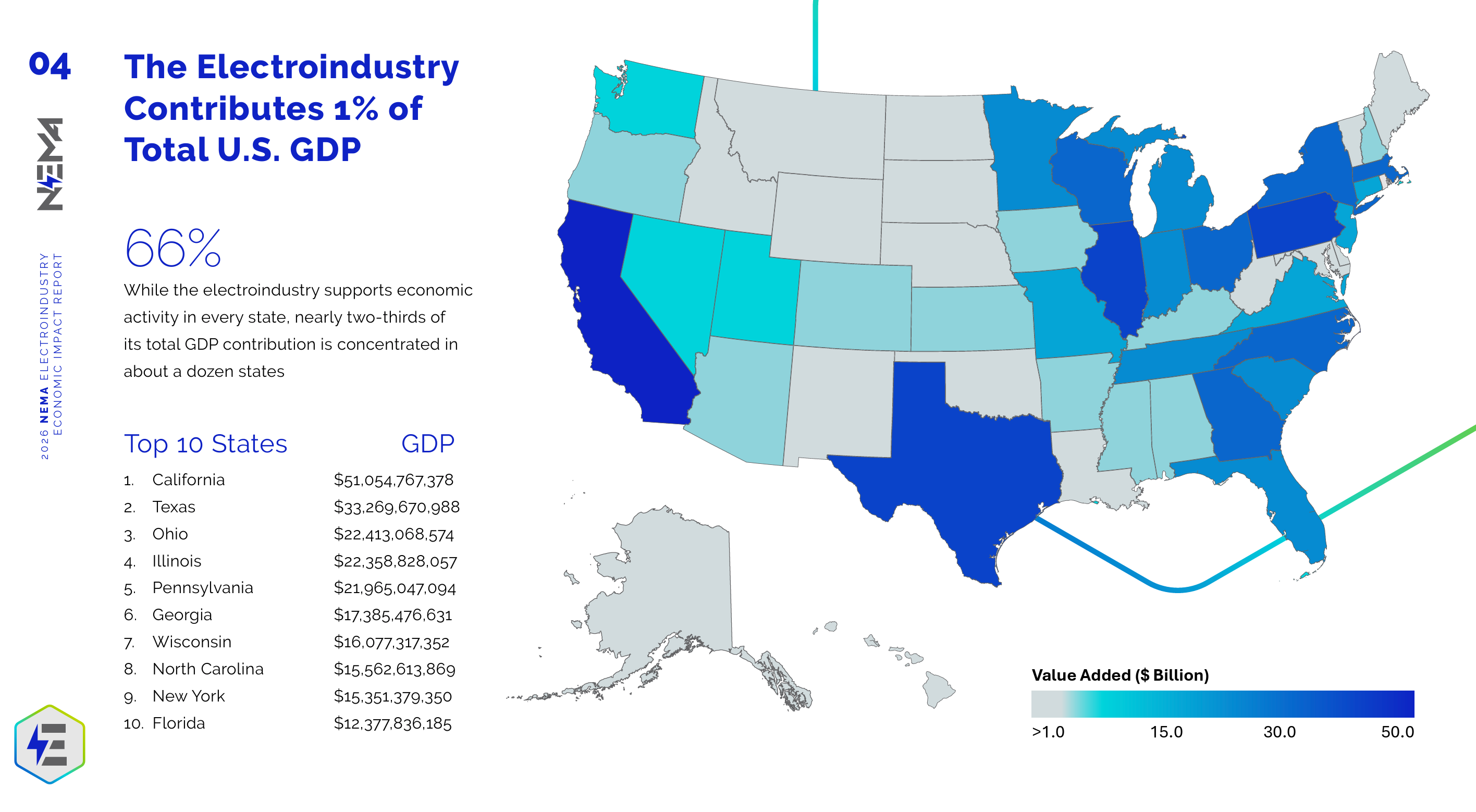
- Nearly two-thirds of its economic contribution is concentrated in only a dozen states.
- California leads both GDP contribution and direct employment, while traditional manufacturing states such as Ohio, Illinois, Pennsylvania and Wisconsin also rank highly.
- Battery manufacturing tops the list on both direct employment and GDP contribution.
- By employment, switchgear and switchboard apparatus, relay and industrial control, and wiring devices follow. By GDP contribution, the order shifts: wiring devices rank second, followed by switchgear and then relays and industrial controls.
Here’s a closer look at what the industry contributes state by state, courtesy of NEMA.