
Build, build, build is the mantra as forecasts emerge about AI’s appetite for energy. How many more power plants do we need? How much transmission will that require? Will we run short causing electricity prices to escalate and maybe even blackouts?
My recent guest on the Energy Changemakers Podcast offers a different perspective. International energy economist Skip Laitner sees slack in the system that needs to be addressed first, a lack of energy productivity.
As Laitner explains, we need to look deeper at the ecosystem, rather than just focus on the economic data.
“If I were a physician and you were my patient, and if I only looked at you using an X-ray, I would not see how healthy you are. But if I use MRIs or CT scans and were able to get a deeper dive into to everything from the blood flow to the way your organs function, as opposed to just your skeleton, I might be able to help you better understand how to maintain and improve your overall health as an individual, but also, in this case, as a community,” Laitner says.
This requires stepping back and understanding the larger picture beyond the market, he says.
“If we understand the metabolism of our economy, not simply the market exchange, but the full metabolism of how we put energy and materials to use, we’re going to be able to do a much better job of maintaining a more robust and more resilient and more prosperous future.”
For example, he looks at how much excess “stuff” we produce — from shoes to parking lots. The sheer mass of human-made materials now likely outweighs all living biomass on Earth, he says.
Laitner isn’t advocating degrowth, but repurposing, reusing, or extending use of products. “If we throw them away, it ends up as really a drain on our economy, a drain on our community well-being.”
When it comes to energy, he champions renewables as a way to increase the system’s productivity. Because solar energy uses a free resource, the sun, as its fuel, it is more productive than power plants that rely on combustible fuels.
“For every kilowatt hour in renewables that we generate, we may be avoiding 1.4, 1.8 kilowatt hours of wasted generation energy, or getting closer to a one-to-one ratio — instead of 2.4, 2.8 units of coal to generate a kilowatt hour,” he says.
Distributed energy also enhances productivity because of its proximity to the energy user — electricity dissipates when traveling long distances over wire.
Laitner likens the efficiency of distributed energy to “biological scaling.”
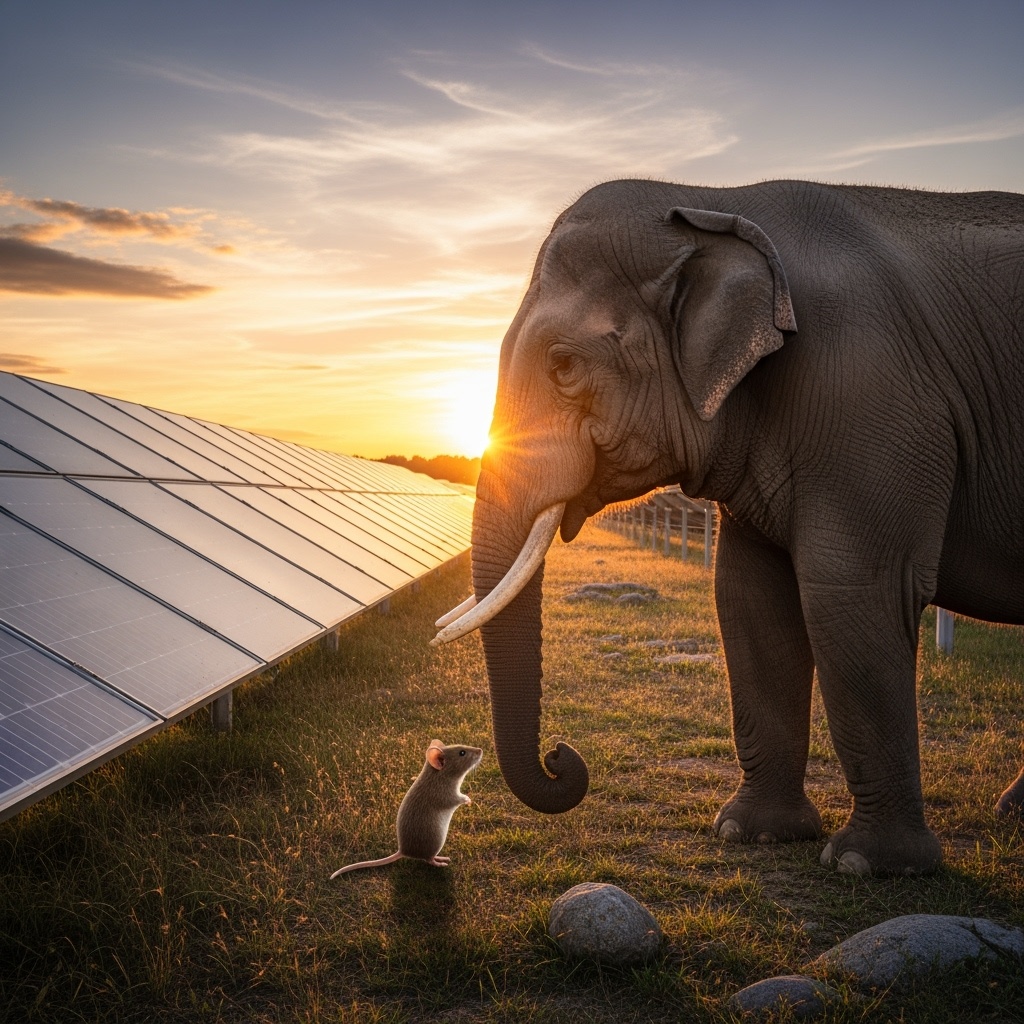
“A mouse that weighs one ounce may require four kilocalories of food per day. An elephant, which may weigh not one ounce, but 192,000 ounces, requires only 0.2 kilocalories of food per day because it has a better nervous system and especially a blood system that is like the distributed energy that we’re talking about here. We more productively get the blood to the tissue where it’s needed,” he says.
Are we heading in the right direction when it comes to energy productivity? The good news is that the Energy Information Administration has been forecasting a decline in the primary energy needed to support the economy by 2050. The bad news is that federal policy could undercut progress because it’s stuck in a 1970s approach, Laitner says, focusing only on energy supply rather than the bigger picture of how to use energy more productively.
This was a rich discussion that took several other turns that may leave you thinking differently about energy. Enjoy the podcast, Less Waste, More Productivity: An Economist’s Take on Our Energy Dilemma.
Follow the Energy Changemakers Podcast by signing up for our free weekly newsletter.