
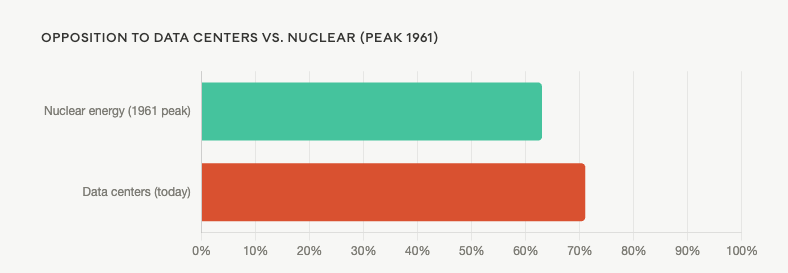
A recent Gallup poll found that a whopping 71% of Americans oppose building data centers in their communities. To put the number in perspective, data centers are less liked than nuclear energy when outcry against it peaked in 1961.
Clearly, data centers face a public relations problem for the ages. And AI’s voracious appetite for electricity is at its center.
In fact, it’s the top concern, according to another poll released this week by Heatmap, which found that half of data center opponents hold them accountable for high electricity prices, up from 28% in August — a big jump in a short time period.
Giving back something tangible
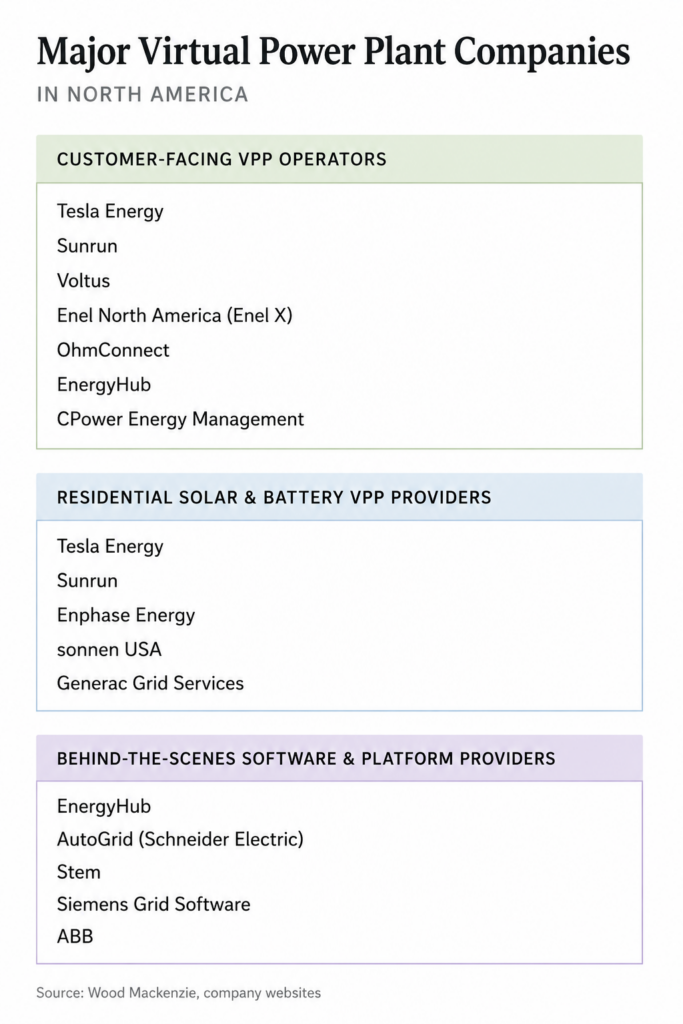
What if instead of promises, data centers gave something tangible back to the community that directly addresses the energy crunch? The recent three-year, 100-MW virtual power plant deal struck between Google and energy company Voltus — and similar proposals — could do that.
Rather than building more power plants or transmission lines, Voltus makes better use of the latent energy in homes and businesses — flexible assets such as batteries, smart thermostats, solar panels, electric vehicles and backup generators to serve the PJM grid.
Aggregating these devices via software into a virtual power plant creates an energy resource that kicks into action when the grid is under strain and electricity prices soar. Batteries discharge. EV charging slows. Onsite power kicks on. The virtual power plant helps stabilize the balance between supply and demand in the same way a physical power plant would, while avoiding the cost and disruption of its construction.
In return for participating in the voluntary program, the household or business receives payment for use of its devices.
So the data center provides two direct benefits to the community through its virtual power plant. First, it offsets some of the electric demand that communities fear is driving up prices. And second, it channels revenue directly to community members.
Adam Scarsella, vice president of digital infrastructure sales at Voltus, describes the concept — and how Voltus’s evolved to provide it — in this Energy Changemakers podcast.
What if tech companies paid for the DERs too?
Other businesses and organizations are pushing a similar approach, some taking it a step further.
Rewiring America proposes that data centers help pay for the solar panels, batteries, heat pumps, or other DERs installed in homes or businesses to form a virtual power plant. That offers yet another — and even more valuable — benefit that could make data centers look more neighborly. Solar panels would be a particularly good peace offering, given that by 89% of Americans like solar.
The same is true for EV ownership — 51% of Americans say they either own or want to own an EV. Price is often a detriment. Here again, tech could step in and offer leasing or purchase discounts to those who agree to participate in VPPs.
Anna Demeo, CEO of Merge4 Energy, says that electric vehicles are a particularly compelling and under-considered resource for virtual power plants.
“While hyperscalers are throwing everything against the wall and seeing what sticks, they may want to take a closer look at electric vehicles to figuratively and literally deliver on speed,” she writes on Energy Changemakers. “EVs represent a vast and distributed pool of storage. Politics aside, the economics are already compelling.”
VPPs are not a panacea, but…
To be clear, we can’t virtual-power-plant our way out of the projected energy crunch brought on by AI. The sheer size of the expected demand precludes it. In 2024 alone, Google used 30.8 million MWh — more than entire countries and double what it consumed four years earlier, according to Cleanview.
And it’s only growing. Google’s parent, Alphabet, plans to spend $185 billion on infrastructure in 2026, much of it on data centers and power infrastructure.
Virtual power plants offer value, but hyperscale AI facilities require additional solutions, particularly AI training centers, as Kay Aikin, CEO of Dynamic Grid, explains in Gigawatt-Scale Data Centers Push the Grid to Its Limits. What’s the Fix?
“There’s a mismatch between how fast VPPs can respond, and how fast the training centers actually affect the grid,” Aikin says.
But Aikin isn’t suggesting virtual power plants be dismissed. “There’s a lot of value in VPPs, but they are not the only solution.”
Growing the model
While the 100 MW Google/Voltus deal may seem large for a distributed energy asset, it’s a fraction of the US virtual power plant potential.
In 2023, the Department of Energy estimated the US could develop 80–160 GW of virtual power plants by 2030, enough to serve 10–20% of peak electricity demand and create $10 billion in annual savings. Wood Mackenzie estimates virtual power plants accounted for about 37.5 GW in North America last year.
If Google and Voltus have their way, data centers will help the US realize this potential. They want their program to serve as a blueprint for other tech companies to adopt.
“This initial phase of our Google partnership is pioneering a model that large load customers can follow, and we expect it to accelerate the role of distributed energy resources as a capacity solution at scale,” said Dana Guernsey, CEO of Voltus.
Virtual power plants won’t resolve every community grievance or exclusively close the gap between soaring AI energy demand and grid capacity. But the underlying logic is sound: if data centers are going to reshape the energy landscape, they ought to leave something tangible in the communities bearing the costs. A check for your battery. A discount on your power bill. Solar on your roof. That’s not charity — it’s an honest accounting. It’s fair. It’s meaningful. It’s a way for data centers to look more like the kinds of business communities would welcome.