
There is nothing like a big storm to make you suddenly change your priorities.
Rory McIlmoil, a researcher with the National Energy Renewable Laboratory (NREL), was on his way to Alaska for a meeting about energy technology innovation when he heard from his wife. The weather had taken a bad turn at his home in Boone, North Carolina.
“We didn’t know the strength of the storm that was about to hit. It was supposed to turn west much earlier, and it didn’t,” he said in a recent interview.
The storm was Hurricane Helene, whose unusual path in late September 2024 demonstrated that hurricanes don’t confine their destruction to coastal regions. More than 100 people died after record rainfall, flooding and mudslides destroyed homes and businesses in the state’s inland Appalachian region.
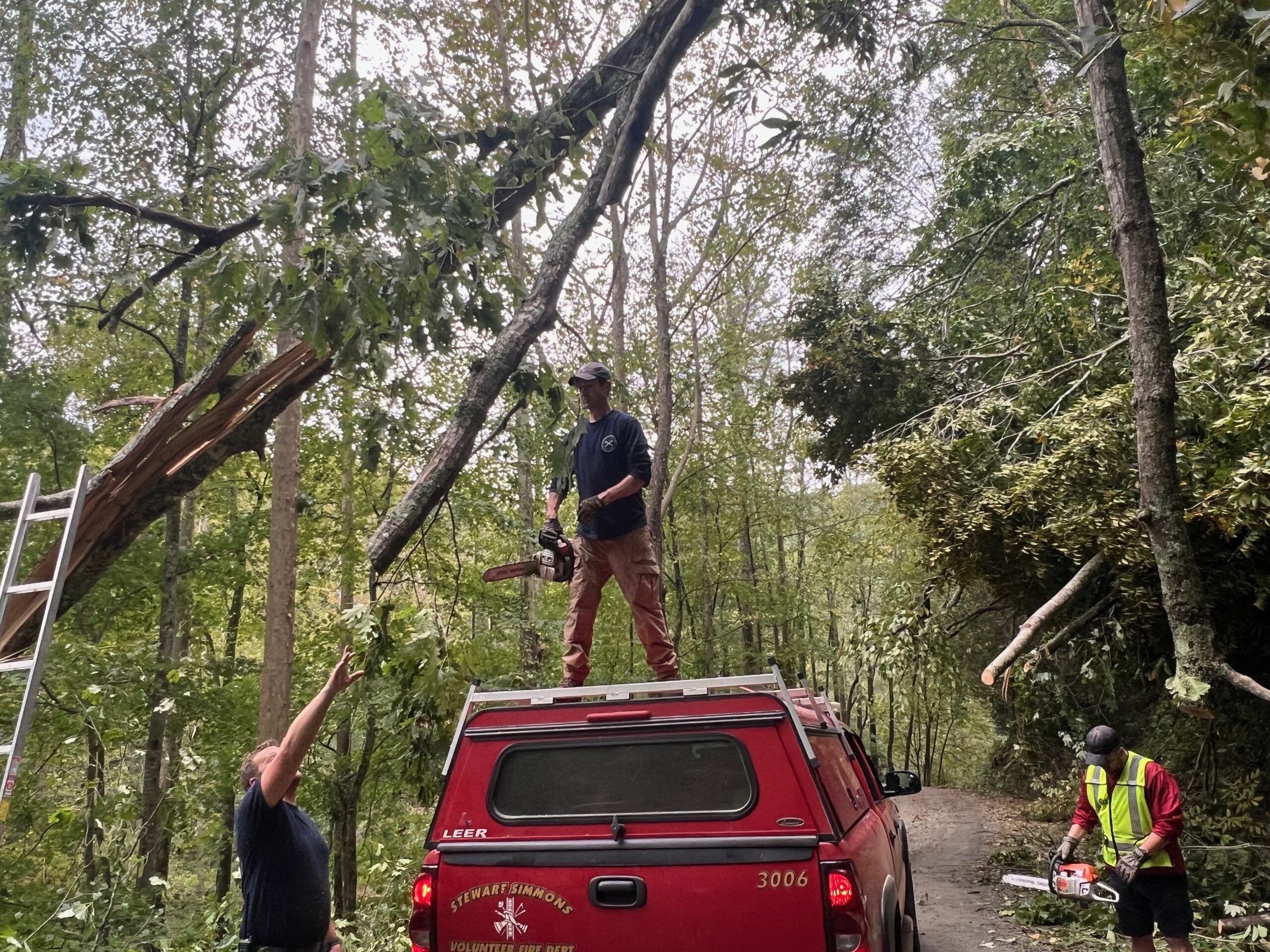
His flight canceled, McIlmoil turned around for home. It was time for him to put on his other hat – that of a local volunteer firefighter.
For the next several days, he cleared trees and undertook other recovery work. The fire station had lost grid power, as did much of the region (in some places for three weeks). The station had a backup diesel generator and became an impromptu resilience center dispensing diapers, flashlights, water, gasoline and other essentials.
But a diesel generator offers limited energy. As he worked, McIlmoil found himself contemplating how much more they could do with consistent microgrid power.
Value of inland community microgrids
He also thought about the slow and arduous process utilities face trying to restore grid power to remote Appalachia.
“We have unique challenges. Power lines go down steep slopes through woods, and they are typically along creeks,” he said. “Utilities have to triage where to focus their efforts in restoring power and fixing power lines and the poles. It’s a complicated and dynamic situation.”
Strategically sited in rural areas, inland community microgrids could relieve some pressure on utilities, allowing them to focus their early efforts on restoring power to more populated areas.
So McIlmoil made a presentation about microgrids to his county’s fire association. The idea spread, and other departments and counties took an interest. That led to the formation of a coalition of regional and local stakeholders that began looking at ways to fund and build stationary and mobile microgrids for critical services.
Subscribe to the free Energy Changemakers Newsletter
In February, the coalition applied for a Department of Energy grant. The proposal includes a full microgrid at the Stewart-Simmons Fire Department, where McIlmoil volunteers, adding batteries to existing solar systems at county facilities and developing and providing mobile microgrids for widespread use. Key organizations working on the resilience effort include Appalachian State University, Appalachian Voices, Footprint Project and Land of Sky Regional Council.
The fate of the $10 million grant, however, is uncertain. Part of the federal Energy Improvements in Rural or Remote Areas program, the grant derives funding through the Inflation Reduction Act, which is being eyed for cuts by Congress.
McIlmoil is also part of second resilience and recovery effort for the region. An NREL team has partnered with FEMA to participate in a broader interagency recovery coordination council focusing on hard-hit hurricane regions, among them North Carolina. Participants include the Department of Agriculture, NOAA, and multiple local, state and federal agencies.
Storms outpacing microgrid development
But the threat of more hurricanes is outpacing microgrid development.
Funding remains a big barrier to getting microgrids built for inland rural areas. Other obstructions exist as well, including a dearth of utility resilience plans that incorporate microgrids. Hence, even with these efforts underway, microgrids are slow to be constructed.
So despite lessons learned and efforts by a broad range of groups, western North Carolina’s electric system remains vulnerable with another hurricane season set to start June 1.
“I think it would be more devastating this time around, just given the fact that we still have debris. Infrastructure has been fixed but not made resilient against future events,” McIlmoil said.
There is still a lot of work to do, including public education.
“We had a fundraising event for a local firefighter family over the weekend. When you’re making coleslaw, you get to talk to people. There are folks who think about solar. They even think about energy efficiency. But they haven’t necessarily thought about what comes next after a hurricane for instance, and how we can strengthen our resilience. Most folks don’t even know what ‘microgrid’ means.”