
Distributed energy gives communities and households a path to energy ownership and value creation. Yet, realizing that energy wealth often remains theoretical, constrained by a lack of practical mechanisms to unlock it.
A novel energy model being developed in Ithaca, New York, could change that.
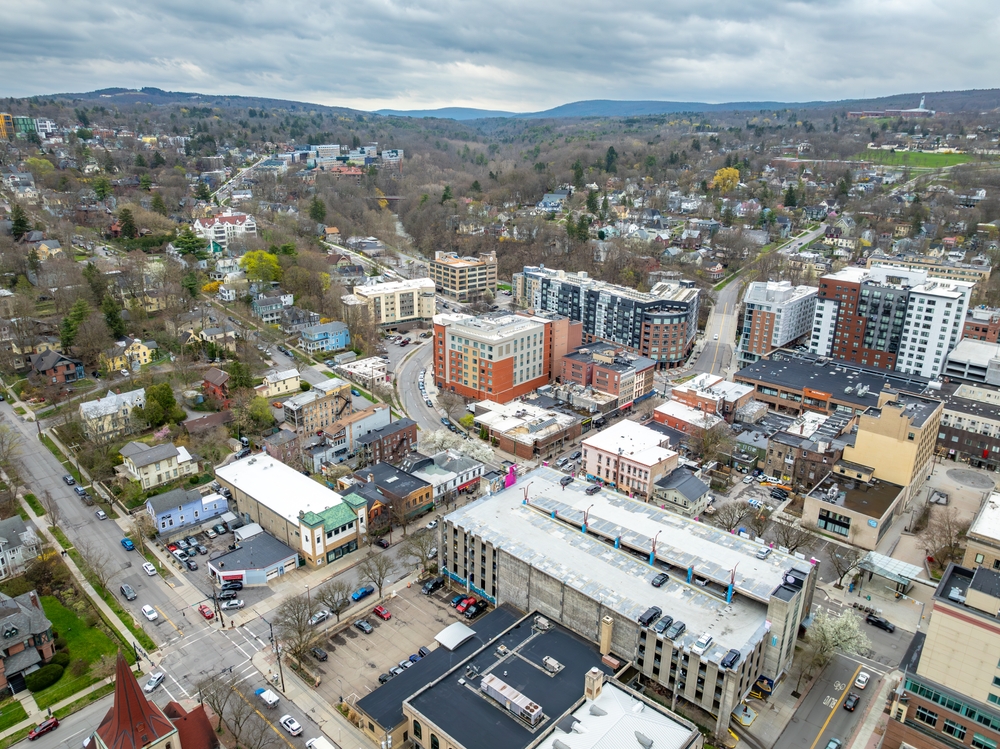
The Ithaca Common Council this week approved its revised Local Distributed Energy Resource (DER) Plan, a strategy to make the city into an independent energy ecosystem that offers dividend-paying DER ownership shares to local residents.
Not a conventional CCA
The plan comes as Ithaca also forms a community choice aggregation (CCA), a model used by about 1,500 U.S. communities that allows local governments to buy energy on residents’ behalf.” What distinguishes Ithaca’s approach is its focus on incentivizing local power and heat to reduce how much energy the city must purchase elsewhere.
Track news about DER innovations. Subscribe to the free Energy Changemakers Newsletter.
The program also does not use typical incentives, such as tax breaks or government grants, to encourage distributed energy development. Instead, the DER plan allows residents, businesses, institutions, and government agencies to take ownership shares in solar, storage, microgrids, thermal loops, and other distributed energy projects developed through the program.
Three ways to participate
Community members may participate in three ways: they can buy power from a distributed energy project, own a direct share of the project (even if it’s not on their property), or do both. Shareholders receive dividends from their DER holdings through distributed energy cooperatives, which consist of building owners and investors.
Savings flow to users and owners by avoiding natural gas, grid electricity, and vehicle fuel costs—offsetting the expense of installing, operating, and managing distributed energy.
Ultimately, the city aims to shift all addressable carbon-based power, heat, transportation, and waste to DERs through this “localization and self-consumption” strategy.
How the idea originated
The Ithaca DER plan is the brainchild of Paul Fenn, owner, founder, and president of Local Power, who has worked on CCA development since the first aggregation formed in Massachusetts in 1997, and later in California’s large and sophisticated CCA environment. Local Power is acting as administer of Ithaca’s CCA and DER programs.
In a recent interview, Fenn said he had grown frustrated with conventional CCAs for their heavy reliance on bulk purchases of renewable energy to meet carbon goals and their limited emphasis on distributed energy and demand reduction.
This led to his conception of a self-contained urban energy system that spares clean energy projects from common roadblocks, such as grid interconnection delays, faltering net metering programs, or on-again, off-again government incentives.
The Ithaca CCA is an opt-out program; residents and businesses are automatically included in the buying aggregation. But the DER program is voluntary – anyone can choose to participate.
Fenn designed the program to include people who can’t easily access DERs—such as renters—offering multiple ways to participate, including shared electric vehicles that double as mobile batteries, plugging in where power is needed. Electric vehicles are particularly flexible energy assets in that they are not subject to utility rights-of-way rules. An electric vehicle can move from place to place to charge or discharge, unencumbered by the restriction. A microgrid, in contrast, cannot typically sell its power to a neighbor across the street.
Next steps for Ithaca DER plan
The program will encompass the city of Ithaca, home to Cornell University, with a population of about 33,000, and an additional 22,000 in the surrounding area known as the town of Ithaca. Other Tompkins County communities may also participate, and the program may open to additional counties.
Through September, the program will educate Ithaca residents via meetings and mailings about the plan and how to participate. Once enough residents enroll, project sites will be selected, agreements finalized, projects engineered, and required approvals secured. Cooperatives will employ vendors, developers and lenders that have been prequalified by the DER administrator via competitive solicitations.
Reducing costs through scale
Fenn hopes that by collecting data, preconceiving projects and bundling like projects, Ithaca can minimize marketing and engineering costs to attract lower-cost competitive bids from developers.
“We’re trying to do some of the work they would normally do,” he said. “We’re hoping for lower cost bids reflecting the work that has been done.”
Doing the early work also takes pressure off energy customers, who often don’t understand which forms of distributed energy are suited for them and will deliver strong returns.
The plan notes how radically different such bundling is to typical DER development.
“Third party DER Vendors are typically siloed by technology, dependent on utility tariffs, and are often either not advanced enough in their technology applications (e.g., stand-alone solar PV), or are prohibitively expensive for many consumers (e.g., solar PV plus a wall battery). Disorganized customers generally lack information to choose or evaluate advanced local renewable energy systems. Disintegrated energy choices in current markets separate decision-making about electricity, heat, transportation, and waste into isolated acts,” according to the plan.
As a result, “disaggregated customers lack market power to achieve project economies of scale, and often cannot afford additional engineering costs associated with more advanced, Interoperable DERs.”
Sharing rather than exporting power
Rather than exporting power to the grid, the system emphasizes energy sharing among neighboring homes and buildings. Sharing may occur in various ways, including with solar on shared circuits, communal use of electric vehicles and chargers, and thermal sharing.
Fenn views energy sharing as a way to broaden participation in the program. “You might be just using hot water or heat, but not power. Or maybe just the vehicles and heat, or just the vehicles. Or maybe you’re in a building that has all of it. It’s all of the above sharing based on what is possible in a location.”
Fenn acknowledges the project is no small effort and will likely take several years to complete. The program’s ultimate goal is to reduce carbon emissions. Building large renewables alone can’t do that, he said, because they require adding more transmission and more spinning reserve to support renewables. In addition, large solar and wind farms can elicit local resistance, especially when they disrupt natural landscapes.
Meanwhile, cities have rooftop space available for solar and other local energy opportunities. They are also “natural redevelopment agencies,” well-versed in the permitting and financing of projects, Fenn said.
The goal is make them aware of this – with Ithaca as an example – to “stimulate the municipal imagination,” he said, so that cities become a force in creating local energy to decarbonize.
The Ithaca DER Plan is available here.