Puerto Rico is the American grid’s cautionary tale. Battered by hurricanes, its aging, undercapitalized electric system is notorious for frequent power outages and high electricity prices.
These problems have forced Puerto Rico to decentralize its grid more quickly than the US mainland. As a result, it offers lessons for the lower 48 states, especially now as they face their own potential supply-and-demand imbalances — not as much from hurricanes and aging, but from the growing energy hunger of data centers.
The island offers a glimpse of a tool that lies in plain sight, ready to help the mainland grid adapt: our homes.
A power outage on the island on June 10 — and its resolution — is a good case in point. Puerto Rico suddenly lost 500 MW, leaving 170,000 utility customers without power.
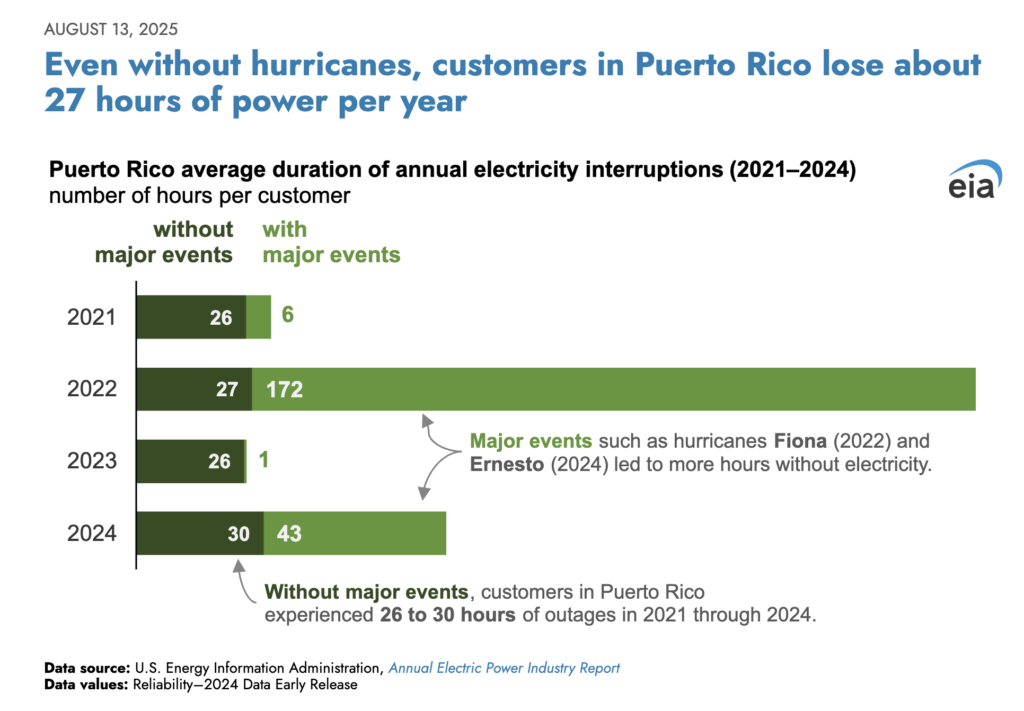
Puerto Ricans are accustomed to grid outages. Hurricanes and major events aside, its households averaged 26 to 30 hours of outages annually from 2021 to 2024. By comparison, US households averaged only two hours per year over that period.
But on June 10, the island’s outage was brief because it tapped into latent energy within households. Sunrun worked with Puerto Rico’s grid operator LUMA to dispatch power from solar and battery systems in more than 33,000 homes. They produced about 30 MW over four-hour dispatches for two consecutive evenings.
Such distributed energy fancywork is becoming more typical on the island. During 2025, Puerto Rico’s utility called on Sunrun’s distributed power plants 48 times. And Sunrun is only one of several aggregators approved by LUMA to offer this service through its Customer Battery Energy Sharing (CBES) program. Others include Tesla, sonnen, Fortress Power, Flip Energy, Virtual Peaker,and SunStrong Management.
Postcard from the future
To be fair, programs like this can be found in some of the states, too. But the mainland hasn’t built a reservoir of household solar and storage anywhere near the proportional size of Puerto Rico’s.
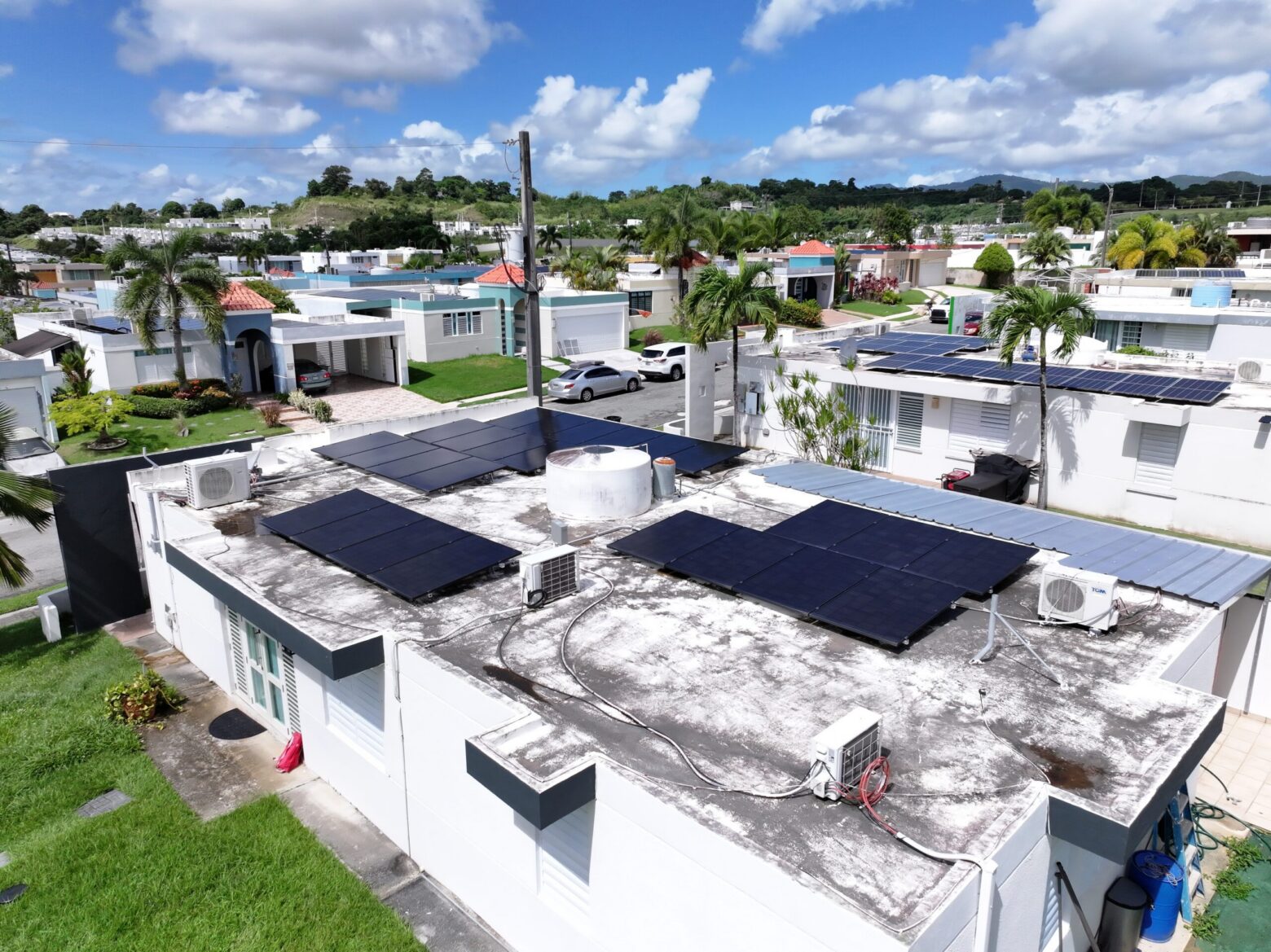
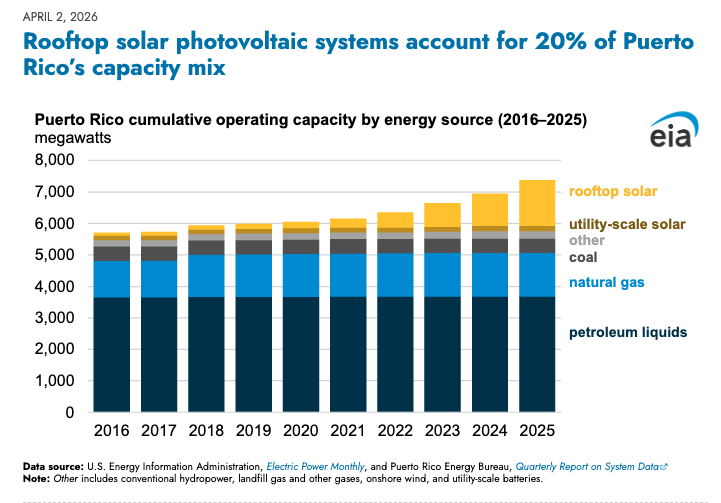
About one in six island households has rooftop solar compared to a US average of one in twenty-six. Rooftop solar accounts for 20% of overall capacity, while the US overall is under rooftop and small scale solar accounts for 4-5%. And Puerto Rico has more than 171,000 distributed battery systems—one of the highest concentrations of residential battery storage anywhere in the United States.
Puerto Rico’s fleet of home power plants makes the island into a postcard for the future, a preview of how distributed energy could reshape electricity systems elsewhere in the United States, says Christopher Rauscher, Sunrun’s head of grid services and electrification.
Billboard of the present
To understand just how deeply energy independence has penetrated Puerto Rican culture, Rauscher offers a comparison: “Fly into San Juan, drive from the airport into Old San Juan — you will see billboards on all the apartment buildings advertising solar and storage. That’s like if flying into Reagan National in D.C. on your way to the Capitol, all you saw were billboards for solar and storage.”
Notably, the Puerto Rico program runs without any federal funding. It’s paid out of the island’s fuel supply fund — the same pot of money used to purchase bunker oil for conventional power plants.
From a customer’s perspective, participation is nearly invisible. Sunrun auto-enrolls customers and allows them to opt out, rather than requiring them to actively sign up, which leads to high participation rates. During a dispatch event, only 20 to 30% of a customer’s battery capacity is drawn upon; the remaining 70 to 80% is held in reserve for home backup power. Every six months, customers receive a payment from Sunrun for their contribution.
“Depending on how many events there are and how much of your battery you pledge, it might be in the dozens of dollars. It might be in the hundreds of dollars that you make off of your solar batteries every year,” Rauscher said.
Household payments for similar programs vary across the US, depending on location, incentives, and program structure.
In Massachusetts, National Grid says customers enrolled in ConnectedSolutions earn an average of $1,200 annually. In California, Pacific Gas & Electric and Sunrun launched a program in 2023 that pays $750 upfront. It also includes a free smart thermostat. Last week, Ava Community Energy in Northern California approved FranklinWH batteries for its SmartHome Battery program. It offers income-qualified homeowners up to $6,000 upfront. This is the highest payment among its California programs.
Not just for the affluent
For years, rooftop solar and storage was seen as a technology for the wealthy. But power purchase agreements have expanded participation across income levels. Instead of requiring customers to buy systems outright, companies like Sunrun own the systems and charge a monthly payment.
“Our customer base never skewed upper income because what we are doing is solving for people all across the income spectrum who don’t have the ability to go out and pay cash for a solar and battery system,” Rauscher said.
That means the distributed resource stabilizing Puerto Rico’s grid increasingly comes from a broad cross-section of the population — not just wealthy early adopters.
Not a virtual power plant
Some would call the Puerto Rico aggregation a virtual power plant (VPP), but Rauscher prefers the term distributed power plant. VPPs often take pressure off the grid by reducing demand — a customer turning down a thermostat, delaying EV charging, or briefly switching off appliances. The distributed power plant does something different.
“We call them distributed power plants to separate ourselves from virtual power plants because there’s nothing virtual about batteries pushing power to the grid to keep the power on,” he said.
When will the postcard arrive?
The mainland is sending signals that it may need to move more quickly toward emulating Puerto Rico. It could be on the verge of losing its status as a wunderkind of reliability and cheap energy.
The North American Electric Reliability Corporation (NERC) has repeatedly warned that electricity demand — driven largely by data centers and electrification — is growing faster than new generation can be added. The US Energy Information Administration says that the nation’s retail electricity prices have increased faster than inflation since 2022 and expects them to continue rising through 2026.
Meanwhile, household solar installations are faltering in the US following the Trump administration’s cancellation of a 30% tax credit. Wood Mackenzie expects solar installations to fall 21% this year. However, they recover beginning next year, albeit slowly through 2031 compared to when the credit was available. Third-party ownership models, rising retail electricity rates, and safe-harbored project pipelines are expected to drive this growth.
Rauscher remains bullish.
“The long-term trend on distributed solar and batteries can’t be denied,” he said. “The economics are there, the customer demand is there. And now with data centers pushing up demand for power on the grid, I think only more and more people are going to be adopting home solar and batteries.”
And there is data to support his optimism. Despite a difficult political climate, solar and storage accounted for 91% of new US generating capacity in the first quarter of 2026. Even the Solar Energy Industries Association, one of its biggest boosters, calls this figure “incredible.” SEIA also notes that 97% of all US solar installations are on homes.
What distinguishes Puerto Rico is not that the model is unique, but that it has reached a level of maturity the mainland has yet to capture. The question for the mainland appears to be not if it will become like Puerto Rico, but whether it will get the postcard from the future via text alert or snail mail — whether political and market forces will move on the opportunity now or wait for real trouble.