
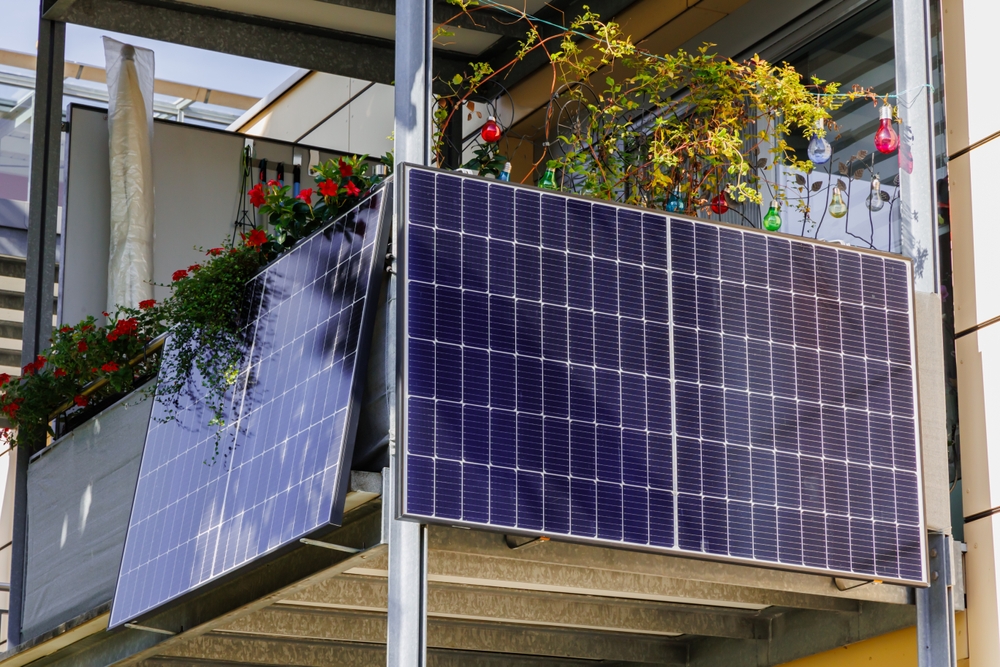
What is plug-in solar? Can households really install it themselves? Is it safe? Is it cost-effective and will it take off in the US as it has in Europe?
State interest indicates it may. Thirty states are considering legislation governing plug-in solar, also called balcony solar. And in the five weeks since we recorded this podcast, three more governors — in Connecticut, Vermont and New Hampshire — signed plug-in solar bills, bringing the total to eight states.
So Americans understandably have questions. I sought answers from a leading voice in the industry: Stephan Scherer, co-founder and CEO of CraftStrom, who spent roughly a decade in the European plug-in solar market before bringing the technology to US households.
Here is what I culled from our conversation. For more details and to learn about technological advancements in plug-in solar, listen to our conversation on Apple, Spotify, Substack, YouTube, or wherever you typically listen to podcasts.
1. What is plug-in solar?
Think of it as the smallest possible rooftop solar system — not necessarily installed on your roof, but maybe in your yard or hanging off your porch or fence.
Plug-in solar systems typically consist of one or two photovoltaic panels, an inverter, mounting hardware and a plug that connects directly to a household outlet. Systems start as small as 200 watts and run up to about 2,000 watts on a single circuit — enough, Scherer said, to offset much of what a five-ton air conditioner draws continuously in a place like Texas.
The system generates electricity during the day and supplies it directly to appliances operating in the home, reducing the amount of electricity purchased from the utility. There is no net metering, no export payment, and — critically — no interconnection agreement, a process that can take months and cost hundreds of dollars for conventional solar.
That’s where the economics come from. Because the customer handles installation and skips the interconnection process, plug-in solar sheds most of the soft costs that burden rooftop solar. Scherer puts traditional US solar at $3 or more per watt installed; plug-in systems can approach $1 per watt. CraftStrom’s smallest 400-watt kit starts at $499. A 2,000-watt system runs about $3,000 — roughly a tenth of a typical rooftop installation.
Several factors came together — and the timeline is instructive for anyone trying to predict the US market.
2. Why has plug-in solar become so popular in Europe?
Austria moved first, taking a serious look at the technology around 2015–2016 after a utility, of all players, began planning to sell the first systems: a tiny 150-watt unit priced at 700 euros. Not economical, Scherer admits, but “the foot in the door that we needed.” Germany followed in 2017, aided by a Fraunhofer Institute study that put the risk of an 800-watt plug-in system on par with a household refrigerator.
The German market, though, didn’t truly take off until 2022, when the Ukraine war sent electricity prices soaring and consumers went looking for control over their bills. Today Scherer counts roughly five million installed systems across Germany and Austria.
For many people, plug-in solar represents their first experience owning renewable energy, making it a gateway to the resource.
3. Can a small system really make a difference?
Not every household needs a large rooftop installation.
Many homes consume a steady amount of electricity throughout the day simply by running refrigerators, internet equipment, computers and other always-on appliances. A plug-in solar system offsets that base load, lowering the bill every day the sun shines.
Scherer argues the small size is a feature, not a flaw. Sizing a system to cover 100% of a home’s usage means paying to cover nighttime consumption and rare spikes — the dryer and oven running at once — which is precisely why a full 10-kW rooftop system costs around $30,000. A plug-in system skips all that and, he says, typically pays for itself in two to five years — or even less than two in California — then keeps producing for another two decades.
The savings compound when people can see their own data. CraftStrom builds Wi-Fi directly into its inverters and sells a companion power meter, and Scherer said customers who report savings as high as 70% get there by pairing solar production with behavior change — running appliances when the panels are producing, and switching off what they don’t need.
4. Is plug-in solar only for apartment residents?
That’s a common misconception — born out of European housing characteristics.
Balconies dominate in Germany, where the technology got its name. American buyers mostly set panels on the ground or mount them on a fence.
Renters can participate, but Scherer is candid about the catch: talk to your landlord first. In Berlin, the city itself is the largest landlord and resisted the technology for years. Still, for households shut out of rooftop solar entirely, he calls it the only viable path in.
5. Is it really safe to plug solar into a wall outlet?
Safety is one of the first questions consumers ask — and the loudest objection on social media is that these systems endanger utility line workers by feeding power into a grid that’s supposed to be dead.
Scherer, who has testified before state legislatures on exactly this question, calls the fear misplaced. Microinverters are certified to anti-islanding standards that require them to shut off within two seconds of detecting a grid outage; in practice, he said, modern units disconnect in far more quickly with an audible click. Across the roughly five million systems in Germany and Austria, he said, there have been no reported incidents. He points to a white paper comparing microinverter safety favorably against diesel generators — which Americans routinely and dangerously back-feed into their homes during outages, and which do have documented deaths.
But Scherer doesn’t wave away safety entirely. His criticism of some new state laws is that they conflate two separate issues: what utilities need to know, and what’s electrically safe. Germany’s 800-watt any-outlet allowance doesn’t translate to the US, where the grid works differently — the safe number here is roughly half that. “To say, okay, just plug 1,200 watts into any circuit, any outlet — that’s not safe,” he told me, particularly in older homes with aging wiring. He points to Colorado’s approach, which creates a safe-harbor category up to 400 watts for any outlet, as the better model.
As with any electrical equipment, the key is to use certified products and follow applicable electrical codes. He notes that UL recently issued a testing outline specifically for plug-in energy systems.
6. Why hasn’t plug-in solar taken off in the United States more quickly?
Technology isn’t the biggest obstacle.
Policy is. Or more precisely: administrative process.
When Scherer and I spoke, five states had enacted plug-in solar laws — Utah first, followed by Colorado, Virginia, Maine and Maryland. Connecticut (June 4), Vermont (June 16) and New Hampshire (early July) have since joined them. New York and New Jersey have passed bills through their legislatures and await gubernatorial action, and roughly 30 statehouses have taken up the issue. Not all succeed; Illinois’ bill failed after opposition from electricians who, in Scherer’s view, hadn’t been adequately informed about the technology.
What these laws actually do is remove the interconnection agreement requirement for small systems — the months-long, fee-laden process designed for rooftop arrays. The safety framework, Scherer argues, already exists in the National Electrical Code and UL standards.
In states without a law, plug-in solar isn’t illegal — it’s just clunkier. CraftStrom sells in all 50 states by configuring its systems for zero export: the system measures household demand and produces only what the home consumes, so nothing flows to the grid. That sidesteps the interconnection question, though it still typically means an email or two to the local utility with certifications in hand.
The state-by-state slog stands in contrast to Europe, where a single federal law applies across the entire continent.
7. Could plug-in solar become a meaningful distributed energy resource?
Viewed one system at a time, plug-in solar appears small. Viewed across hundreds of thousands — or millions — of households, the picture changes dramatically.
Utilities are starting to see it. Scherer said CraftStrom is talking with utilities, including in Canada, about using plug-in technology to relieve stress on aging distribution grids. The company participated in PG&E’s innovation showcase in 2025 — invited not for its solar, but for its plug-in battery.
The logic: deployment accounts for roughly half the cost of a typical home energy storage system, because it requires electricians and installation crews. A battery that plugs into a wall outlet can be deployed in weeks rather than years — which makes recruiting households into virtual power plants far easier.
“Why invest heavily in an aging grid if you can simply have localized smart grids?” Scherer asked.
That doesn’t mean utilities have dropped their guard. Scherer said the pushback now centers on wattage caps written into the new laws and on export visibility. His proposed middle ground: a simple registration — name, address, meter ID, system size — that provides utilities with the load-planning data they legitimately need, without recreating the interconnection process that the laws were written to eliminate.
Plug-in solar may ultimately prove less important because of the electricity generated by any single system than because it expands participation in distributed energy to millions of households that have traditionally been left out. “This is pure democratization of renewable energy,” Scherer said.
8. What’s next?
Scherer says we’ll know plug-in solar has hit the mainstream when mass retailers — he names Costco — start stocking it. Today’s buyers are still first-mover personalities. They have read up on the technology; some are politically active and pushing for laws in their own states. He guesses the mass market is a year or two out.
The German precedent suggests the wait could be short. It took an energy price shock to turn Germany’s 2017 law into 2022’s boom — and US electricity prices are now climbing the way European prices did then. “I remember we were making fun of electricity prices in Europe,” Scherer said. “Well, we’ve reached those now.”
Whether the United States follows Europe’s path will depend on regulation, product availability and consumer education. But one thing seems increasingly clear: plug-in solar has moved beyond being an interesting European experiment.
It’s becoming another example of how distributed energy continues to get smaller, less expensive and easier for ordinary people to adopt.