Virginia Gov. Abigail Spanberger called on state regulators this week to reject the proposed Dominion–NextEra merger unless the combined company prioritizes distributed energy resources (DERs), including energy efficiency.
The request came less than three weeks after the state issued a new energy plan that positions distributed energy as a central resource.
The proposed $67 billion merger of Dominion Energy and Florida-based NextEra Energy, announced in May, would create the nation’s largest regulated electric utility business by market capitalization, serving roughly 10 million customer accounts across Virginia, North Carolina, South Carolina and Florida.
Support our work with a free or paid subscription
The Virginia State Corporation Commission is now reviewing the merger (PUR-2026-00112).
The regulatory proceeding opened a pathway for the governor to apply the state energy plan. As Energy Changemakers reported earlier this month, the plan models Virginia deploying 10 GW of distributed energy resources by 2045.
Customer-sited resources before grid-scale
In the testimony, Richard McCann, representing Spanberger and Chief Energy Officer Josephus Allmond, argued for a utility investment hierarchy often championed by energy efficiency advocates. Energy efficiency becomes the ‘first fuel’ — applied before the utility decides how much power it needs to build or buy — reducing the need for capital investment in new power plants and transmission lines. Spanberger’s recommendation goes a step further by adding distributed energy to the first-fuel mix.
“As a condition of any approval, the commission should direct that Dominion must focus first on implementing energy efficiency measures and facilitating deployment of distributed energy resources to the extent feasible before turning to grid-scale resources,” McCann said. “These resources should have the highest priority for several reasons.”
Those reasons include DERs ability to lower electricity use and bills, provide backup power during outages, create local employment, and reduce exposure to wholesale electricity prices, he said.
McCann argued that conventional analysis often underestimates DER value when it comes to avoided capacity requirements, line losses and exposure to wholesale power prices. The testimony also singled out the ability of DERs to at times avoid or defer transmission spending, noting Dominion’s transmission rates rose by 70% from 2014 to 2026 after adjusting for inflation.
“These resources [DERs] are less expensive than grid-scale generation when all costs are accounted for,’ McCann said.
To boost distributed energy, the testimony calls for:
- Eliminating Virginia’s rooftop solar net-metering cap
- Creating an independent energy efficiency utility
- Establishing a separate generation company to serve large data centers without exposing other customers to its financial risks.
Beyond changing how utilities plan resources, he said the state should develop policies that encourage customers to invest in DERs.
McCann also called for consumer protections and financial conditions on the merger, including:
- A six-year freeze on residential base rates
- $29 in monthly bill credits for residential customers over four years
- Changes to Dominion’s capital structure and cost-allocation methods to reduce customers’ electricity costs.
- Stronger protections against service disconnections for vulnerable households
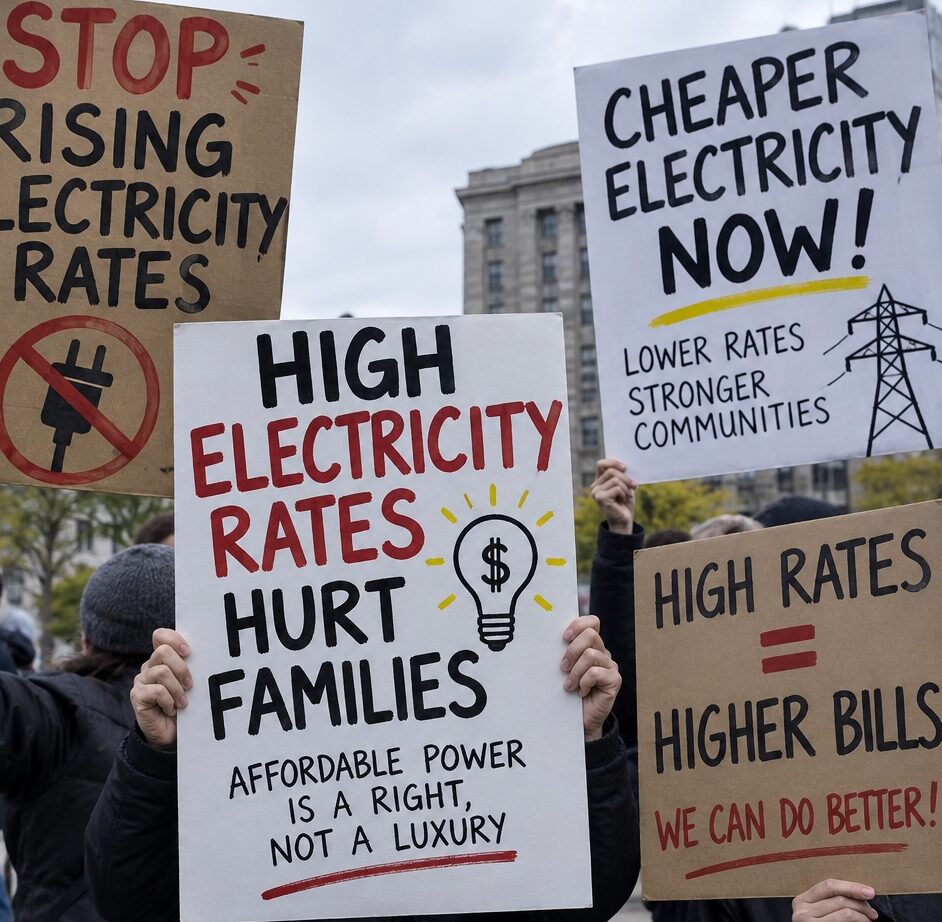
The testimony also sets out several other conditions to the merger, including freezing residential rates. Virginia’s electricity rates have risen 40.1% over five years, and the public is wary of more as the state’s data center boom continues. Dominion, the state’s largest utility, says that 28% of its energy sales came from data centers in 2025.
McCann urged regulators to reject the merger unless the companies substantially addressed these proposals or offered acceptable alternatives.
Google calls DERs “core cost-containment tools”
Support for distributed energy also came from Google, a large electricity consumer in Virginia.
Testifying for Google, economist Carolyn Berry recommended that the merged company establish programs and private-capital investment channels to expand customer access to distributed energy, virtual power plants, demand flexibility, efficiency and community solar.
“Long-term ratepayer affordability in a high-growth electric system requires treating customer-sited programs — including DERs, demand-flexibility, energy efficiency, VPPs, and community solar — as core cost-containment tools,” Berry wrote. She described flexible load and distributed resources as “among the fastest, most modular, and most cost-effective tools available to manage rapid load growth.”
Google’s position in the Virginia merger proceeding is part of a broader effort by the tech giant to use distributed energy to offset the strain data centers place on the grid.
The company has been exploring the virtual power plant concept and this week expanded one it plans to create in PJM by 10-fold to 1070 MW. The original 3-year deal with Voltus had called for a 100-MW virtual power plant.
Under the plan, Google pays homes and businesses to make batteries, smart thermostats and other flexible energy resources available when the grid needs them.
In California, Google is pursuing a similar approach through SHARE, a partnership with PG&E that will help pay for new energy equipment in nearly 500 homes while enrolling almost 21,000 existing flexible devices.
Developers push for seven DER commitments
The Virginia Distributed Solar Alliance filed testimony outlining utility obstructions to distributed energy by competitive developers and seeking remedies as a condition of merger approval.
Anthony Smith, the alliance’s chair and co-founder and CEO of Secure Solar Futures, filed testimony arguing that Dominion’s interconnection requirements have made some smaller solar projects prohibitively expensive.
Smith pointed specifically to direct transfer trip requirements imposed on solar installations between 250 kW and 1 MW. He says the equipment and communications requirements can increase total project costs by 40% or more.
He also reported that new solar capacity installed at Virginia K–12 schools fell 84% between 2023 and 2025.
The alliance laid out seven changes it wants to see as conditions of merger approval, including:
- Modernizing the inverter standard
- Eliminating certain utility-imposed hardware costs on developers
- Setting firm deadlines for utility response to developer applications
- Requiring the utility to adopt a widely used model rulebook for connecting projects
- Making it easier to add energy storage
- Protecting the competitive market by disallowing utility development of solar on public property
- Paying utilities based on performance, not the purchase of hardware
Separately, SCC staff have recommended against approving the merger in its current form, citing financial and business risks associated with NextEra’s unregulated operations.
The companies hope to close the deal in the second half of 2027, pending regulatory approvals from the Federal Energy Regulatory Commission, the Nuclear Regulatory Commission, regulators in North Carolina and South Carolina, and review by federal antitrust authorities.