

Virginia, a state that has become ground zero for data center development, makes a strong case for distributed energy in a new energy plan released Oct. 1 by Gov. Abigail Spanberger.
Positioning distributed energy as a key piece of the answer to Virginia’s power supply crunch — rather than a niche resource — it calls for scaling customer-sited solar, batteries and flexible load. It sets a modeling target of 10 GW of distributed energy aggregated into virtual power plants by 2045, with 5 GW by 2040.
The plan also pushes data centers to become flexible grid participants and help finance distributed resources that can benefit other customers.
“For the first time in Virginia history, a governor is leading with the benefits of a more distributed, local energy system in the Commonwealth’s energy plan,” said Mary Rafferty, executive director of Common Charge, a pro-local energy group.
Support our work as a free or paid subscriber
Virginia is taking a hard look at where to go next as data centers gobble up 31% of its electricity demand — about as much as its households use — and consumers grow uneasy about electric rates that rose 4.6% in 2025.
New kind of energy planning
To create the energy plan, the state upped its game, replacing traditional single-forecast analysis with a “what if?” approach that uses scenario modeling, similar to the way utilities handle capacity expansion planning. Virginia has developed the ability to do the modeling in-house.
The state weighed local energy such as solar and storage, along with nuclear and out-of-state electricity. It also posited scenarios that limit solar and build no new natural gas, all with an eye toward meeting supply requirements, keeping costs in check and reaching net zero by 2050.
Natural gas (41.2%) and imports (30.6%) have dominated the state’s electricity supply in recent years, according to 2024 figures cited in the report. Solar is the fastest-growing resource but accounted for only 4.7% of the state’s electricity.
The plan identifies multiple ways to meet growing electric demand, starting with faster, lower-cost resources — particularly solar, storage, efficiency, distributed energy, demand flexibility and better use of the existing grid. For the longer term, it envisions new nuclear, offshore wind and other clean firm resources.
To increase distributed energy, the plan calls for:
- Modernizing distributed energy interconnection rules
- Enabling aggregation into retail and PJM markets
- Compensating distributed energy for grid services
- Integrating distributed energy and virtual power plants into utility planning and operations
- Steering distributed energy development to brownfields, landfills, abandoned mines, parking lots and warehouse roofs
- Treating customer resources as part of the capacity available to meet peak demand and maintain reliability
Data centers help pay for distributed energy
Virginia pushes for data centers to become flexible grid participants. New facilities could be required to show they can reduce demand during grid emergencies using batteries, flexible computing, backup arrangements, or contracted demand-response resources.
The state wants data centers to finance distributed energy and virtual power plants that lower electricity bills for households, businesses and public facilities. Similar models have been emerging privately.
Data centers would also pay the incremental generation, transmission, and distribution costs they cause, rather than shifting costs to other customers. The plan points toward tariffs similar to Dominion Energy’s new GS-5 structure — a new rate class for customers that demand 25 MW or more — and stronger cost-causation principles.
Natural gas remains part of Virginia’s near-term system, but the plan recommends using existing gas infrastructure more efficiently before building new pipelines.
For data centers specifically, it proposes limiting new behind-the-meter fossil generation and prioritizing non-combustion or zero-carbon bridge technologies such as batteries, fuel cells using lower-carbon fuels, linear generators, and similar resources.
The numbers favor distributed flexibility in the state’s modeling
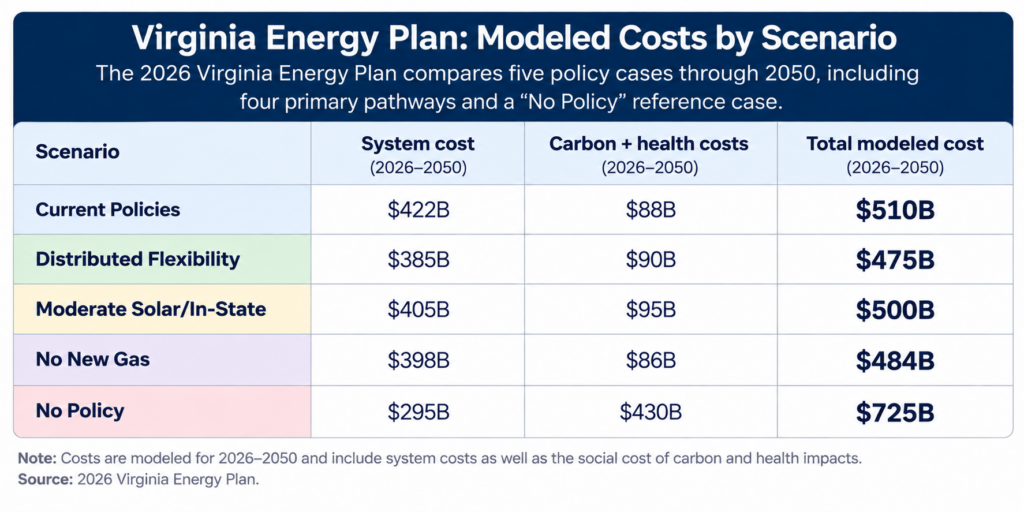
The state looked at five principal pathways:
No Policy — a reference case that drops the state’s Clean Economy Act and withdraws Virginia from the Regional Greenhouse Gas Initiative (RGGI). It has the lowest system cost but nearly doubles emissions over the next 20 years and pushes 2050 emissions above 2005 levels.
Current Policies — the baseline. It assumes Virginia complies with existing law, including the Clean Economy Act and RGGI, with no major new policy changes.
Distributed Flexibility — the most explicitly distributed energy-oriented case. It adds a 10-GW distributed energy target by 2045 (5 GW by 2040), assumes data centers can provide 10% demand flexibility, and considers as much as 5 GW of non-combustion gas resources — such as fuel cells and linear generators.
Distributed Flexibility + Moderate Solar/In-State Priority — starts with the Distributed Flexibility pathway, but reduces utility-scale solar, cuts import capacity by half, and selects more nuclear and offshore wind.
Distributed Flexibility + No New Gas — again starts with Distributed Flexibility but prohibits all new gas generation, including both conventional combustion and non-combustion. It is the only case in which Virginia doesn’t need to expand gas infrastructure.
The Distributed Flexibility pathway cuts direct system costs about 10%, from $422 billion under Current Policies to $385 billion through 2050, largely because reducing peak demand lowers the need for larger centralized resources.
Another important piece is utility regulation. The plan argues that traditional cost-of-service regulation rewards utilities largely for capital investment and says Virginia should consider incentives that reward cost-effective outcomes instead.
Among its recommendations are changes to utility return-on-equity rules, cost allocation, debt/equity structures and potentially performance-based regulation.
The state plans to explore a state-led competitive renewables marketplace to replace the existing utility procurement structure. Utility-owned projects and third-party projects would compete on cost and risk.
Although distributed energy has grown rapidly in Virginia in recent years — 25-fold between 2016 and 2024 for behind-the-meter capacity — the state still trails market leaders. Upping its game will require much greater customer-scale deployment and virtual power plant enrollment, the report says. Obstacles include program caps, interconnection barriers, utility planning and lack of customer compensation.
Praising the plan on LinkedIn, energy entrepreneur Jigar Shah said it takes a “cheaper-by-design rather than clean energy at any cost” approach.
“Grid utilization and DERs aren’t just decarbonization levers, they are specifically identified as the lowest-cost path, and the data-center cost-allocation piece is the mechanism meant to keep that savings from being erased by load growth,” he said.