

The Voice of Distibuted Energy
Menu
  • Stories
    • Distributed Generation
    • Storage & EVs
    • Virtual Power
    • Energy Efficiency
    • Policy
    • Microgrids Now
    • Prosumers
    • Decentralized Grid
  • Podcast
  • Resources
    • White Papers
    • Case Studies
    • Content Services
  • About
  • Newsletter
  • Substack
    • Become a Member
Energy Changemakers
Subscribe
Decentralized Grid

Petition Filed with FERC to Protect Virtual Power Plants from “Death by a Million Pdfs”

Complaint Says DER Companies Face Data Blocking by Utilities in PJM

by Elisa Wood

virtual power plant
Natasa Adzic/Shutterstock.com
October 12, 2025
Share

Voltus and the Mission:data Coalition last week filed a complaint with the Federal Energy Regulatory Commission (FERC) saying that utility data blocking is making it hard to develop virtual power plants within PJM.

Energy Changemakers described the data blocking problem last year in an article “Death by a Million Pdfs: Confusing and Inaccessible Data Delays Virtual Power Plants.”

The data comes from utility smart meters, which eight utilities in PJM spent $5.7 billion to install. Although utility ratepayers and federal taxpayers paid for the smart meters, “the cost-saving benefits to consumers have remained elusive,” according to the filing.
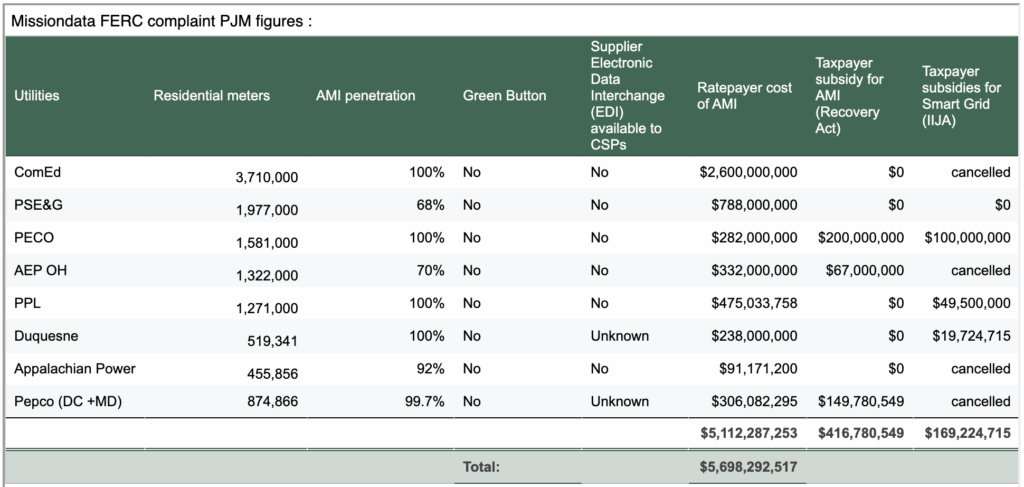
data blocking
Courtesy of Mission:data

The smart meters are collecting the data, but the utilities are not presenting it to distributed energy companies in a “scalable, efficient, and meaningful” manner, according to the filing. Entities like Voltus use the data when forming virtual power plants. (Voltus leverages and aggregates home automation systems and devices to deliver demand response and ancillary services in the PJM region.)

The PJM utilities either do not provide bulk access to hourly interval meter data for thousands of residential customers or do so in a way that is “so impracticable as to in effect amount to an inability to obtain data,” says the filing.

The filing essentially argues that PJM requires virtual power plant operators to provide data that they cannot obtain from utilities. This makes the requirement discriminatory, giving utilities, which do have the data, a competitive advantage as they compete against virtual power plant providers.

Another virtual power plant provider, CPower, tried to bring the problem to the attention of FERC in 2023.  However, the commission denied the petition last year due to a lack of evidence.

So Voltus and Mission-data focused on documenting what they described as “widespread practices of data blocking” at the eight utilities. For example, they allege that:

  • PECO and PEPCO will not provide interval usage data, peak load contribution values, or capacity and energy loss factor values to distributed energy companies, even when the customer consented.
  • Commonwealth Edison limits data requests to 10 accounts at a time and does not provide name, address, account number, or other information necessary to tie a particular customer to usage data.
  • AEP Ohio and Appalachian Power only provide 12 months of interval data for individual customers over email, charge $50 per request, and require a 2-4 week turnaround.

“Today’s complaint should be a wake-up call to state regulators that they cannot wait any longer to mandate data portability,” said Michael Murray, president of the Mission:data Coalition, which advocates for customer-friendly energy data access policies. “By depriving virtual power plants of the data needed to operate, utilities undermine competition and contribute to today’s affordability crisis.”

The filing is available here.

Subscribe to our free weekly newsletter about all things distributed energy.
Subscribe

Top Podcast

energy changemakers podcast

A Complete List of Energy Changemakers Podcasts

The Energy Changemakers Podcast, with host Elisa Wood, is available every other Wednesday on Apple and Spotify.

Latest Resources

2026 Market Survey: Microgrid and Distributed Energy Projects Grow in Complexity

Reports of distributed energy’s demise have been greatly exaggerated, according to a 2025 survey of distributed energy and microgrid industry professionals. When the One Big Beautiful Bill Act became law in July 2025, many industry experts feared solar-heavy distributed energy development would dry up with the loss of federal incentives. While survey respondents (67%) say […]
Ameresco energy allies

Energy Allies: Communities and Utilities Building Resilience Together

This white paper examines how successful partnerships among communities, utilities, and energy service providers can improve the grid and achieve mutually beneficial outcomes.
microgrids as building blocks

Microgrids as a Building Block for Future Grids

This white paper is the fourth in a series of seven white papers in support of the DOE Microgrid R&D Program and presents a broad vision for future grids where microgrids serve as a building block along with technologies that would need to be developed, use case scenarios and the research targets. The DOE Microgrid […]
utility bills

Utility Bills are Rising: PowerLines

New polling by PowerLines, a nonpartisan consumer education nonprofit, reveals the toll of rising utility bills on American energy consumers.

RSS Microgrids Now

  • Microgrids Are a Goldmine for Grid Operators — They Just Don’t Know It
  • What Makes a Community Microgrid Actually Work? Start by Listening, Not Engineering
  • Is Distributed Wind Poised for a Second Act in Virtual Power Plants and Microgrids?
  • Data Centers Are Changing Microgrid Companies. Scale Microgrid’s New Acquisition Offers the Latest Example
  • New Mexico Senate Approves Microgrid Renewable Portfolio Standard Bill
The Voice of Distributred Energy
Learn about grid edge opportunities
Subscribe
Energy Changemakers
Energy Changemakers
600 Twentyninth Place Ct #1055
Charlottesville, VA 22901
elisa@energychangemakers.com
© Wood Energy Writers LLC. All rights reserved.
  • Terms of Service
  • Privacy Policy