

The bridge-to-grid concept started as a workaround for data centers that couldn’t connect to the grid immediately. They chose to install onsite power to bridge the gap until the grid was ready.
That makes sense if the wait is a couple of years. But large-load connections can require transmission and substation upgrades that push wait times to 10 years or longer.
This is causing some data center developers to raise the bridge — stop thinking of onsite power as a temporary solution and instead design for the long term.
How long is the wait really?
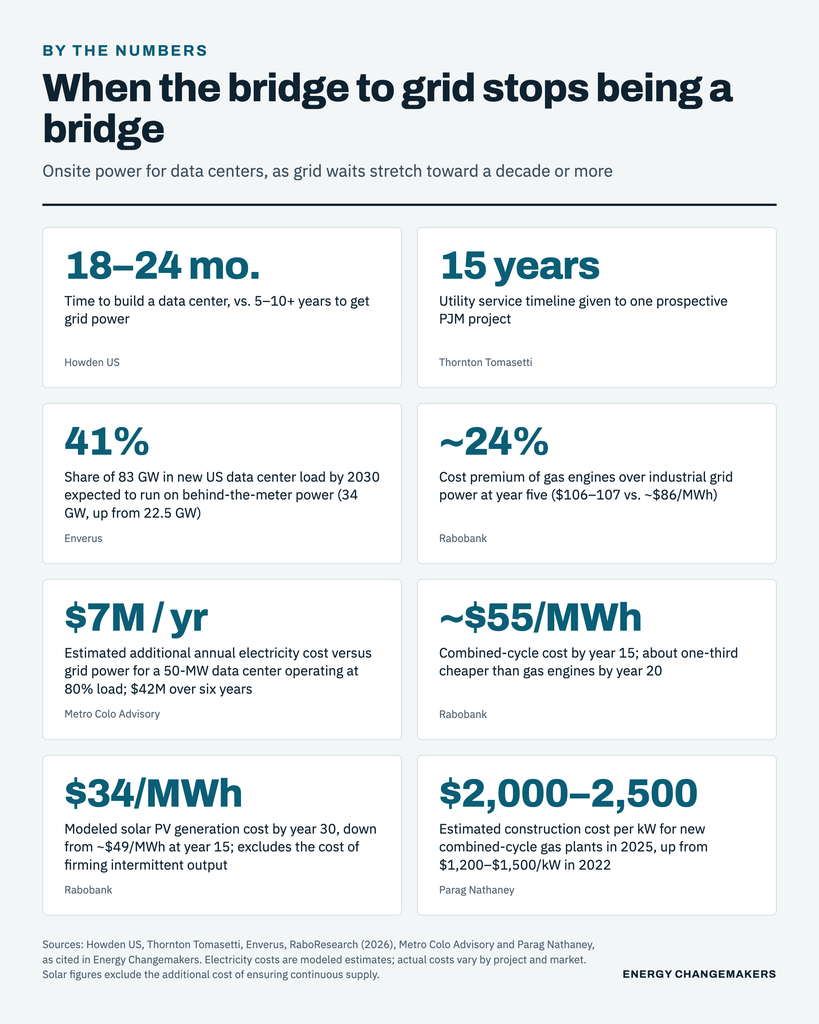
“You can build a data center in 18 to 24 months, but they’re looking at backlogs of five to six to 10 years to get the power,” said Stuart Adam, head of natural resources at global insurer Howden US.
One prospective project in PJM territory was given a 15-year timeline for utility service, according to Emily Kunkel, associate principal at engineering firm Thornton Tomasetti.
Support our work with a free or paid subscription
“I’m not even going to call it bridge to grid,” said Kunkel. Bridge to grid assumes utility service will arrive within about five years, she said. In some cases, the approach becomes “let’s build behind the meter, hope for bridge to grid.”
Faced with these delays, some may abandon the bridge concept entirely.
“We believe going ‘off grid’ will become more common for inference data center and commercial & industrial (C&I) customers,” wrote Morgan Stanley in an Oct. 6 report, Living on the Edge: The Rise of Distributed Power.
While the grid or large independent power plants may remain the best option for mega campuses, the report says distributed energy suits edge computing, a growing approach that processes data closer to where it’s used.
“A bridge is supposed to end,” said James Mercer, principal at Metro Colo Advisory, an independent data center advisory practice. “When the utility date slides past the first five years of a fifteen-year lease, the onsite plant isn’t a bridge anymore. It’s the primary power for a third of the deal, and it should be designed, permitted and contracted that way from day one.”
Mercer also cautions developers to be realistic about when grid power will arrive. “Most sites marketed as ‘powered’ are further from power than the listing suggests,” he said. “A load letter or a queue position is not a date, and the bridge decision should start from what the utility has committed in writing.”
Whether short-term or long-term, onsite power use by data centers is on the rise. Energy intelligence firm Enverus now forecasts that of the 83 GW of new US data center load expected by 2030, 41% (34 GW) will be served by behind-the-meter power, up from 22.5 GW in its earlier forecast. Most of those projects still plan some form of grid connection, according to Enverus senior analyst Alex Nevokshonoff. But fully off-grid data centers, barely discussed a year ago, are now emerging, he says in an upcoming Energy Changemakers podcast.
With the bridge gone, then what?
Redefining an onsite plant as a long-term asset, rather than a short-term bridge, changes its financing, design and engineering requirements — as well as its economic profile. Equipment selected for speed-to-power isn’t necessarily the best choice over many years.
“As you start to look at that 8-15-year timeline, you would really want to change the technology that you’d be using because you’d want that longer-term, more efficient energy,” Kunkel said. This requires layering in different or additional technologies that combine early speed-to-market with a lower price for power delivered later.
Simple-cycle gas turbines and reciprocating engines offer speed. But Kunkel said some developers start with simple-cycle turbines and later add a steam cycle, converting them into a more efficient combined-cycle plant.
Other configurations combine gas generation with batteries, solar or fuel cells. Kunkel considers these fully islandable systems microgrids, even at hundreds of megawatts.”It’s a macro microgrid,” she said.
Batteries help manage rapid changes in AI power demand while letting generators run more steadily.
The economics change with time
A developer expecting to operate onsite generation for two or three years might accept higher electricity costs in exchange for faster market entry. But costs can accumulate when a two-year bridge morphs into a 10-year power strategy.
A Rabobank analysis finds that gas reciprocating engines and aeroderivative turbines carry a structural cost penalty over long periods, largely because continuous use triggers major overhauls and rebuilds about once a decade. Five years into operation, they produce electricity at an estimated $106 to $107/MWh, compared with roughly $86/MWh for average industrial grid power — a premium of about 24%. Costs dip in later years, then jump again when rebuilds come due, according to the analysis.
Combined-cycle plants follow a different path. Rabobank finds their costs fall to roughly $55/MWh by year 15, and by year 20 they cost about one-third less than gas engines, which supports Kunkel’s case for changing technology as the timeline stretches.
Metro Colo Advisory calculated what the gas-engine premium means for a 50-MW data center running at an 80% load factor:
“On a 50 MW campus, the gap between on-site gas and grid power is about seven million dollars a year. For two years, that is the price of speed. For six years it is forty-two million dollars, and it deserves the same engineering scrutiny as the building,” Mercer said.
Those figures are illustrative, not a project-specific forecast. Actual costs depend on fuel contracts, equipment selection, financing, and utility rates. And they don’t account for the value of getting expensive AI computing equipment operating years earlier.
The Rabobank analysis also points out that renewable energy faces no long-term fuel constraint and becomes more valuable over time. Solar PV reaches roughly $49/MWh at year 15 and $34/MWh by year 30. Renewables offer the most favorable long-run cost trajectory, the report says, but data centers also require firm generation or grid supply to meet the reliability needs, says the report.
The move toward renewables may accelerate over time. “Hyperscalers have very public decarbonization objectives; thus far, they have been willing to accept gas generation technology as a means to gain speed. Over the longer term, the expectation may be to incorporate greener technology,” Kunkel said.
Operating a power plant is different from owning backup generators
Running onsite generation for years rather than months also changes operational requirements.
Maxwell Spaeth, director of business development, U.S., at Equans Services, said operators should consider long-term fuel contracts, redundancy, maintenance, environmental permitting and emissions compliance, and future capacity needs.
Equipment may need more frequent servicing and inspection if it was designed for emergency backup but is used frequently instead.
Securing fuel also becomes a bigger challenge, since gas pipelines face their own development delays.
Kunkel said independent power developers and landowners are increasingly assembling these projects, offering data centers land, natural gas access and power purchase agreements.
What happens when the grid finally arrives?
Data centers also need to plan what they will do with the onsite energy system when the grid finally arrives.
“Do I maintain my power purchase agreement with this new behind-the-meter power plant, or do I just go back to a traditional grid operator?” Kunkel asked.
A data center might continue buying onsite electricity, retain the plant for backup or sell its output into wholesale markets once utility service arrives.
Kunkel said efficiency matters particularly in that last scenario. An inefficient simple-cycle plant built for speed could struggle to compete in wholesale markets, while a more efficient plant could have a longer economic life.
Owners are also considering how these assets might eventually support peak shaving, resilience or campus expansion, making them more useful over the long term, according to Babatunde Ukwu, business development director for energy and industrial at Equans Services, an energy and facilities services company.
Is the grid moving further out of reach?
The gap isn’t likely to close soon between data center demand and the grid’s ability to serve it. Utilities face a parts problem. Equipment to expand the grid is in short supply and getting more expensive.
Parag Nathaney, a utility engineer and power market analyst, cited a rise in new gas combined-cycle costs from 1,200–1,500/kW in 2022 to 2,000–2,500/kW in 2025, and order reservations for new equipment, like gas turbines and transformers, extending through 2030–2032.
State and federal policy swings and market design changes that discourage investors compound the problem, he said. Meanwhile, data center construction, behind-the-meter generation for hyperscalers, and tax-credit-backed battery projects compete for the capital and developers that might otherwise build grid-connected generation.
Another wrinkle: If more data centers pursue self-supply, it could complicate transmission planning, which relies on forecasts of where grid-served demand will appear. Onsite plants that also send power to the grid could change the system’s topology and require closer coordination between utilities and data centers. One option, Nathaney suggested, is for utilities to steer data centers to grid nodes with spare capacity. Utilities could even auction that headroom, much as they sell pipeline capacity, to ease interconnection and planning delays.
For now, the question is whether onsite power becomes a permanent fixture of data center development or continues to act as a workaround until the grid catches up.
“One of the major issues with the long grid interconnection delay is that it is impossible to predict what will be at the other end of the wire 10 years from now. To mitigate this risk, utility and data center operators should agree on a go/no-go timeline as an inflection point for diminishing returns,” Kunkel said.