
Sometimes it takes an outsider to spot a good business opportunity.
Such is the case with Adam Zucker, who spent his career not in energy but in New York City real estate — asset management, finance, law, development, property management, and commercial sales.
Energy was mostly a “theme humming in the background,” he said during a recent interview.
Then, in 2019, two laws changed the way he viewed New York City’s apartment buildings.
The first was the state’s overhaul of rent regulation, which eliminated most of the paths owners had used to move apartments out of rent stabilization and into the free market. At the time, Zucker led a commercial sales and investment advisory practice serving international investors. He watched demand implode, as values fell.
The second was Local Law 97, which required large buildings to cut their greenhouse gas emissions.
To Zucker, it was well-intended policy aimed at the wrong stakeholders. Landlords know buildings, rents and roofs. Decarbonization is another thing entirely. They are unlikely to know what technology to install, how to finance it, and who to trust to do the work. And all of this arrived when many of them had little capacity to pay for it.
The hum got louder.
New York City landlords had a problem that Zucker thought he could fix. Seventy-three apartment buildings later, he has brought his idea to fruition.
Building tenant, not solar contractor
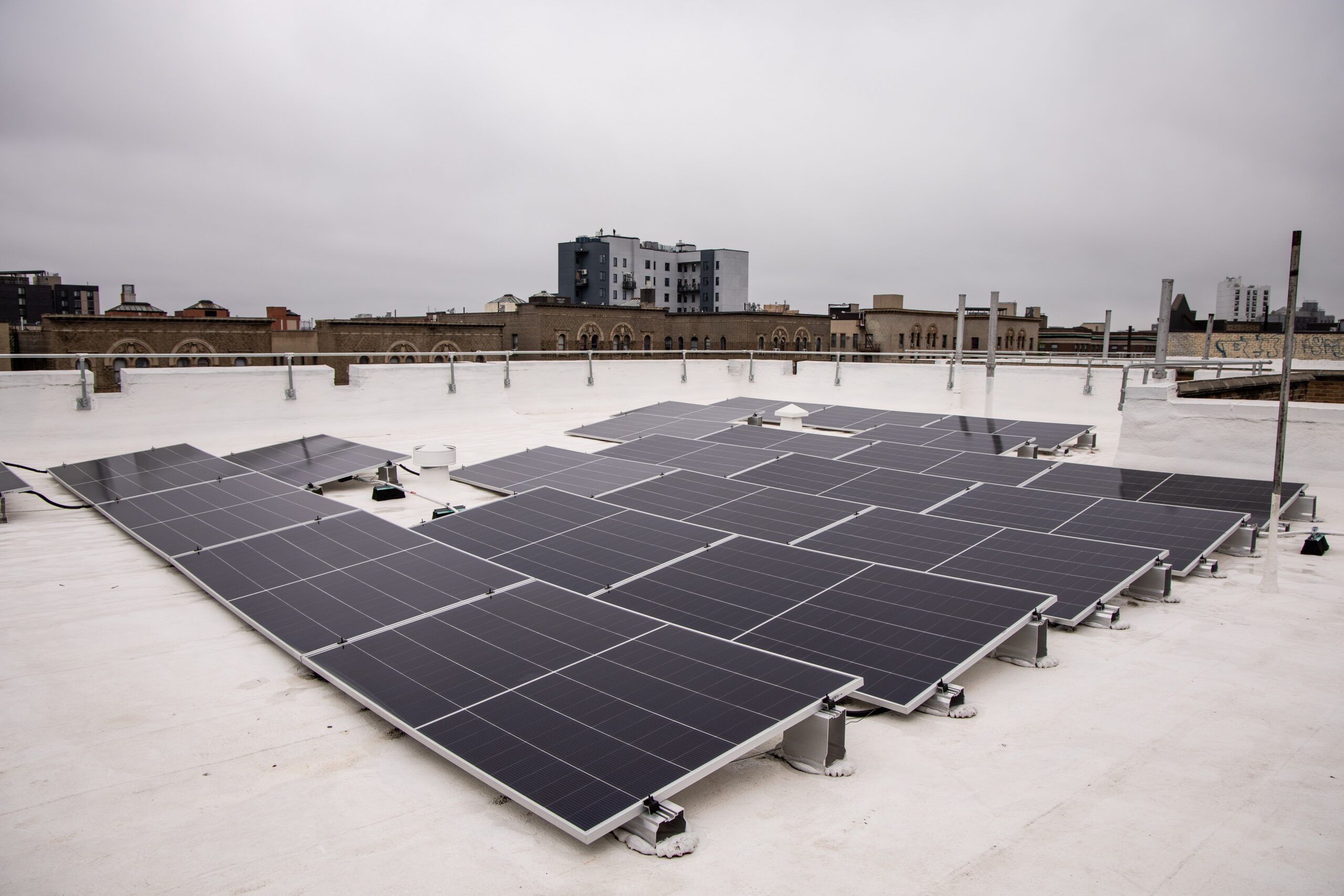
Fieldston Power, which Zucker cofounded with Alex Weisberg in 2024, leases rooftop space on predominantly rent-stabilized and rent-controlled multifamily buildings, rehabilitates the roofs and installs solar.
Fieldston finances and owns the energy infrastructure and remains responsible for the solar installation and the roof under a 25-year lease. The landlord acts as host.
“We take over everything,” Zucker said. “The burden, the cost, the responsibility, the maintenance, the figuring it out, everything.”
The approach differs from one in which a building owner hires a solar contractor, finances a system and then takes responsibility for the asset. Fieldston becomes a long-term energy tenant instead.
That allows Fieldston to aggregate small urban rooftops into investable portfolios.
$20 million of community solar built one roof at a time
The company’s first portfolio across 73 apartment buildings produces about 3.3 MW in the Bronx, Brooklyn, Queens and Manhattan. Zucker valued it at about $20 million.
Fieldston structured the installations as community solar projects, which allows their savings to be shared more broadly. Electric customers throughout Con Edison’s service territory can subscribe to the program. A subscriber in Brooklyn, for example, can receive credits from a community solar system in the Bronx.
Each building acts as its own community solar project with its own subscribers.
The rooftops aren’t the expansive structures that typically attract commercial solar developers. They tend to be 80- to 100-year-old apartment buildings with 30 to 120 units and 5,000 to 8,000 square feet of roof space, often in need of repair.
That’s part of the opportunity Zucker believes others have missed.
“What we’ve unlocked is the ability to make significant impact at scale by aggregating lots of smaller rooftops that are often overlooked by the C&I or utility industry,” he said.
You may also like to read: It’s the Chief Accountant — Not Just Environmentalists — Calling for Local Energy in New York City
Solve the landlord’s problem first
The more interesting part of the model is what Fieldston Power is selling to the building owner: relief from the cost and complexity of both an aging roof and complying with New York City’s decarbonization law.
Zucker said many landlords had already considered solar before Fieldston approached them. Some had even tried working with engineering, procurement and construction companies, only to find the process difficult and the installations poorly suited to older buildings.
Fieldston begins with what Zucker calls a wholesale cosmetic rehabilitation of the roof. The company identifies pockets of moisture and instability, remediates them and applies a fluid-applied membrane carrying a 20-year warranty. Then it assumes responsibility for maintaining the roof.
Landlords, Zucker said, are “always thinking about the roof.” Under the Fieldston model, “that’s now transferred to us as a tenant over the 25 years of our lease. We’re obligated to maintain it.”
In other words, Fieldston isn’t asking the property owner to take on another unfamiliar asset. It’s taking an existing problem off the owner’s hands.
The building owner also gets help complying with Local Law 97 and access to discounted electricity for the building’s common-area meter.
How the money works
The systems are front-of-the-meter. Fieldston receives bill credits from Con Edison and monetizes them through community solar subscriptions.
Under the current structure, 60% of the electricity is allocated to qualified low-income customers in Con Edison’s service territory at a 20% discount. Fieldston uses a community subscription management company to identify, qualify and enroll those subscribers. According to information supplied by Fieldston, the arrangement translates to approximately 550 households receiving roughly 20% savings on the electricity supply portion of their Con Edison bills.
The other 40% is offered to the host buildings for their house meters — which cover loads such as common-area lighting — at a 5% discount.
Zucker said the projects receive grants from the New York State Energy and Development Authority (NYSERDA) and participate in New York’s Inclusive Community Solar Adder program. Fieldston finances construction with sponsor equity and construction debt, then refinances using a combination that includes federal investment tax credits, New York State grants and permanent debt. Long-term revenue comes from monetizing the Con Edison bill credits through subscriptions.
Fieldston’s projects qualify for a 60% federal investment tax credit — the 30% base credit plus a 10% adder for domestic content and a 20% adder for serving low-income subscribers.
The cell-tower model, reworked for distributed energy
“We’re not EPCs, we’re not installers, we’re not an NTP flip developer,” Zucker said, referring in the last case to developers that sell projects once they reach the notice-to-proceed stage.
But they are somewhat like another entity landlords understand. The cell carrier company that takes a corner of the roof, signs a lease and sends a check for a few thousand dollars.
That relationship has pitfalls that Fieldston’s model worked to avoid.
What owners often discover later, Zucker said, is that the carrier has subleased its real estate interest to one, two or five parties operating below the landlord’s purview. And that the installation crews ran what he described as a rat’s maze of conduit across the roof, cannibalizing the roof, the facade and sometimes the electric room with work he called shoddy at best. When a leak turns up years afterward, the landlord is working a publicly traded company’s phone tree, trying to find out which subcontractor to call.
Fieldston offers a similar lease structure and hires contractors to do the installations. But it doesn’t hand the landlord off to those contractors afterward.
“I’m the tenant responsible for the space,” Zucker said.
That means the landlord has someone to rely on to ensure the solar array performs correctly or fix a leaky roof.
Zucker said Fieldston’s initial foothold would not have been viable without incentives at the city, state and federal levels. But he ranks the landlord relationship above them.
“More important than that, in many ways, is the relationship and trust that we engender with our landlords as a long-term tenant,” he said. When something goes wrong, the owner calls him directly.
From 73 rooftops to 1,000
Fieldston isn’t treating the first 73 projects as a one-off portfolio.
Zucker said the company has expanded its pipeline to roughly 10 to 12 times the size of the original portfolio and safe-harbored equipment that it expects will allow it to continue construction through 2030.
“We’re going to be building distributed solar on a thousand rooftops in the next two years,” Zucker said. “And there’s no reason we can’t, a hundred X that if we have the right capital and public policy understanding going forward.”
For now, the company remains focused on New York City. However, Zucker sees potential in Westchester County, Long Island, northern New Jersey and eventually other cities where its landlord clients own property.
Fieldston is also looking at distributed battery storage. Zucker sees an even larger potential market there because a building that isn’t well suited for solar may still have a place for storage.
“We believe that storage can be installed on every single building or roof,” he said.
Whether Fieldston reaches 1,000 rooftops — or even more — remains to be seen. But the first buildings say something useful about the advantage of distributed energy. Scale doesn’t necessarily require big projects. It comes from finding a business model that makes many small projects worth doing.
And sometimes it takes someone from outside the energy business to pursue it.