
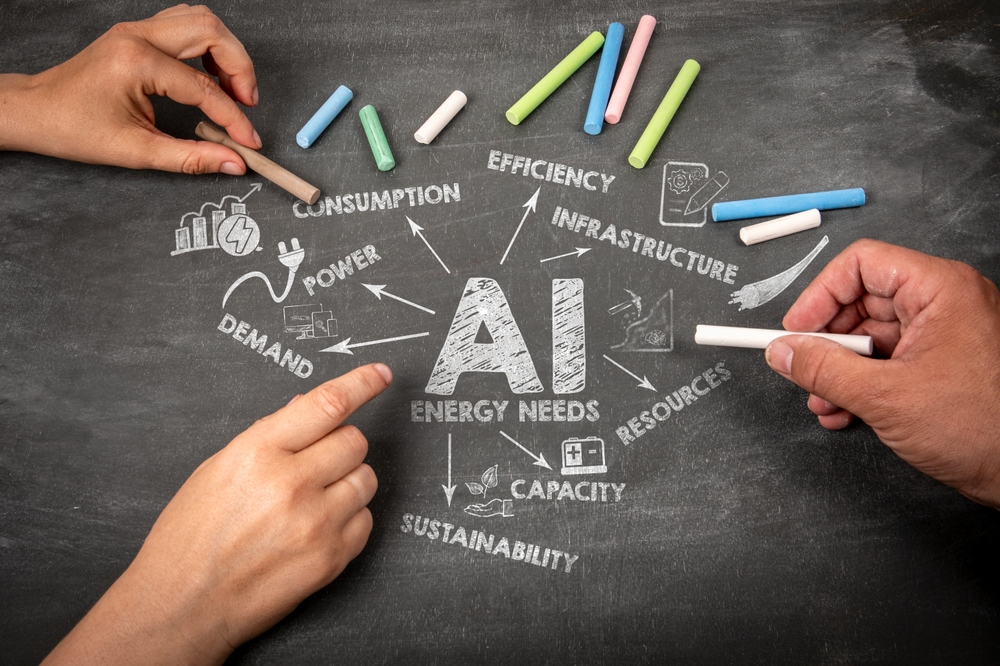
Depending on which side of the debate you’re on, AI is either going to break the grid or save it. Jeff Willert, Director of Data Science for SE Advisory Services at Schneider Electric, has a different take: both camps are arguing about the two ends of a distribution and skipping the “missing middle,” where purpose-built, right-sized AI is already doing real work.
In this episode, host Elisa Wood and Jeff unpack what “frugal AI” actually means, why it starts with asking whether you need AI at all, how to judge AI’s carbon cost against its benefits, and why efficiency alone won’t settle the data center debate. It’s a practical, jargon-friendly conversation, with a bonus segment on how Schneider breaks AI workflows into steps instead of routing them to bigger or smaller models.
Key takeaways
- The debate is missing the middle. “AI breaks the grid” and “AI saves the grid” both focus on extremes: energy-hungry consumer chatbots on one side, efficiency miracles on the other. In between sit purpose-built agentic systems built for a specific decision or workflow, with very different energy and climate profiles. Jeff notes that agentic usage overtook human usage in 2026, so much of the growth is automated business processes, not people typing into chatbots.
- Frugal is not the same as efficient. Efficiency means doing what you’re already doing with less energy. Frugality starts one step earlier and asks whether you need a model at all. In Jeff’s words, frugal AI is “about matching the size of the tool to the size of the job.” Sometimes that’s a frontier LLM, sometimes a small language model, and sometimes a lookup table, a decision tree, or basic statistics. There’s even a published French national standard for frugal AI, and its first test is demonstrating that AI is necessary in the first place.
- Scale comes from business processes, not personal prompts. Schneider’s platform handles about a million energy invoices a month for clients, extracting data from PDFs and images for use in procurement, sustainability, and efficiency decisions. Jeff says a single agent request can carry roughly 15 times the tokens of a human chat, so individual restraint is “just a drop in a very large ocean.” (Good news for anyone feeling guilty about booking travel with ChatGPT.)
- Measure impact per watt, not compute per token. Nobody buys tokens; they buy outcomes. A lean agent that finds a 1–5% efficiency gain across a global manufacturing fleet can avoid thousands of tons of CO2, while the inference itself is measured in kilowatt-hours and, at most, kilograms. AI’s own emissions still count, but the comparison belongs on benefit delivered per unit of energy.
- Smaller models are catching up fast. On the artificial analysis intelligence scale, the original ChatGPT scored roughly a 9 about three years ago. Models small enough to run on a laptop or phone now perform at comparable levels. Jeff treats benchmark scores as a directional indicator, not a guarantee of fit for your use case.
- Trust comes from audit trails and deterministic math. Resource Advisor Plus stores every agent’s reasoning, tool choices, inputs, and outputs so users can validate answers rather than take them for granted. And where a calculator will do, that’s what Schneider uses: calculations stay deterministic, not handed to an LLM.
- Efficiency can raise demand. Jeff isn’t confident in the data center demand forecasts, noting the Jevons paradox: as AI gets cheaper and more capable, people will want more of it. That’s why he argues for the frugal principle as a discipline, not a one-time fix.
- Efficiency won’t win over communities. Asked whether the frugal argument will land at town hall, Jeff is candid: residents are asking about electricity rates, water, noise, land, and traffic, not intelligence per parameter. He says he can’t answer whether we need all the forecasted data centers, but he’s committed to not increasing demand more than necessary.
- Distributed compute is a natural partner. Small compute nodes, the size of a desktop or mini fridge, can run the smaller models frugal AI favors, powered by low-carbon energy and without adding grid strain. Jeff sees a “nice parallel” with pilots like Sunrun’s, though he wasn’t familiar with that specific program.
- Advice for sustainability leads. Point AI at the right problem. If your emissions inventory takes nine months, it’s stale on arrival and leaves no time for decarbonization. Small open-source models can help compress that to one month. Use procurement as your fastest lever, and ask vendors what tasks their AI solves, which models they use, and whether they run on low-carbon electricity. As Jeff puts it, if a vendor can’t say what decision their AI helps change, “they’re probably selling a demo.”
- Five-year outlook. If frugal AI succeeds, Jeff hopes compute stops behaving like a fixed industrial load and becomes a flexible, schedulable grid resource. Frugal AI won’t make data centers more efficient on its own, but it can change the demand signal.
About the guest
Jeff Willert is Director of Data Science for SE Advisory Services, Schneider Electric’s global consulting arm. He leads the team behind the AI in Resource Advisor Plus (RA+), the enterprise energy and sustainability platform, including its conversational assistant, Sarah, and has grown the team from two people to more than 20 over seven years. An applied mathematician by training, he holds a PhD from North Carolina State University, worked in computational physics at Los Alamos National Laboratory, and then did modeling and simulation work for the U.S. government in Washington, DC. His doctoral thesis on hybrid deterministic Monte Carlo methods for nuclear reactor modeling carried an idea that still drives his work: pair cheap models with expensive ones and pay for the expensive part only where you need it. He is the author of the paper The Missing Middle in the AI Energy Debate.
In this episode
- [00:00] Cold open: is AI going to break the grid or save it?
- [01:09] Meet Jeff Willert: from nuclear reactor modeling to Schneider Electric’s AI team
- [03:29] Grid killer or efficiency win? The “missing middle” and the rise of agentic AI
- [07:31] What is frugal AI? Right-sizing the tool, frontier models explained, and the French standard
- [11:23] Chatbots, Google, and everyday use: should you feel guilty?
- [13:13] Benchmarks and intelligence scores: how much do they matter?
- [15:30] Impact per watt vs. compute per token
- [18:28] How AI cuts carbon: comparing decarbonization levers and mapping Scope 3
- [21:08] A word on the Energy Changemakers newsletter
- [22:09] Trusting AI: audit trails, deterministic math, and managing agents like employees
- [24:40] Forecasts, Jevons paradox, and the rebound effect
- [27:08] Making “frugal AI” verifiable, not just marketing
- [29:02] Data center backlash and community concerns
- [30:40] Distributed compute and Sunrun’s home compute pilot
- [32:21] Advice for sustainability leads: fix the data bottleneck, ask vendors the right questions
- [34:15] Five years out: compute as a flexible grid resource
- [35:45] Bonus: breaking workflows into steps (”Plan Then Act”) instead of routing to models
Memorable quotes
“I’m actually happy when I get to solve a problem without AI.” — Jeff Willert
“What is the cheapest computation that still gets me the right answer?” — Jeff Willert
“If a vendor can’t tell you what decision their AI actually helps change, they’re probably selling a demo.” — Jeff Willert
On controls: a high-efficiency chiller run by a bad control system “might perform worse than a mediocre chiller sequenced properly” — and AI systems work the same way. — Jeff Willert
People & concepts mentioned
- Resource Advisor Plus (RA+) — Schneider Electric’s enterprise energy and sustainability platform
- Sarah — RA+’s conversational, agentic assistant
- Frugal AI — right-sizing AI to the task, starting with whether AI is needed at all; the French national standard (AFNOR) was developed with Schneider’s participation
- Frontier models — the newest, largest state-of-the-art models from companies like OpenAI, Google, and Anthropic
- Tokens — the word fragments, converted to numbers, that language models process
- Artificial Analysis — the benchmark source behind the intelligence scores Jeff cites
- Scope 1, 2, and 3 emissions — on-site emissions, purchased electricity, and supply chain emissions
- Jevons paradox / rebound effect — efficiency gains that increase overall demand
- Plan Then Act — a workflow approach that decomposes work into discrete steps, each tested for ROI
- Sunrun’s distributed AI compute pilot — compute nodes placed in homes with Sunrun solar and storage, announced July 2026
- IEA forecasts — International Energy Agency projections of data center and AI electricity demand
Resources
Read Jeff’s paper, The Missing Middle in the AI Energy Debate
Read the Energy Changemakers article: What is Frugal AI? And What Does It Mean for Energy?
Get a clear weekly briefing on where the power system is heading — subscribe to the Energy Changemakers newsletter for free.
.