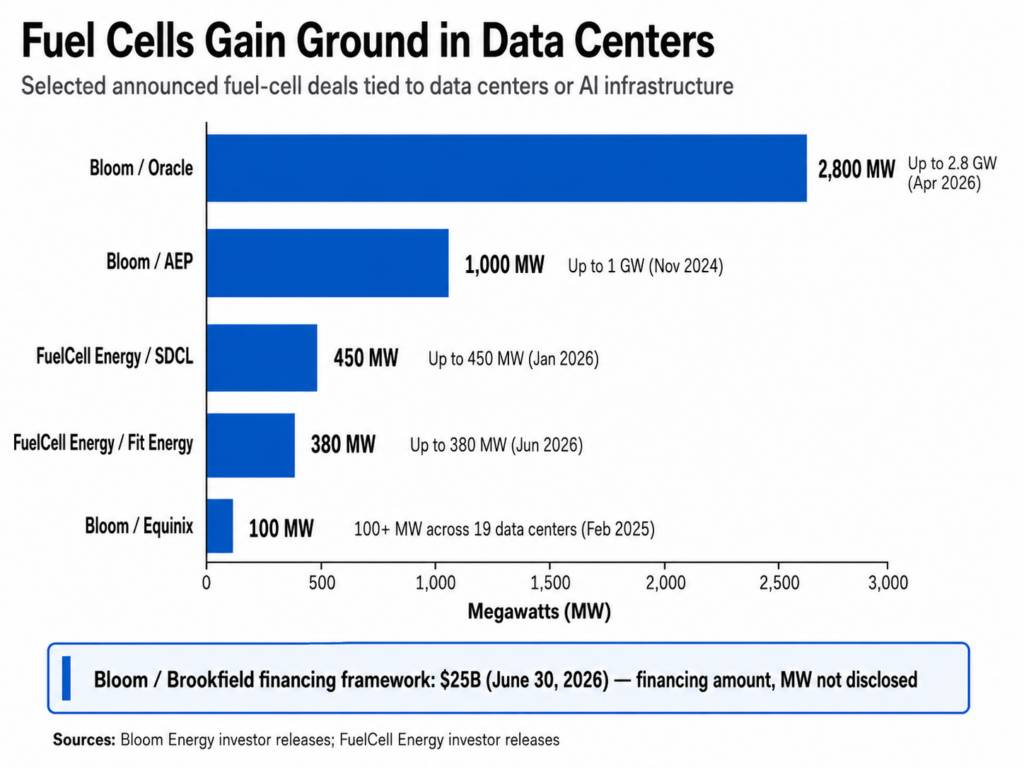
Before the AI data center boom, fuel cells had a foothold in onsite power, but nothing like the momentum they are seeing now. Deals tended to be small, in the single megawatt range. That’s changed radically as underscored by Bloom Energy’s recent $25 billion announcement.
The company and Brookfield announced June 30 that they are expanding their strategic AI infrastructure power partnership from $5 billion to $25 billion — a fivefold increase since the partnership was first announced in October 2025. The expanded framework is designed to finance Bloom fuel cell projects for AI infrastructure globally.
Bloom already had momentum before the Brookfield expansion.
- In 2024, the company announced a gigawatt-scale procurement agreement with American Electric Power to help serve AI data centers, including an initial 100-MW order.
- In 2025, Bloom said its relationship with Equinix had surpassed 100 MW across 19 US data centers.
- Also in 2025, Bloom struck a deal to deploy fuel cells for select Oracle Cloud Infrastructure data centers, promising onsite power for an entire data center within 90 days.
- In April 2026, Bloom and Oracle expanded that relationship to include up to 2.8 GW.
Bloom is not alone. FuelCell Energy and Sustainable Development Capital announced a January 2026 collaboration to explore up to 450 MW of fuel cell systems for data centers and other mission-critical distributed power needs globally.
FuelCell Energy and Fit Energy followed in June with an agreement for up to 380 MW of onsite fuel cell power for data centers, with an initial 30 MW expected to begin delivery this year.
FuelCell Energy, Diversified Energy and TESIAC also struck a 2025 partnership aimed at supplying as much as 360 MW to data centers in Virginia, West Virginia and Kentucky using natural gas and coal mine methane.
There are also backup power and demonstration examples. Microsoft has tested hydrogen fuel cells for data centers, including a 3-MW prototype system described in 2022. Caterpillar, Microsoft and Ballard later demonstrated a hydrogen fuel cell and battery microgrid at Microsoft’s Cheyenne, Wyoming, data center, simulating a 48-hour backup power event.
Some of the fuel cell deals are commercial deployment frameworks. Some are utility procurement agreements. Some are demonstrations. Some use solid oxide fuel cells, some use carbonate fuel cells, and some use hydrogen proton-exchange-membrane systems for backup power. But taken together, they show that fuel cells are becoming a bigger part of the data center conversation.