
If the Trump administration is at war with renewable energy, it appears to be losing, based on recent federal data.
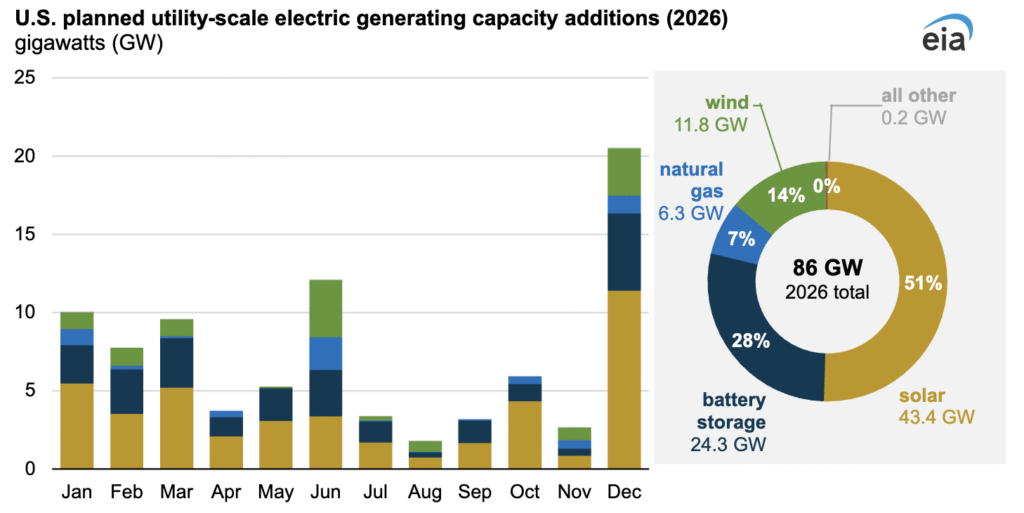
The US Energy Information Administration reported last week that solar, batteries and wind will make up most of the 86 GW expected to be added to the grid this year. If all of the projects come to be, it will mark a record-high capacity addition.
Utility-scale solar alone makes up 51% – a 60% increase over last year. That’s followed by energy storage at 28% and wind at 14%. Natural gas comes in next at 6.3%.
In all, developers plan to add 43.4 GW of new utility-scale solar capacity in 2026, a 60% increase over last year.
Batteries could hit another record high at 24 GW, compared with 15 GW added in 2025, also a record at the time.
Four states are building most of the solar: Texas (40%), Arizona (6%), California (6%), and Michigan (5%).
Texas also dominates in battery additions, with 53%, followed by California at 14% and Arizona at 13%.
The report projects that new wind power capacity will reach 11.8 GW, double last year’s installations, with New Mexico, Texas, Illinois, and Wyoming accounting for 60% of the installations.
The report examined only utility-scale additions; it did not include behind-the-meter distributed energy, like rooftop solar, microgrids and batteries installed at homes and businesses.
Behind-the-meter, a smaller slice of the pie
Behind-the-meter assets account for a smaller share of US generation capacity than utility-scale installations. Small-scale solar makes up only 4.5% of the total 1,250 GW of electric capacity in the US, while utility-scale solar accounts for neary 10%, according to EIA figures.
Behind-the-meter energy storage is also a relatively small piece of the US storage pie. A report issued this week by the Solar Energy Industries Association found that total energy storage additions last year totaled 57.6 GWh, and behind-the-meter energy storage accounted for only 13% of that, or 8 GWh.
The residential energy storage sector added 3.1 GWh in 2025, a 51% year-over-year increase. The report credited the expansion of virtual power plant programs in states like Massachusetts, Texas, Arizona, and Illinois.
Separately, Xendee’s 2026 Market Survey found distributed energy resource (DER)and microgrid companies entering 2026 bullish, despite a loss of federal incentives after passage of the One Big Beautiful Bill Act (OBBBA) last year
Respondents anticipate growth in almost all DER technology types, with 4% to 12% increases expected for resources such as solar, wind turbines, biogas, batteries, natural gas generators, fuel cells, and hydrogen electrolyzers.
.