Rising power costs and data center growth shaped races across the US on Tuesday. For distributed energy resources (DERs), it’s an opening.
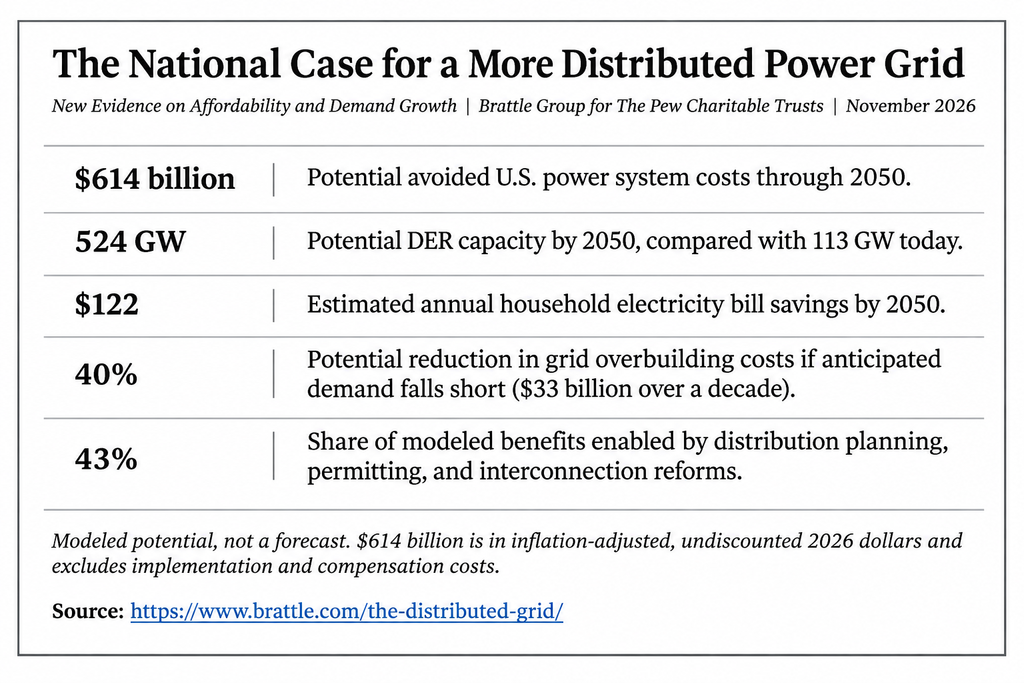
Two days after the election, the Pew Charitable Trusts met the moment with a Brattle Group report that quantifies DER savings and the prospect of them becoming the fourth-largest resource in the U.S. capacity mix.
With the new voter mandate and armed with solid data, how should the DER industry make its case now? Here are five ways forward.
Support our work with a free or paid subscription
1. Tie local energy to cost savings
After the 2024 election gave Republicans the White House and both chambers of Congress, many companies shifted their message from climate to cost. Meanwhile, the administration championed fossil fuels. Then gasoline prices and utility rates climbed, and voters made their frustration known at the polls.
That created an environment where voters and policymakers are more likely to be receptive to arguments for local power — especially when it’s less exposed to fuel markets and can reduce the need for grid upgrades, a leading driver of recent bill increases.
Voters asked for lower bills. Candidates in both parties ran on household costs, and the DER industry can now offer a path.
The Pew study supplies strong talking points, estimating that DER savings could cut the projected inflation-adjusted rise in household bills roughly in half by 2050. The savings are large enough to lower rates for households that never install a battery or enroll in a program.
Robert Hymes, chief development officer of MYNT Systems, a California-based commercial solar and storage developer, says the industry should take the cue.
“The distributed energy industry needs to lead with affordability and reliability, then demonstrate results,” he said. That means showing “how much money projects can save, how much capacity they can provide and whether that capacity is available when the grid needs it.”
2. Educate the new state players
Electric policy innovation comes mostly from the state, not Washington. Republicans won most of the commission seats called by Thursday, according to E9. But two Democratic wins, by Peter Hubbard and Shelia Edwards, flipped Georgia’s Public Service Commission to a Democratic majority. E9 reported that Republicans held their majorities in Alabama, Louisiana, North Dakota, Oklahoma and South Dakota. Arizona, Montana and Nebraska were still counting. (See E9’s commission map.)
While the commission seats are important, the bigger shift, E9 says, may come through governors’ offices. Newly elected governors will appoint dozens of commissioners by the end of 2027, most of them Democrats by E9’s projection. E9 notes that party changes in Texas, Iowa, Ohio, Nevada and likely Alaska could bring new regulators to several large markets.
New governors can move fast, too. New Jersey Gov. Mikie Sherrill ordered regulators to require utility VPP programs on her first day in office, Jan. 20, 2026. Virginia Gov. Abigail Spanberger elevated distributed energy to a policy priority in her first year.
Where to focus? The Pew study singles out three reforms:
- Integrating DERs into distribution planning
- Streamlining permitting
- Reforming interconnection to allow flexible exports.
Other groups also have reforms on the table. Solar United Neighbors wrote model VPP legislation that Virginia adopted. IREC and Vote Solar grade the state on its distributed energy interconnection rules through their joint initiative Freeing the Grid, which gives utility commissioners a way to compare how they’re doing.
3. Offer a middle path for data centers
The economy led, but voters also made clear how concerned they are about data centers. Of the 47 ballot proposals this year to restrict data centers, voters upheld all but one, according to Ballotpedia.
Elected officials are keyed into the sentiment and, even before the election, were taking action in several states to decouple costs associated with data center electric demand from utility customer bills.
The Pew study positions DERs as a hedge. Data center forecasts vary widely, raising concerns that utilities will invest in power plants and transmission lines only to find that demand for power didn’t materialize. This could leave utility ratepayers on the hook for stranded costs. Unlike big power projects, DERs can be added quickly and incrementally and scaled back if electric demand falls short. Brattle finds that this flexibility would substantially cut the cost of overbuilding if data center load stalls. Others propose that data center developers fund DERs for homeowners and businesses to help offset their grid impact.
These approaches give policymakers a way to help solve the cost problem while avoiding the extremes — moratoriums versus excess buildout.
4. Ask Washington for stability, and bank the bipartisan wins
Democrats will run Congress, but the president holds the veto, so passing federal legislation will likely be hard.
Hymes sees the immediate opportunity less in legislating and more in creating a stable investment environment, such as predictability in storage tax credits and permitting. “Commercial battery projects require significant upfront capital, and businesses need confidence in the policies and incentives supporting those investments,” he said.
There may be one exception. Cora Stryker, co-founder and co-CEO of Bright Saver, a nonprofit promoting plug-in solar, believes plug-in solar legislation has a shot at passage. It’s already attracted a lot of activity on the state level, with 10 states passing pro-plug-in solar bills in less than two years, most this year. She expects several federal bills and predicts at least one will pass with bipartisan support.
“It will be a very bad look for even this president to veto something that puts cold, hard cash back into Americans’ pockets and doesn’t have to cost the government a cent,” she said.
5. Think everybody, everywhere
Affordability is an equal opportunity anxiety, neither blue nor red.
Stryker says she is watching historically red states where energy affordability was a top issue. She wants to reach people who care about price but may not focus on climate.
“We want to recruit millions of Americans to the clean energy movement who do not care that their energy is clean, but care only that it is the cheapest electricity around,” she said. “The greatest predictor of who has rooftop solar is whose neighbors have rooftop solar.”
Getting panels and batteries into communities that can afford them and save money, she said, “is when we hit the tipping point.”
As Congress and states prepare for a political shift, competing ideas will jockey for attention. It’s going to get noisy. Moments when voters care about their electric bills don’t come often. It’s a good time to be loud about DERs.