Business challenge
Meeting Local Law 97, New York City’s decarbonization rule, is difficult for landlords of older multifamily buildings. They understand real estate, not energy, and have little experience financing or operating rooftop solar. They aren’t sure which contractors to trust. Plus, their rooftops tend to be small and aging, making them unappealing to many energy developers.
The landlord’s problem
- Owners know real estate, not energy and greenhouse gas rules
- Many do not know how to select solar contractors or finance the project.
- Solar installation costs may be burdensome.
- Older roofs often require work before panels can be installed.
- Small urban rooftops often lack profit potential for conventional commercial solar developers.
Adam Zucker understood the landlord perspective because he spent his career in New York City real estate—asset management, finance, law, development, property management, and commercial sales. To solve the problem, he and Alexander Weisberg founded Fieldston Power. Their goal was to remove the obstacles to clean energy that landlords face. This case study describes their business model.
The model: become the tenant
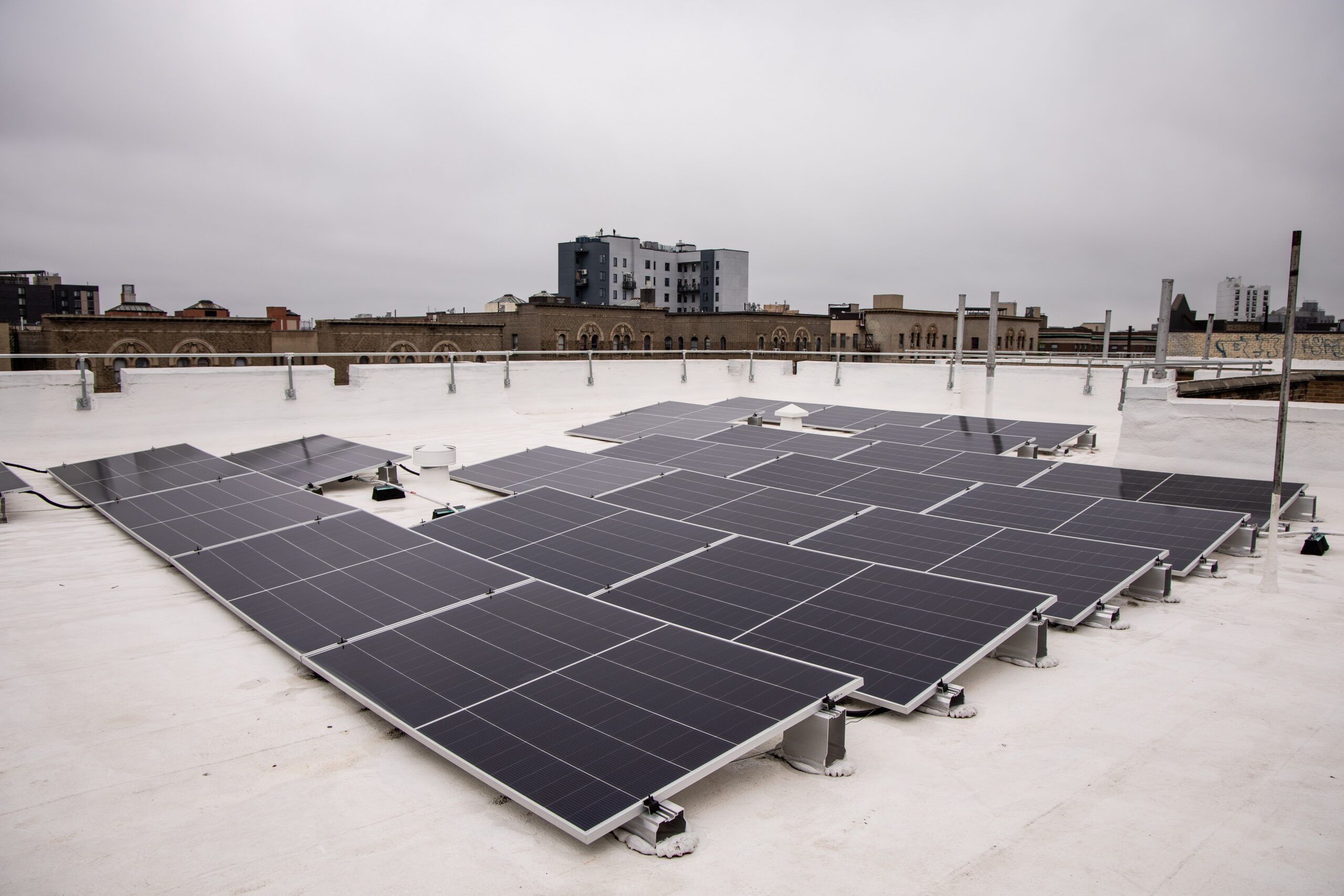
Fieldston leases rooftop space, rehabilitates the roof, installs and finances solar, and retains ownership and responsibility for 25 years. The landlord serves as host. Each rooftop acts as a community solar project, selling subscriptions to low-income electricity users throughout the city to lower their energy bills.
| Conventional Solar Model | Fieldston Model |
|---|---|
| Owner hires a solar contractor | Fieldston leases rooftop space |
| Owner finances the system | Fieldston finances and owns it |
| Owner assumes asset risk | Fieldston carries the risk |
| Owner remains responsible for roof | Fieldston assumes roof obligations |
“We take over everything. The burden, the cost, the responsibility, the maintenance, the figuring it out, everything.” — Adam Zucker
The structure allows Fieldston to aggregate small, dispersed rooftops into portfolios large enough to finance and develop at scale.
The asset base: Rooftops others skipped
Fieldston targets properties that generally do not fit the conventional commercial-solar profile:
- 80- to 100-year-old apartment buildings
- 30 to 120 residential units
- 5,000 to 8,000 square feet of rooftop space
- Roofs frequently requiring rehabilitation
- Predominantly rent-stabilized and rent-controlled buildings
“What we’ve unlocked is the ability to make significant impact at scale by aggregating lots of smaller rooftops that are often overlooked by the C&I or utility industry.” — Adam Zucker
The Landlord Proposition
Fieldston does not lead with solar. It addresses two problems the property owner already has: an aging roof and a legal requirement to decarbonize.
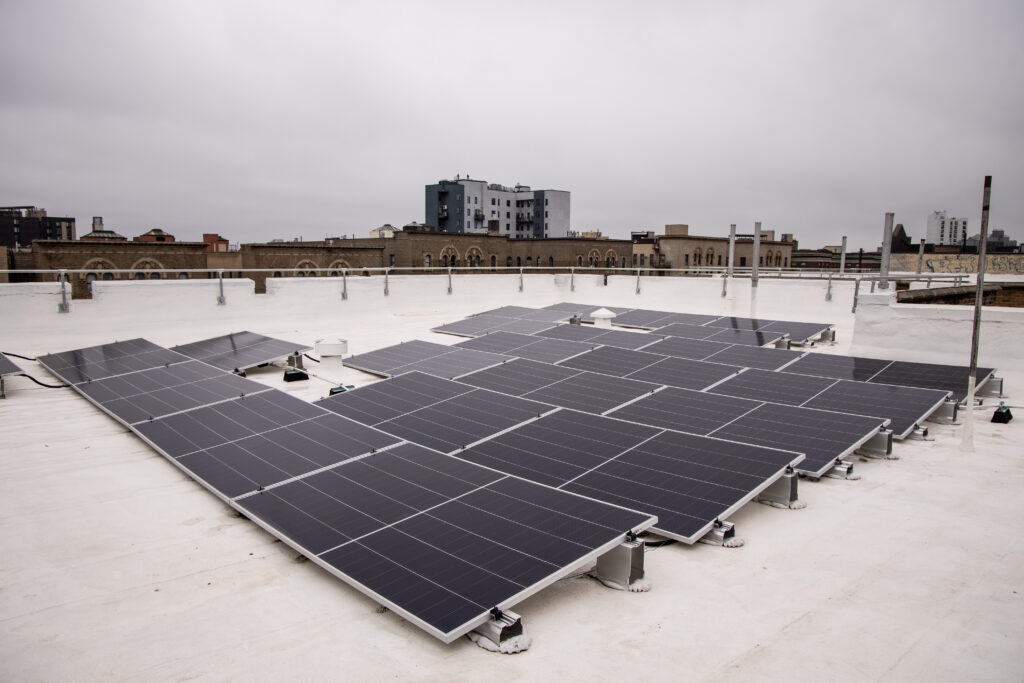
Before installing solar, Fieldston rehabilitates the roof, remediates moisture and instability, and applies a fluid membrane carrying a 20-year warranty. Fieldston then assumes ongoing roof maintenance.
The landlord receives:
- An improved roof that is under warranty and freedom from maintaining it
- Help meeting Local Law 97
- Discounted electricity for common-area loads
- One accountable counterparty for 25 years
Public incentives helped make the initial projects economical. But Zucker considers the landlord relationship even more important.
“More important than that, in many ways, is the relationship and trust that we engender with our landlords as a long-term tenant.” — Adam Zucker
How the money works
Fieldston operates each installation as a community solar project. The systems are front-of-the-meter, with Fieldston receiving utility bill credits from Con Edison. Fieldston monetizes them through community solar subscriptions.
Subscriber allocation
60% — Qualified low-income customers. A subscription management company identifies, qualifies and enrolls participants. Fieldston says roughly 550 households receive approximately a 20% discount on the supply portion of their electricity bills.
40% — Host-building common-area meters. These loads receive a 5% discount.
Capital stack
Construction is financed with sponsor equity and construction debt and subsequently refinanced using federal investment tax credits, New York State grants and permanent debt.
Fieldston says its projects qualify for a 60% federal investment tax credit:
- 30% base credit
- 10% domestic-content adder
- 20% low-income adder
Projects also benefit from NYSERDA grants and New York’s Inclusive Community Solar Adder.
Scale and Expansion
Fieldston began with 73 buildings totaling about 3.3 MW.
As of August 2026, the company’s project pipeline was 10 to 12 times the original portfolio, and the company has safe-harbored equipment to support construction through 2030.
Near-term development remains focused on New York City, with Westchester County, Long Island and northern New Jersey under consideration.
Fieldston is also evaluating distributed battery storage, which could expand its addressable market beyond buildings suitable for solar.
Case study takeaways
- Sell relief, not solar. Fieldston addresses problems landlords already have — aging roofs, compliance obligations and capital constraints.
- Aggregate for financial scale. Individual urban rooftops may be too small for conventional developers. Hundreds managed under a repeatable model become a different asset class.
- Act as tenant. By remaining the long-term tenant and asset owner, Fieldston removes financing, maintenance and operational responsibility from the landlord.
- Policy creates opportunity. Local Law 97 created a need. Fieldston built a business model around making compliance workable for property owners.
- Real estate becomes an energy platform. Long-term control of rooftop space creates opportunities beyond solar, with distributed storage potentially extending the model to more buildings.
Source: Aug. 17, 2026 Energy Changemakers interview with Adam Zucker, co-founder of Fieldston Power. Also see: Selling Relief, Not Panels.