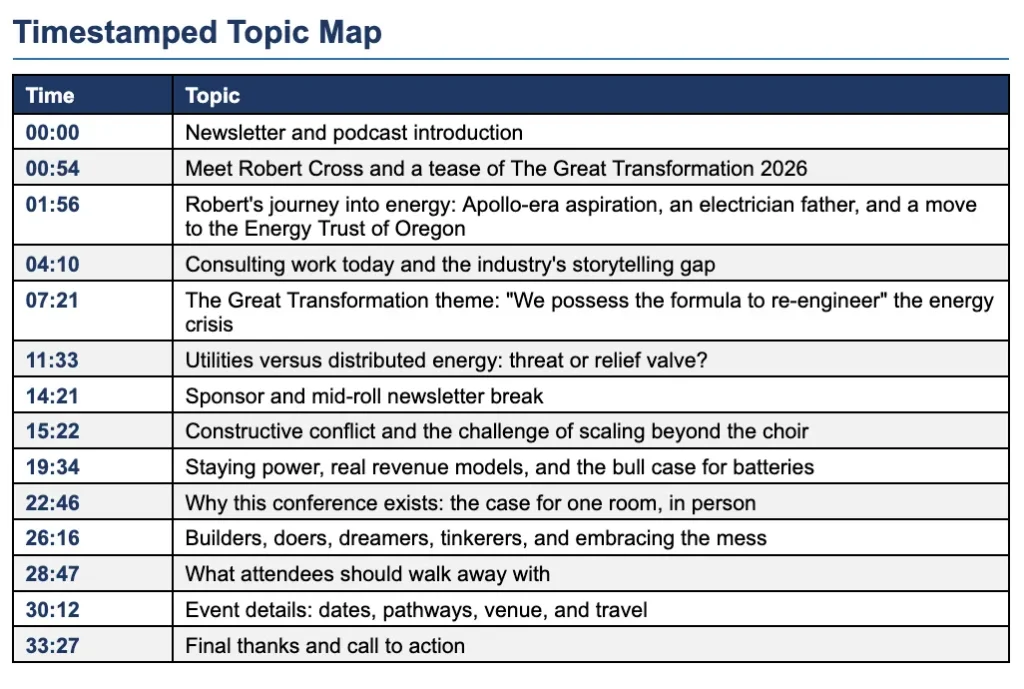

The technology to transform the electric grid already exists. So why isn’t the transition happening faster?
In Episode 50 of the Energy Changemakers Podcast, I sat down with Robert Cross—founder of Cross Consulting and principal at Outfit—to explore what may be the real bottlenecks: financing, storytelling, regulation, and the industry’s tendency to work in silos rather than together.
Cross argues that distributed energy resources have become an “irresistible force” colliding with the “immovable object” of the traditional utility business model. But instead of seeing distributed energy as a threat, he believes utilities increasingly have an opportunity to embrace it as a relief valve—one that can help meet AI-driven electricity demand, strengthen resilience, and reduce the need for costly infrastructure expansion.
Our conversation ranges from batteries and microgrids to geothermal energy and utility pricing, but it ultimately comes back to people. How do we get developers, utilities, financiers, regulators, and entrepreneurs into the same room to solve problems together? That’s the thinking behind The Great Transformation 2026, the conference Cross is co-hosting with The Technology Organization of Oregon on July 8-10 in Bend, Oregon, where constructive disagreement is part of the design.
We also discuss:
- Why battery storage may be the industry’s biggest opportunity
- How time-of-use pricing could reshape distributed energy economics
- Why so many technically sound projects fail to attract financing
- Why the cleantech sector needs to become much better at explaining itself to customers, communities, and policymakers.
If you’ve been wondering what comes after the industry’s current wave of hype around AI, data centers, and grid constraints, this conversation offers a thoughtful look at what it will actually take to build the next energy system—not just technologically, but institutionally.