
Early numbers indicate that high oil prices worldwide are giving renewable energy a 1970s-style boost — and now electric vehicles are along for the ride too.
The oil embargo of the 1970s put renewables on the radar of governments and consumers and led — after a long and sometimes bumpy journey — to a dramatic uptake of wind and solar.
Five decades later, things are a little different because clean energy brings new muscle to a worldwide energy crisis. No longer niche, it is widely available, often competitively priced, and can pair with energy storage to extend its benefits.
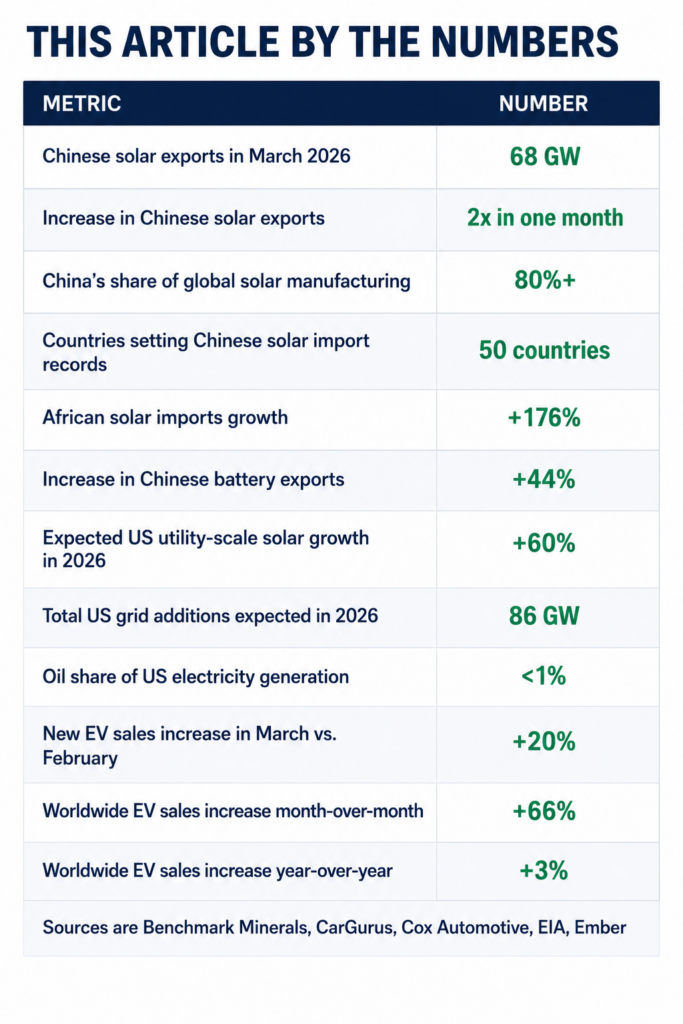
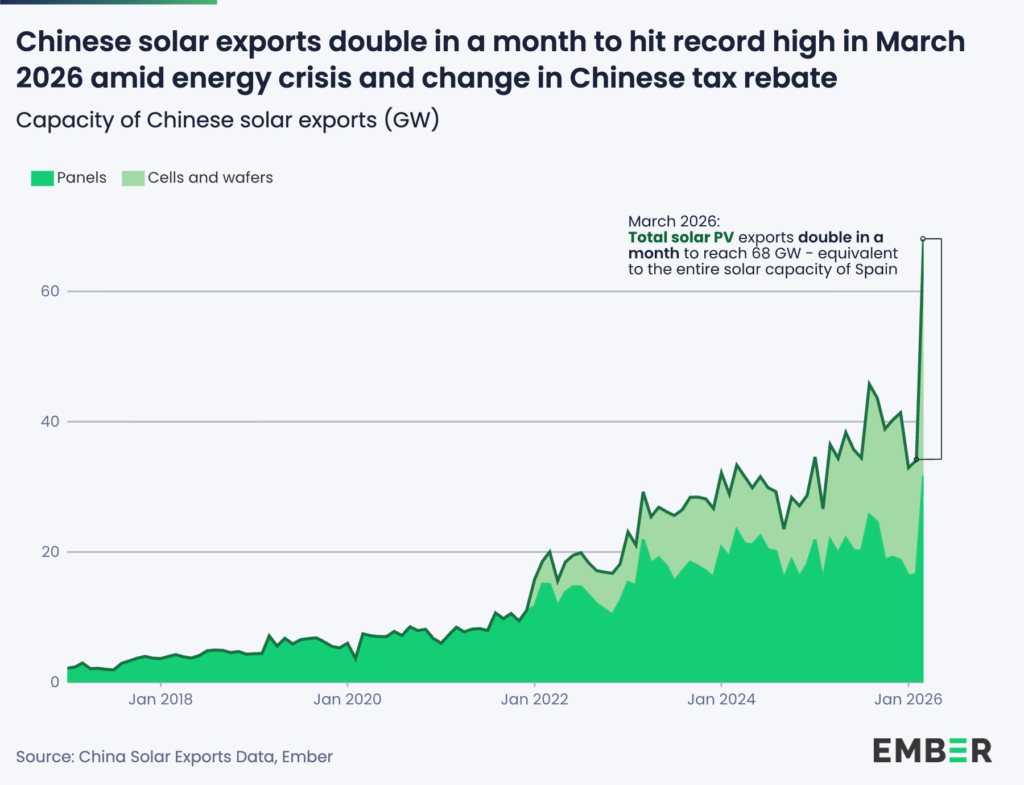
So it’s not surprising that China — which controls more than 80% of global solar manufacturing — saw worldwide solar exports double in March, reaching 68 GW, equal to Spain’s entire solar capacity, according to research firm Ember.
Who’s buying up the Chinese panels?
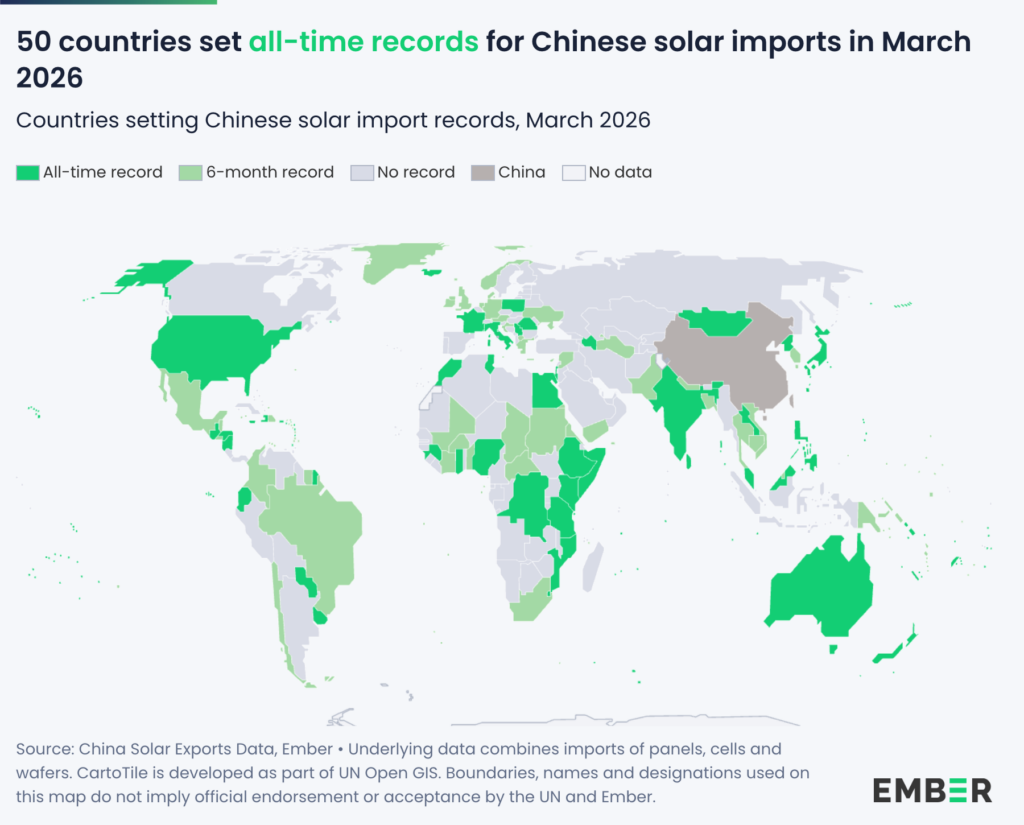
The big importers of solar panels and cells are those most harmed by high oil prices.
Africa increased exports by 176% compared to February 2026 to reach 10 GW. Asia doubled exports to 39 GW, an all-time record, according to Ember.
“Fossil shocks are boosting the solar surge,” said Euan Graham, senior analyst at Ember. “Solar has already become the engine of the global economy, and now the current fossil fuel price shocks are taking it up a gear.”
It’s not just solar experiencing a rise. China’s battery exports are up 44%.
A psychological bonus for solar
Even before today’s energy crisis, the US government expected solar growth in 2026, despite cutbacks in federal incentives. The Energy Information Administration forecasts that utility-scale solar will increase by 60% over last year.
The government agency also expects solar, batteries and wind will make up most of the 86 GW added to the grid this year, with solar making the biggest contribution.
On its face, high oil prices are unlikely to affect the uptake of clean electricity technologies because the US uses oil for less than 1% of its power generation. So oil has little influence on electricity prices.
High oil prices, however, do confer a psychological bonus for renewable power. Consumers tend to lean into the ideas of energy security and independence during international energy crises. In the US, rising utility rates — a phenomenon unrelated to oil — are likely to accelerate this sentiment.
US rooftop solar companies need whatever edge they can get right now, given that many are still reeling from the sudden loss of federal tax incentives last year. Unlike utility-scale solar, rooftop installations are expected to drop in the US this year before ticking up again next year.
Window shopping for EVs
High oil prices, however, do hit the household pocketbook hard in the car-centric US. Some early indicators suggest this could affect electric vehicle sales.
Cox Automotive says new EV sales were up 20% in March compared with February, though still down from a year ago, when the federal incentive was still available.
Meanwhile, more consumers are researching EVs and hybrids online, according to CarGurus’ first-quarter recap. Consumers appear especially interested in used cars.
Prolonged high gasoline prices are likely to turn browsers into buyers.
“If they hold above $4 [per gallon], the EV and hybrid interest we saw in March could become a sustained trend rather than a blip,” wrote CarGurus. “For any dealer not yet stocking used EVs: the demand signal appears to be getting louder.”
Worldwide, March saw EV sales rise 66% over the previous month and 3% year-over-year, according to Benchmark Minerals.
The 1970s but better
Whether this moment becomes another 1970s-style turning point remains unclear. Today’s clean energy economy faces its own obstacles — trade disputes, supply chain concentration, shifting subsidies and political backlash among them.
The difference now is that renewables no longer sit on the fringe waiting for commercialization. They are no longer emerging tech, but are mainstream infrastructure.
That may be the most important difference between now and then. In the 1970s, high oil prices sparked interest in clean energy. In 2026, pain at the pump is accelerating the adoption of technologies already deeply embedded in the global economy.