

When I tell people I’m from California, they often express admiration for the state’s much-ballyhooed reputation as a clean energy leader. I wrote a few books extolling the state’s leadership. Reaping the Wind (2001) tells the story of how California jump-started the global wind power industry, and Introduction to Energy in California traces the state’s energy history from the beginning and touts many of the cutting-edge technologies and public policies enacted in the past.
But that was then, and this is now.
There is a growing consensus among those in the know that the California Public Utilities Commission (CPUC) has regressed to the point where it is hostile to many clean energy programs, especially when it comes to distributed energy resources (DER). This hostility extends to deployment of larger-scale community solar projects that address a problem the commission keeps raising, which can be summed up as follows: solar photovoltaics tend to be adopted by wealthy prosumers, thereby shifting costs onto renters and low-income ratepayers.
What the CPUC seems to be missing is that California will never reach its renewable energy and climate change goals if it continues its current siloed emphasis on large utility-scale projects, which are prone to delays. California needs an “all of the above” strategy for renewables and batteries spanning individual homes and businesses as well as community-scale projects to maintain its reputation as a clean energy leader. Right now, Texas is shaming California on the DER front by scaling up virtual power plants (VPPs) that dwarf California’s efforts.
Why distribution grid projects make sense
An analysis by Renewable America of the latest data from the resource interconnection queue at the California Independent System Operator (CAISO) — which serves as a traffic cop for large-scale power plants serving the state market — puts it in stark terms: Of 316 active utility-scale projects representing 88,155 MW of total generating capacity in the queue to be connected to the grid, 98.4% are overdue. The average delay? 6.4 years.
The culprit isn’t just slow permitting or interconnection studies. It’s transmission infrastructure. Building the colossal lines needed to connect carbon-free resources to the grid requires massive capital investment, years of construction, and permitting processes that haven’t kept pace with the energy transition. As a result, the vast majority of queued projects aren’t expected to reach commercial operation before 2031.
Unlike transmission infrastructure, whose costly upgrades require lengthy timelines, many distribution circuits already offer immediate hosting capacity. Deploying solar at this community level improves resiliency and avoids major transmission buildout costs. It also allows renters and other lower-income utility customers to benefit from clean energy.
Utilities — and the CPUC — often complain that these customers are suffering cost shifts due to wealthy prosumers installing on-site solar and batteries. Yet both entities continue to sabotage efforts to allow these same constituents to take part in the clean power revolution, which keeps moving forward despite the best efforts of the current federal administration. Community solar and storage, whereby ratepayers derive cost savings and clean air benefits from regional mid-scale solar and battery projects, is a key piece of the puzzle.
Community solar, initially proposed by a municipal utility in the Pacific Northwest in 2006, has been adopted in over 20 states across the country, with over 80% specifically addressing the needs of moderate- and low-income utility customers. California is often included in these tallies despite the state’s apparent unworkable regulatory quagmire. Note that in the Institute for Local Self-Reliance’s (ILSR) Community Solar Leaderboard, California does not even show up.
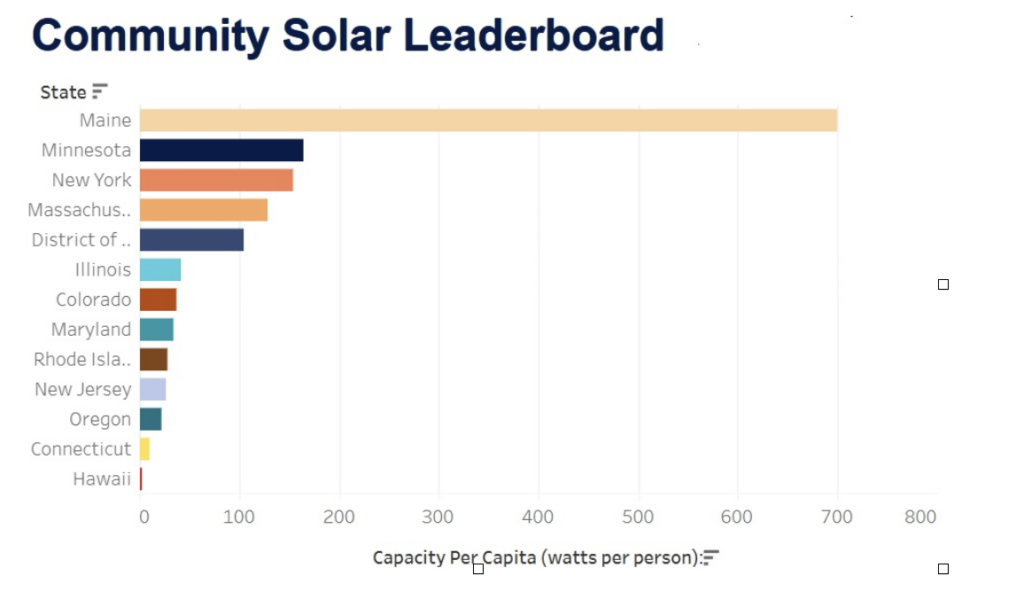
Credit: Institute for Local Self-Reliance
Today, public policy and valuation gaps stand in the way of wider community clean power projects in California. Policy and regulation treat distribution-level projects similarly to large transmission-scale projects, even though their size and grid impact are vastly different. The primary barrier in this market is not cost—it is regulatory design. According to a white paper I published earlier this year, which cites research from Aurora, California, could conservatively host 5.4 GW of clean energy on the distribution grid.
The CPUC finally issued a decision last month in response to legislation passed in 2024 mandating that community solar programs be offered to renters and low-income customers in California. In the eyes of Derek Chernow, executive director of Californians for Local, Affordable Solar and Storage (CLASS), the CPUC’s latest move is a disaster.
“The CPUC vote is doubling down on failure. In the midst of an affordability crisis and rising utility rates, the CPUC has once again handed the keys to the utilities — community solar never gets built — and called it a program,” said Chernow. “The legislature passed AB 2316 four years ago with clear direction to deliver a workable community solar and storage program. Instead, the CPUC produced a program that got zero projects built, forfeited $250 million in federal Solar for All funding, and is now being voted through again in essentially the same packaging.”
Can AB 1813 ride to the rescue?
“In one of the wealthiest states in the country, it is unacceptable that millions are struggling with their utility bills,” added Ardi Arian, founder & CEO of Renewable America. “The average overdue utility balance in California is $1,120. A report issued last year claimed that almost 2 million Californians were behind in their electricity bills, and 50,000 had their service disconnected altogether.
The good news? “Policymakers have a solution sitting on their desks,” Arian said.
New community solar and storage legislation, AB 1813 (Ward), would go a long way toward bridging California’s energy affordability gap, he noted. The measure will be up for a floor vote in the Senate next month. His company has overcome substantial regulatory barriers by focusing on working with California Community Choice aggregation programs to deploy community-scale projects.
With a more workable, statewide community solar policy in place, Californians could subscribe to a local solar project and receive a credit on their utility bill. On average, community solar subscribers save $200 a year on their utility bills, with higher savings for low-income households. No roof or equipment is required, and no commitment or long-term contract is needed. According to the legislation, over half of new solar projects developed at the community level would be required to serve low-income customers.
Community solar is not a panacea. Yet it is a key tool to help democratize clean energy – and allow those who have previously been shut out of the clean energy revolution to participate. And regulators need to properly value community solar and storage projects for the avoided costs they deliver to the grid.
California was on the cutting edge of energy public policy innovation for decades, dating back to Jerry Brown’s first term as governor in the late ’70s when the state was the global leader in renewable energy development and energy efficiency standards. But its lack of vision and leadership on clean energy — particularly at the distribution level of service — has stretched out for nearly a decade. AB 1813 is a step in the right direction and long overdue.