We’re nearing that time of year when people start publishing their end-of-year recaps and ruminations.
Like those holiday shoppers who have all their gifts bought and wrapped by Thanksgiving, I’m getting my year-end analysis done early.
There’s no need to wait four more weeks. The big energy story of 2026 came with foghorn clarity months ago.
It’s all about oil…and poor memories.
Subscribe to our free weekly newsletter or follow us on Substack
It’s easy to forget that the decades-long quest to advance distributed energy — rooftop solar at first, and now energy storage, virtual power plants, vehicle-to-grid, and microgrids, too — grew out of a desire to bring energy independence to homes and communities in ways oil cannot.
We get caught up in family squabbles within the power industry. Big solar versus rooftop solar. Utility-run versus independently operated virtual power plants. Grid-connected versus off-grid microgrids. Batteries versus natural gas engines. We argue over who should own energy assets, who should control them, and who should profit from them.
I don’t mean to diminish these topics — Energy Changemakers spends a lot of time on them. But sometimes the industry gets so immersed in them that we miss the bigger picture: what a path toward energy independence looks like.
Real and false energy independence
Self-sufficiency was a powerful theme in the early days of the modern solar energy movement. The idea that we could harvest energy where we lived and worked appealed not only to environmentalists but also to those uneasy about how our dependence on oil concentrates economic and political power.
The 1973 oil embargo gave the fledgling solar industry a sense of urgency. By 1979, President Jimmy Carter was installing solar water-heating panels on the White House roof.
Here we are nearly half a century later, and it almost feels like we’re in the movie Groundhog Day. The 1973 oil embargo, the 1979 Iranian revolution, the 1990 Iraqi invasion of Kuwait, the 2022 Russian invasion of Ukraine, and now the 2026 closing of the Strait of Hormuz: oil-related economic havoc, on repeat.
Meanwhile, what we were sold as American energy independence — our emergence as a net petroleum exporter — didn’t free us as much as some imagined. For all the domestic oil we pump out, we’re still in the grip of a world market.
Distributed solar reality check
So how far have we come?
It can get really discouraging when you look at the progress of distributed solar by the numbers. It’s true that US distributed solar capacity grew 710% from 2014 to 2025 (measured in gigawatts), while US oil production grew only 55% (measured in barrels per day).
But production isn’t the real measure of our dependence. Consumption is. Convert distributed solar generation and petroleum consumption into a common unit, quadrillion British thermal units, or quads, and it’s hard to cheer. In 2025, US petroleum consumption was 113 times US distributed solar generation, and from 2014 to 2025, annual petroleum consumption increased 4.4 times as much as annual distributed solar generation.
These numbers need context. For one, the quad comparison gives oil more credit than it deserves. Gasoline loses energy as heat. An electric vehicle is three times more efficient. Side by side, a quad of electricity achieves more work than a quad of oil.
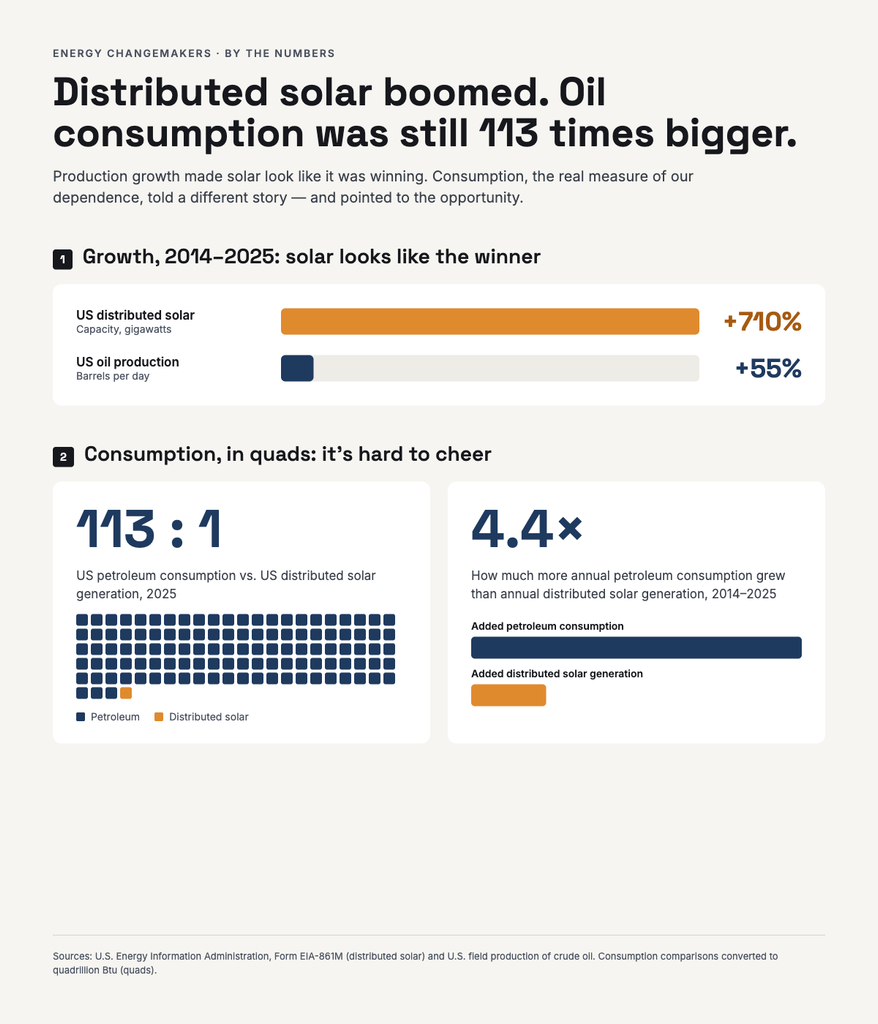
It’s also important to point out that rooftop solar doesn’t displace oil on its own. Very little electricity is made with petroleum. So using solar energy doesn’t lead to less oil burned. It’s the electric vehicle and heat pump that do that, providing transportation, heat and cooling with electricity instead of petroleum products. From that perspective, the 113-to-1 gap can be viewed as the measure of opportunity for future electrification.
And the goal was never to vanquish petroleum, anyway. That’s not realistic. Oil is too deeply woven into our food supply, industry and transportation. A more realistic goal is to defang it—replace enough of it so that it no longer tyrannizes our economy and environment.
The Apollo 13 playbook
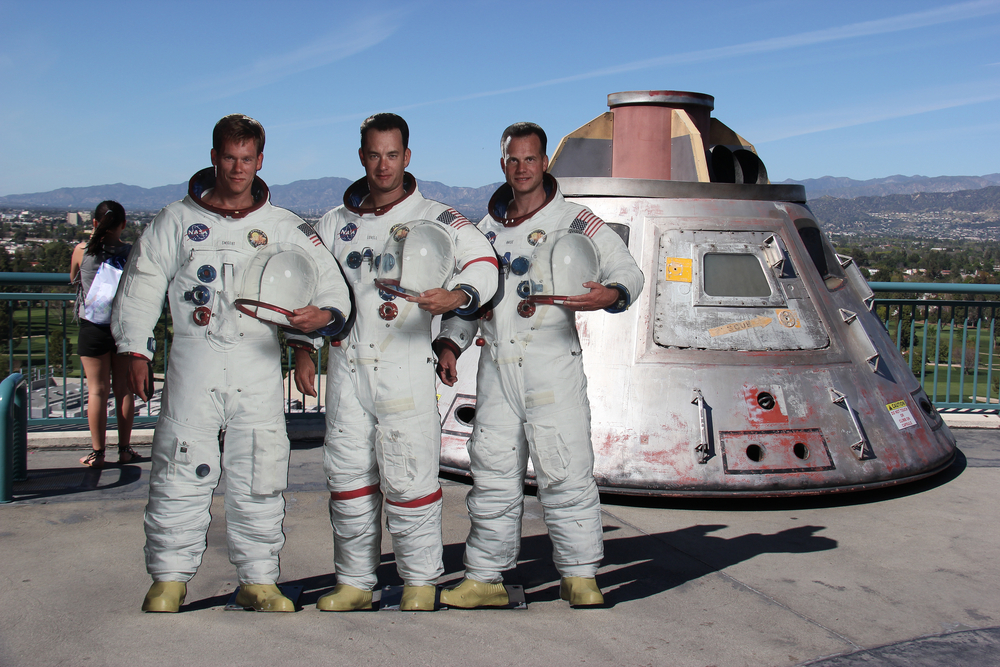
That’s where the story of distributed energy starts to look less like the Groundhog Day and more like the film Apollo 13. Sometimes you can rewire your way out of a crisis. The crew had to figure out a way to remove carbon dioxide from the cabin air, reduce electricity consumption, make the best use of stored energy and devise a new way to power up the command module.
That’s the distributed energy playbook in a space capsule: conserve, store, improvise, restart.
(Note: The picture would be different if I included other forms of renewable energy in the graphic above, but my goal here is to illustrate how one of the most local forms of energy, distributed solar, fared against one of the least local, oil.)
And it’s about more than ingenious engineering. We’re gaining a better understanding of the sociology of energy, a realization that energy is as much about human relationships, community acceptance, and distributing financial advantage more widely.
Consider that this year we saw:
- A city in upstate New York developed a plan to turn its residents into shareholders in a local energy economy.
- Energy innovators began breaking down the barriers that have made participation in the distributed energy economy largely a privilege of homeownership.
- A rethinking of the relationship between data centers and their host communities, in which the growing energy needs of big tech could help households gain greater energy independence.
- A movement to bring housing and energy policy together, treating the repair of America’s deteriorating housing stock as an energy infrastructure investment.
- The groundswell of interest in balcony solar — a relatively unsophisticated technology with potentially profound implications for how people view their relationship with energy.
No backyard oil wells
Few of us can produce our own oil, but we can make our own electricity, on our rooftops or in our community. Electricity opens the door to personalized energy — to making our homes into power plants, grid assets, and maybe even mini data centers. It offers a way to shift political and economic power from a few far away to many close at hand.
The distributed energy industry has spent much of its existence trying to secure a place for itself within the existing energy economy. Perhaps it’s time to think beyond that.
What would an energy economy designed around the independence of households and communities actually look like? What if that were a primary policy goal? What would we need to get there, not just in terms of regulation or economics, but in terms of mindset? How do we need to change fundamental thinking about energy — to make it clear it’s yours, not theirs?
Those are questions worth pursuing in 2027. Answering them could be how we finally break the oil loop.